
| name | Amanita recutita sensu Coker |
| name status | sensu |
| english name | "Woody-Stemmed Coker's Caesar" |
| synonyms |
non Agaricus (Amanita) recutita Fr. (=A. porphyria) |
| images |
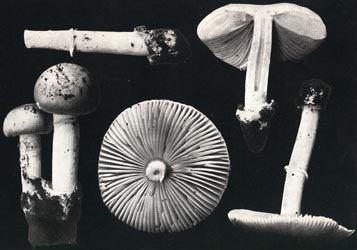  1. Amanita recutita sensu Coker, Coker's plate. 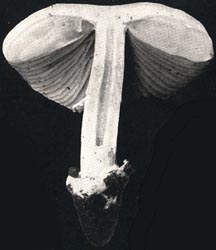 2. Amanita recutita sensu Coker, individual from Coker's plate. 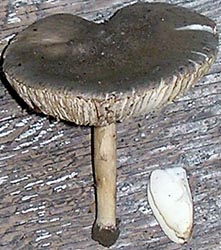 3. Amanita recutita sensu Coker, Salmon River St. For., Connecticut, U.S.A. |
| intro |
The following macroscopic description of Amanita recutita is based largely on (Coker, 1917). |
| cap |
The cap of this species is 40 - 85 mm wide (most often near 60 mm), "light pallid tan" with a tint of "smoky pink, fading to nearly white" at margin or tannish gray. It is hemispheric at first, then planoconvex to planar; at maturity it is sometimes centrally depressed. It has no umbo. The cap's flesh is white (about 5 mm thick over the stipe) and thins rather evenly to the cap margin. The latter is short striate (about 10 - 15 % of the cap radius at most) and nonappendiculate; it is incurved at first and then becomes decurved. Remnants of volva are often absent from the cap. When they are present, they appear as scattered soft white patches over the center and are membranous to submembranous. |
| gills |
The gills are very narrowly attached to the stem with a decurrent line on the stem apex; they are moderately close, "pure white" (Coker) to yellowish cream (in age?). They are roughly spindle-shaped, but are rounded broadly at their outer ends. The gills are up to 10 - 13 mm broad and are seen to project quite prominently below the cap margin. Short gills are truncate, of diverse lengths, and rather common (although not between every pair of gills). |
| stem |
The stem is 62 - 77+ × 8 - 10.5 mm, usually subcylindric, infrequently narrowing downward, and smooth or with some fibrillose decoration. In the upper part, the stem is white or palely similar in color to the cap. The flesh of the stem is pale tannish white, very lightly stuffed, and has a central cylinder that becomes hollow when the stem is sectioned. In addition, the stem flesh is extremely firm and unusually wood-like for an Amanita. The stem's ring is nearly white or colored similarly to the cap ("not as smoky as in A. spreta" according to Coker), thin, rather fragile, skirt-like at first, decorated with light flocculence on the underside, and originally located 25 - 30 mm below the top of the stem. The ring often falls away by maturity or in age. The volva on the stem base takes the form of a rather short sac attached near the stem's base and sheathing the lower stem. This sac is soft, thick (when very fresh), submembranous to membranous, often rather fragile (e.g., breaking up when collected leaving fragments in the soil), and usually buried to its upper (more or less uneven) edge in soil. |
| spores |
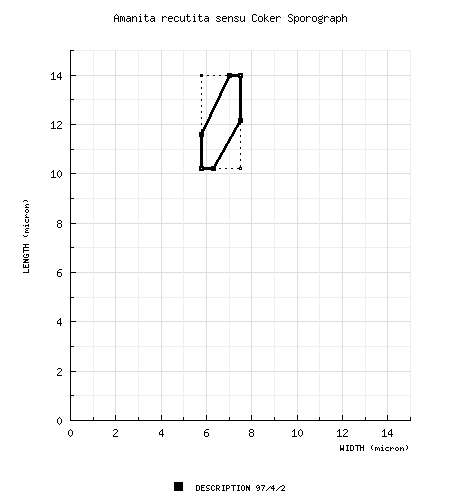
The spores of this species (combining those from Coker's collection with those of a recent collection) are (9.0-) 10.2 - 14.0 (-14.5) × (5.6-) 5.8 - 7.5 (-9.5) µm, ellipsoid to elongate, infrequently cylindric, and inamyloid. Clamps are rather common at bases of basidia. |
| discussion |
Until recently, this rather odd species was known only from the area of Chapel Hill, North Carolina (U.S.A.). Coker recorded no woody plants in the area in which he collected his material. When the species was collected again recently (see below), it was found with oak (Quercus). Coker reported the species to be odorless and tasteless. He noted some similarity to Amanita spreta (Peck) Sacc., but pointed out that the gills of that species were narrower, the ring a more dark and smoky color, and the volval sac more robust. In reviewing all material labeled "recutita" in Coker's herbarium, I found that, excluding the single 1915 collection, the material was of a different species, probably A. virginiana (Murrill) Murrill. On the other hand, one of Coker's two plates labeled "A. pubescens" (see A. pubescens sensu Coker) in his 1917 monograph on Amanita appears to depict material of A. recutita sensu Coker which has lost its ring. The only collections that can be confirmed since Coker's of 1915 were recently (2007 and 2008) made in southwestern Connecticut, U.S.A. The 2007 collector was Connie Borodenko, a person with an uncanny knack for finding rare, undescribed, or otherwise noteworthy fungi. When the material was examined, some surface drying had taken place; this may have altered the cap color. The ring had been lost from the stem. The specimen was compared macroscopically and microscopically to the single collection of Coker. The match was good. In the following year, Connie gave me a map to the spot along the Salmon River, and I was able to find the species again.—R. E. Tulloss |
| brief editors | RET |

 Spore data sets and their composite