| name |
Amanita sp-F11 |
| author |
Tulloss |
| name status |
cryptonomen temporarium |
| english name |
"Tequila Sunrise Slender Caesar" |
| GenBank nos. |
Due to delays in data processing at GenBank, some accession numbers may lead to unreleased (pending) pages.
These pages will eventually be made live, so try again later.
|
| intro |
Olive text indicates a specimen that has not been
thoroughly examined (for example, for microscopic details) and marks other places in the text
where data is missing or uncertain.
The following material is based on the collector's annotation of fresh material and original research by R. E. Tulloss.
|
| pileus |
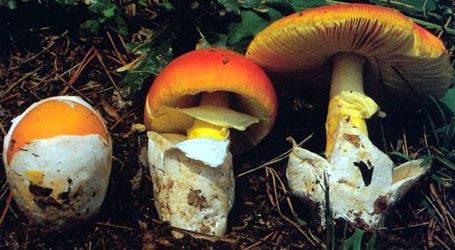
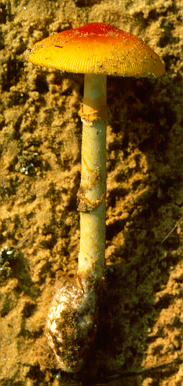
76 - 102 mm wide, reddish to yellowish orange over
disc, yellow over marginal striations, ovoid at
first, then campanulate to convex to
plano-convex to planar or slightly depressed in
center, sometimes umbonate in gracile
basidiomes, viscid when moist; context white,
unchanging when bruised or cut, 9.5 - 13 mm thick
over stipe, ??;
margin striate (0.35R - 0.5R),
nonappendiculate; universal veil absent or as
single cottony white membranous patch. |
| peridium |
double click in markup mode to edit. |
| lamellae |
free to barely adnexed with very faint to distinct
(then 12 mm long) decurrent line on stipe apex,
crowded, cream to yellow in mass, white to whitish to
pale yellow in side view, unchanging when damaged,
5.5± mm broad,
??; lamellulae
truncate, plentiful, of diverse lengths. |
| stipe |
140 - 152 × 8 - 11 mm, pale yellow above annulus,
yellow to white below, unchanging when cut or
bruised, narrowing upward, with yellow (yellow
orange or orange with age/drying)) appressed
patches or squamules both
above and below partial veil, with context
white, unchanging
when cut or bruised, stuffed; partial veil
superior (25± mm below apex), membranous,
yellow, ??; universal
veil as saccate volva, avoid to cylindric,
off-white to white, membranous,
firm, with cottony exterior surface, 44 × 22 mm,
lacking obvious limbus internus. |
| odor/taste |
not recorded. |
macrochemical
tests |
none recorded. |
| lamella edge tissue |
sterile. |
| basidiospores |
[40/2/2] (8.4-) 8.7 - 11.9 (-13.6) × 5.2 - 7.0 µm, (L = 9.6 - 10.1 µm; L’ = 9.8 µm; W = 5.8 - 5.9 µm; W’ = 5.8 µm; Q = (1.48-) 1.54 - 1.88 (-1.94); Q = 1.66 - 1.72; Q’ = 1.69), hyaline, colorless, thin-walled, smooth, inamyloid, ellispoid to elongate, sometimes expanded at one end; apiculus sublateral, ??; contents ??; white in deposit. |
| ecology |
Solitary. In sand in area of mixed Pinus and Quercus. |
| material examined |
U.S.A.: FLORIDA—Lee Co. -
Alva [ca. 26.7664° N/ 81.6064° W, ca. 6 m],
12.vi.2013 Benjamin Dion s.n.
[mushroomobserver #136334]
(RET 537-5), 14.vi.2013 B. Dion s.n.
[mushroomobserver #136582]
(RET 537-10).
Marion Co. - Ocala, 11.viii.1985 A. Norarevian s.n.
[Tulloss 8-11-85-AN3] (RET 138-1), [Tulloss
8-11-85-AN4] (RET 138-2); Ocala Nat. For.,
18.vi.2013 Justin Brosey s.n. [mushroomobserver #136778] (RET 547-10),
21.vi.2013
J. Brosey s.n. [mushroomobserver #137218]
(RET 548-8). |
| discussion |
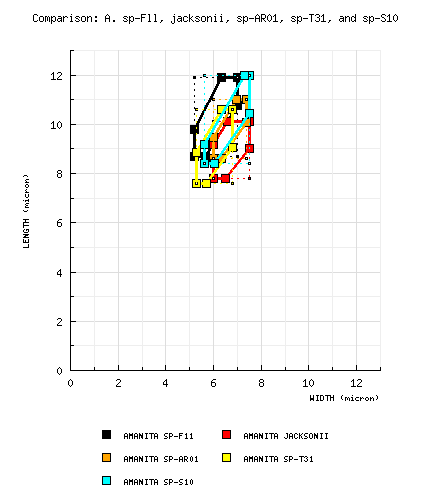
For purposes of comparison, spore data from Amanita jacksonii is provided here:
[317/15/11] (7.0-) 7.8 - 10.0 (-12.1) × (5.2-) 6.0 - 7.5 (-8.7) µm, (L = (8.1-) 8.4 - 9.5 µm; L’ = 8.8 µm; W = (6.0-) 6.3 -
7.3 µm; W’ = 6.7 µm; Q = (1.11-) 1.20 - 1.52 (-1.63); Q = 1.25 - 1.40 (-1.42); Q’ = 1.32).
For purposes of comparison, spore data from Amanita sp-AR01 is provided here:
[60/3/1] (8.0-) 8.6 - 11.0 (-19.2) × (5.7-) 6.0 - 7.4 (-8.0) µm, (L = 9.4 - 9.7 µm; L’ = 9.6 µm; W = 6.5 - 6.7 µm; W’ = 6.6 µm; Q = (1.31-) 1.36 - 1.58 (-2.40); Q = 1.44 - 1.48; Q’ = 1.45)
For purposes of comparison, spore data from Amanita sp-T31 is provided here:
[100/5/2] (7.3-) 7.6 - 10.6 (-14.1) × (5.0-) 5.3 - 6.8 (-8.5) µm, (L = 8.3 - 9.5 µm; L' = 9.0 µm; W = 5.6 - 6.5 µm; W' = 6.0 µm; Q = (1.30-) 1.33 - 1.67 (-1.92); Q = 1.46 - 1.54; Q' = 1.49).
For purposes of comparison, spore data from A. sp-S10 is provided here: [80/2/2] (8.0-) 8.4 - 12.0 (-15.5) × (5.5-) 5.6 - 7.5 (-8.3), (L = 9.1 - 10.3 µm; L' = 9.6 μm; W = 6.2 - 6.6 µm; W' = 6.3 μm; Q = (1.35-) 1.39 - 1.64 (-1.94); Q = 1.49 - 1.57; Q' = 1.51).
[Nota: The size and form of the sporograph for A. sp-S10 may be exaggerated because of probable immaturity of the basidiome sampled—this condition is suggested by the presence of giant spores produced by bisterigmate basidia near the start of sporulation.] |
| citations |
—R. E. Tulloss |
| editors |
RET |
|



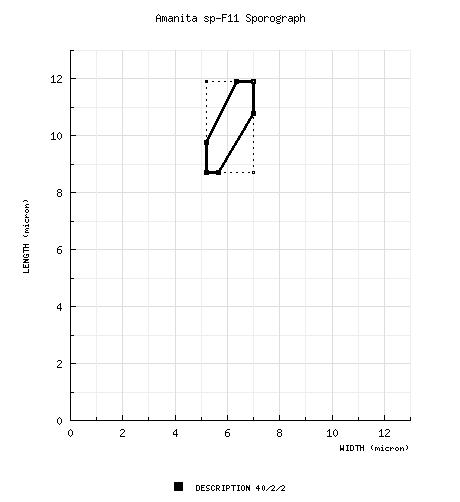
 Spore data sets and their composite