

| name | Amanita simlensis |
| name status | insufficiently known |
| author | R. P. Bhatt, Locq. & T. N. Lakh. |
| english name | "Shimla Slender Caesar" |
| intro | The following is based entirely on the original description in (Kumar et al., 1990). |
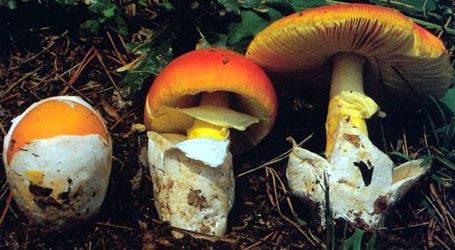
| cap | The cap of this species is 70 - 160 mm wide, reddish orange (7A8), fleshy, convex when young, soon expanding and becoming applanate at maturity, umbonate, smooth, and ndecorated. The cap's flesh is white to yellowish white. The cap's margin is striate. As far as can be told from the original description, there are no remnants of the volva on the cap. |
| gills | The gills are very narrowly attached to the top of the stem or free, yellow to yellowish orange, "conspicuously thick and broad," with edges "dentate." The short gills are said to be "of two lengths." |
| stem | The stem is 100 - 180 × 15 - 40 mm, narrowing upward, and yellow to yellowish orange. The stem's flesh is white to yellowish white, with soft cottony stuffing at first, and then hollow. The ring on the stem is large, thin, membranous, orange (5A7), hangs close to the stem and flaring at the ring's edge. The sack-like volva is up to 80 × 30 - 60 mm, white, fleshy and thick, "distinctive," usually with 3 lobes, and with an internal limb present. |
| odor/taste | The odor of this mushroom is mild, and the taste is said not to be distinctive. |
| spores | In the original description the spores are said to measure 7.0 - 11.5 × 6.0 - 9.0 μm and to be subglobose to broadly ellipsoid and inamyloid. There are said to be no clamps in the fruiting body; however, since the original description includes an illustration that apparently shows an umbonate species of stirps Hemibapha, the authors are likely to be in error concerning absence of clamps. |
| discussion |
This species is known to the editors only from the type locality, the Himalayan region of northern India (Himachal Pradesh state). The original description seems to indicate that hyphae from the fruiting body(ies) in the holotype collection were traced to the terminal roots of one or more Deodara Cedars (Cedrus deodara). Because the original material can only be examined in HPUB (because it is preserved in liquid) and because of the brevity and partially (apparently) erroneous nature of the original description, this mushroom is not presently well-understood. In general A. simlensis appears to be similar to Amanita caesareoides.—R. E. Tulloss |
| brief editors | RET |
| name | Amanita simlensis | ||||||||||||||||||||
| author | R. P. Bhatt, Locq. & T. N. Lakh. in A. Kumar et al. 1990. Amanitaceae India: 85, fig. 15(A-C). | ||||||||||||||||||||
| name status | insufficiently known | ||||||||||||||||||||
| english name | "Shimla Slender Caesar" | ||||||||||||||||||||
| MycoBank nos. | 360947 | ||||||||||||||||||||
| GenBank nos. |
Due to delays in data processing at GenBank, some accession numbers may lead to unreleased (pending) pages.
These pages will eventually be made live, so try again later. Search:
Showing 0 to 0 of 0 entries | ||||||||||||||||||||
| holotypes | HPUB (in liquid and unavailable for loan) | ||||||||||||||||||||
| intro |
Olive text indicates a specimen that has not been
thoroughly examined (for example, for microscopic details) and marks other places in the text
where data is missing or uncertain. This species is only known from its protolog, which is very brief. A small amount of microscopic information in non-standard format has been omitted from the following by RET. | ||||||||||||||||||||
| pileus | 70 - 160 mm wide, reddish orange (7A8), fleshy, convex when young, soon expanding and becoming applanate at maturity, umbonate, smooth, glaborous; context white to yellowish white, up to 8 mm at disc; margin striate-sulcate; universal veil not described, absent in illustration. | ||||||||||||||||||||
| lamellae | finely adnexed to free, yellow to yellowish orange (3A7-4A7), conspicuously thick and broad, with edges "dentate"; lamellulae of two lengths. | ||||||||||||||||||||
| stipe |
100 - 180 × 15 - 40 mm, narrowing upward, yellow to yellowish orange; context white to yellowish white, with soft cottony stuffing at first, then hollow; partial veil large, thin, membranous, orange (5A7), pendent, closely adhering to stipe and flaring at edge; universal veil up to 80 × 30 - 60 mm, white, fleshy and thick, "distinctive," saccate, usually with 3 lobes, with limbus internus present (??as "disc or pad"??). [Note: There is no mention of decoration on the stipe.—ed.] | ||||||||||||||||||||
| odor/taste | Odor mild; taste not distinctive. | ||||||||||||||||||||
| macrochemical tests |
none recorded. | ||||||||||||||||||||
| subhymenium | comprising "pseudoparenchymatous cells," "20 - 35 μm thick." | ||||||||||||||||||||
| basidia | 40 - 55 × 8.0 - 12.0 μm, clavate, 4-sterigmate, with sterigmata up to 4.0 - 6.5 μm long; clamps ??absent?? [But this latter must be incorrect—ed.]. | ||||||||||||||||||||
| basidiospores |
from protolog: [-/-/-] 7.0 - 11.5 × 6.0 - 9.0 μm, (est. Q = 1.17 - 1.28; est. Q' = 1.23), hyaline, smooth, thin-walled, inamyloid, "subglobose to broadly ellipsoid"; apiculus present; contents as "large refractive guttule"; white in deposit. [Methodology used for obtaining these spore measurements is not known; and the data may not be reproducible.] | ||||||||||||||||||||
| ecology | Solitary. Forming mycorrhizal association with roots of Cedrus deodara. | ||||||||||||||||||||
| material examined | INDIA: HIMACHAL PRADESH—Shimla Distr. - Hatoo Peak, 24.viii.1982 coll. unkn.[?] s.n. (holotype, HPUB 1208, in liquid). | ||||||||||||||||||||
| discussion |
Because this material can only be examined in HPUB and because of the brevity and partially (apparently) erroneous nature of the original description, the taxon is not presently well-understood. In general A. simlensis appears to be similar to Amanita caesareoides. | ||||||||||||||||||||
| citations | —R. E. Tulloss | ||||||||||||||||||||
| editors | RET | ||||||||||||||||||||
Information to support the viewer in reading the content of "technical" tabs can be found here.
| name | Amanita simlensis |
| bottom links |
[ Keys & Checklists ] [ India, Annotated list of species reported from (PDF) ] [ Draft description of, & key to, sect. Caesareae ] |
| name | Amanita simlensis |
| bottom links |
[ Keys & Checklists ] [ India, Annotated list of species reported from (PDF) ] [ Draft description of, & key to, sect. Caesareae ] |
 Spore data sets and their composite
Each spore data set is intended to comprise a set of measurements from a single specimen made by a single observer; and explanations prepared for this site talk about specimen-observer pairs associated with each data set. Combining more data into a single data set is non-optimal because it obscures observer differences (which may be valuable for instructional purposes, for example) and may obscure instances in which a single collection inadvertently contains a mixture of taxa.

Text and User-Generated Sporographs are published under the Creative Commons License.

In the case of a taxon page, image credits are on the 'image' tab.