| name |
Amanita
savannae |
| author |
Tulloss & Franco-Mol. 2008. Mycotaxon 105: 317-323, figs. 1-1 (sic) [two figures with same number]. |
| name status |
nomen acceptum |
| english name |
"Savanna Lepidella" |
| etymology |
"of the savanna" |
| MycoBank nos. |
511862 |
| GenBank nos. |
Due to delays in data processing at GenBank, some accession numbers may lead to unreleased (pending) pages.
These pages will eventually be made live, so try again later.
|
| holotypes |
NY; isotypes, COL and RET 086-2 |
| intro |
The following text may make multiple use of each data field.
The field may contain magenta text presenting data from a type study
and/or revision of other original material cited in the protolog of the present taxon.
Macroscopic descriptions in magenta are a combination of data from the protolog and
additional observations made on the exiccata during revision of the cited original
material.
The same field may also contain black text, which is data from a revision of the present
taxon (including non-type material and/or material not cited in the protolog).
Paragraphs of black text will be labeled if further subdivision of
this text is appropriate.
Olive text indicates a specimen that has not been
thoroughly examined (for example, for microscopic details) and marks other places in the text
where data is missing or uncertain.
The following text is derived from the protolog of this species by its authors.
The protolog is available here as a PDF (Tulloss and Franco-Molano 2008) (open). |
| pileus |
from protolog: 12–30 mm wide, white to grayish brown (6B2), convex to planar to concave; context white, unchanging when cut or bruised, 2+ mm thick at stipe; margin nonstriate, appendiculate, decurved to inflexed at first, eventually flaring upward, entire; universal veil as fine squamules, densest over disk, brown (6E5). |
| peridium |
double click in markup mode to edit. |
| lamellae |
from protolog: free, subclose, white, unchanging when cut or bruised, ventricose, not marginate, 2± mm broad; lamellulae attenuate, of at least two lengths. |
| stipe |
from protolog: 13–30 (including bulb) × 4–7 mm, pallid, narrowing upward or downward or subcylindric, smooth and glabrous toward the apex, covered with rather fine and pallid fibrillose scales below annulus; bulb subnapiform; context white, unchanging when cut or bruised, solid; partial veil white, membranous, median to inferior, sometimes left in part on pileus margin or covering the outer portion of lamellae; universal veil distributed on the lower stipe as scales (see above) and in broken ring of pallid tissue around apex of bulb. |
| odor/taste |
from protolog: Odor mild. Taste not recorded. |
macrochemical
tests |
from protolog: Spot test for tyrosinase (paracresol) - positive throughout basidiome after 30 min. Spot test for laccase (syringaldazine) - negative throughout basidiome. Test voucher: Franco-Molano 850. |
| pileipellis |
from protolog: lacking; pileus context intergrading with universal veil through region with elements more closely packed than lower in pileus context. |
| pileus context |
from protolog: filamentous, undifferentiated hyphae 1.2–9.8 µm wide, intergrading with narrow inflated cells, occasionally having intercalary inflated cells similar to the acrophysalides of this tissue, branching, walls thin or slightly thickened as in the acrophysalides; acrophysalides subfusiform to narrowly fusiform to clavate to fusiform-rostrate to narrowly clavate to elongate-ellipsoid, up to 169 × 26 µm, dominating, sometimes branching, with walls thin or thickened (up to 0.8 µm thick), often with subradial orientation; vascular hyphae 3.2–8.0 µm wide, branching, common; clamps observed. |
| lamella trama |
from protolog: bilateral, divergent, with central stratum (wcs = 25–35 µm) appearing dark and quite distinct at low magnification, with angle of divergence from very shallow to nearly perpendicular to the central stratum; filamentous, undifferentiated hyphae 1.8–6.0 µm wide, branching; terminal, inflated cells not observed; vascular hyphae not observed. |
| subhymenium |
from protolog: as branching structure of short uninflated hyphal segments, with wst-near = 15 µm and wst-far = 45 µm, rather small partially inflated to inflated (e.g., 10 × 8.5 µm) intercalary cells, and irregular (e.g., branched) elements, densely interwoven, with elements approaching bases of basidia at 45–90° angle, with most basidia arising from uninflated hyphal segments, but some (especially in regions that are generally more inflated) arising from small inflated cells. |
| basidia |
32–64 × 10.0–14.0 µm, 4-sterigmate, containing dextrinoid granules; clamps rather plentiful. |
| universal veil |
from protolog: On pileus: extensively gelatinized, more yellow-brown than adjacent pileus context, with elements having periclinal orientation, with most extensively gelatinized regions red-brown and amorphous; filamentous, undifferentiated hyphae 2.5–6.2 µm wide, branching; inflated cells in chains, dominant, subfusiform to narrowly clavate, up to 53 × 21 µm, all badly damaged in material reviewed; vascular hyphae not distinguished due to extensive gelatinization. On stipe base: (from broken ring at bulb apex) slightly sordid in mass; filamentous, undifferentiated hyphae 3.0–8.5 µm wide, branching, plentiful; inflated cells in easily dissociated chains, dominant, elongate to cylindric to clavate to ellipsoid, up to 99 × 29 µm, with walls thin to slightly thickened to 0.8 µm thick; vascular hyphae not observed; clamps present. |
| stipe context |
from protolog: longitudinally acrophysalidic; filamentous, undifferentiated hyphae 2.2–8.8 µm wide, dominating, branching; acrophysalides subfusiform to clavate, rather slender, up to 158 × 45 µm, with walls thin or slightly thickened; vascular hyphae 5.0–18.5 µm wide, branching; clamps present. |
| partial veil |
from protolog: upper surface partially gelatinized; filamentous, undifferentiated hyphae 1.0–6.5 µm wide, branching, dominating, criss-cross interwoven; inflated cells terminal, unevenly distributed, subclavate to subfusiform, up to 114 × 36 µm, with slightly thickened walls; vascular hyphae not observed; clamps present. |
| lamella edge tissue |
sterile. |
| anatomical figures |
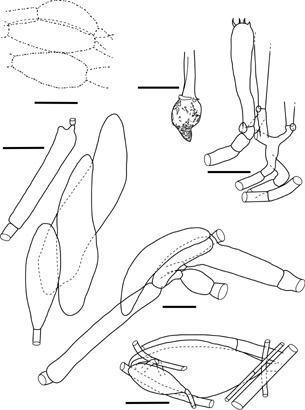
1. Amanita savannae, figs. 2a-2f from original description. |
| basidiospores |
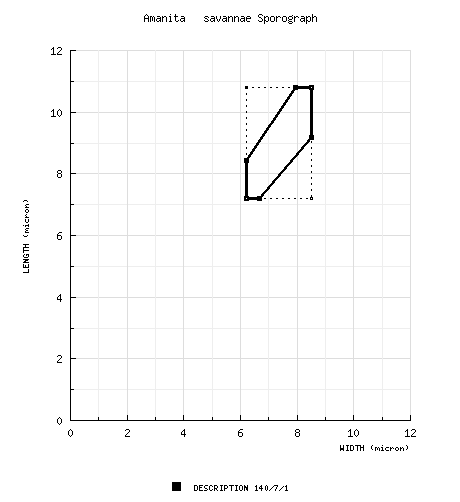
from protolog: [140/7/1] (6.5–) 7.2–10.8 (–13.5) × (6.0–) 6.2–8.5 (–9.5) µm, (L = 7.6–9.2 (–10.2) µm; L’ = 8.6 µm; W = 6.6–7.6 (–8.2) µm; W’ = 7.2 µm; Q = (1.02–) 1.08–1.36 (–1.73); Q = 1.14–1.22 (–1.27); Q’ = 1.19), hyaline, smooth, thin-walled, amyloid to somewhat palely amyloid, subglobose to broadly ellipsoid to ellipsoid, occasionally globose, occasionally elongate, often not adaxially flattened; apiculus sublateral, proportionately small to very small, cylindric; contents multiguttulate; color in deposit unknown. |
| ecology |
from protolog: Subgregarious to gregarious. At 120 m elev. In wet savanna apparently without nearby woody plants and recently flooded by heavy rains. |
| material examined |
from protolog: COLOMBIA: EL META—Mpio. Puerto Gaitan - Puente Arimena, sobre la carretera a Carimagua, 18.v.1992 A. E. Franco-M. 850 (holotype, NY; isotype, COL; isotype, HUA; isotype, RET 086-2). |
| discussion |
from protolog: This taxon is easily keyed to Amanita stirps Vittadinii using the keys of Bas (1969). The species most similar to A. savannae that is treated by Bas (1969) is A. codinae (Maire) Bertault (1955), described from the Mediterranean region. However, A. codinae has a rather thickset habit (pileus up to 130 mm wide) with a roughly cylindric stipe (up to 80 mm long) that lacks both a bulb and a point at the bottom; and it has much larger spores than does A. savannae with Q between 1.45 and 1.60.
Described from the State of Paraná, southern Brazil, Amanita grallipes Bas & de Meijer (1993) differs in being larger (pileus up to 90 mm wide; stipe up to 120 mm long) with downward tapering stipe lacking a bulb, lamellae becoming golden yellow (4A6) in age, and smaller spores with higher Q value.
Among the remaining taxa of subsect. Vittadiniae described since the publication of (Bas 1969), the only other taxon with which A. savannae might be confused is A. pleropus (Kalchbr. & MacOwan) D. A. Reid (1975) described from South Africa (Reid & Eicker 1991, 1996). However, there are marked differences between the two species. Amanita pleropus has a universal veil with elements having anticlinal orientation. As a result the universal veil remnants on the pileus sometimes become "densely crowded, erect, hair-like spines or pyramidal warts." The African species also has larger spores (10.8–14.0 × 7.0–9.5 µm) with Q in the range of 1.5±.
Dextrinoid (or possibly dextrinoid) contents of basidia or spores is a character reported for two other species in Amanita sect. Lepidella—A. mutabilis Beardslee (Bas 1969, Tulloss 1984), belonging to subsect. Limbatulae Bas and A. westii (Murrill) Murrill (Bas 1969, Tulloss and Lewis 1994), belonging to subsect. Solitariae Bas. This paper provides the first report of dextrinoid granules in Amanita subsect. Vittadiniae. These granules apparently occur rarely outside of Amanita subgen. Lepidella (E.-J. Gilbert) Beauseign. emend. Corner & Bas; they have been noted by Tulloss (unpub. data) in A. umbrinolutea var. flaccida D. A. Reid (1987) of Amanita sect. Vaginatae sensu Yang (1997) and others. Such granules were considered of taxonomic importance in the case of A. mutabilis; however, whether or not they are genetically determined is an open issue. |
| citations |
The protolog is available here as a PDF (Tulloss and Franco-Molano 2008) (open).—R. E. Tulloss and A. E. Franco-Molano |
| editors |
RET |
|


 Spore data sets and their composite