
| name | Amanita pleropus |
| name status | nomen acceptum |
| author | (Kalchbr. & Macowan) D. A. Reid |
| english name | "African Spindle-Bulb Lepidella" |
| intro |
The following description is based on Reid & Eicker (1991, 1996). |
| cap |
The cap of A. pleropus is 40 - 85 mm wide, hemispherical-campanulate, then planar, pinkish, with a nonstriate, appendiculate margin extending beyond the edge of the gills. The cap is entirely covered by brown or dark rusty volva, which disrupts into crowded, appressed, felty, polygonal or areolate, flat scales, sometimes spine-like (sometimes touching at their tips), especially at the center which has distinct purplish tints, appearing more radially fibrillose toward the margin. The flesh is buff. The cap suggests certain species of Agaricus. |
| gills |
The gills are ochraceous or cream, sometimes developing a gray tint in aging, and adnexed to almost free, rather distant, proportionately quite broad. |
| stem |
The stem is 50 - 90 × 6 - 20 mm, cylindrical, slightly inflated toward base to 14 - 20 mm wide, creamy-white above the ring, fibrillose developing a golden tint and become brown where handled below the ring, with brown fibrils or brown zig-zag bands as volval remnants on the lower portion of the stem. The ring is on the upper third of the stem, well developed, skirt-like, membranous, felty to cottony below, white above, buffy brown or cream colored below. The bulb is subrooting and fusiform that may penetrate into the substrate or go off on a slight angle. The flesh is white. The smell is nil or indistinct according to Reid & Eicker (1991), unpleasantly radish-like or like "fungus sauce" according the original description. |
| spores | The spores measure 9.0 - 11.5 × 6.2 - 8.0 µm or 9 -13 × 7 - 9 µm. Spores from a spore print are 10 -12 (-13) x 7.5 - 9 (-11) µm. Clamps are present at bases of basidia. |
| discussion | This species is reported to occur with Acacia and Jakaranda. It can grow in open grassland without trees present and has been observed in large ferry rings on lawns, as in a number of other species in subsection Vittadiniae. In this subsection, this species can be placed within stirps Vittadinii. The cap of the present species suggests that of a species of Macrolepiota. While it is the cap skin that breaks up in Macrolepiota, it is the volva that breaks up in Amanita subsection Vittadiniae; and there is no cap skin proper in the latter subsection.—R. E. Tulloss |
| brief editors | RET |
| name | Amanita pleropus | ||||||||||||||||||||
| author | (Kalchbr. & MacOwan) D. A. Reid. 1975. Contrib. Bolus Herb. 7: 130. | ||||||||||||||||||||
| name status | nomen acceptum | ||||||||||||||||||||
| english name | "African Spindle-Bulb Lepidella" | ||||||||||||||||||||
| synonyms |
≡Agaricus pleropus ("pteropus") Kalchbr. & MacOwan in Kalchbr. & Cooke. 1880. Grevillea 9: 17.
≡Lepiota pleropus (“pteropoda”) (Kalchbr. & MacOwan) Sacc. 1887. Syll. Fung. 5: 35. The editors of this site owe a great debt to Dr. Cornelis Bas whose famous cigar box files of Amanita nomenclatural information gathered over three or more decades were made available to RET for computerization and make up the lion's share of the nomenclatural information presented on this site. | ||||||||||||||||||||
| etymology | per Reid (1975): πλερες (Grk.), "full" or "solid" + πούς, "foot"; hence, "solid foot" (in this case, with reference to the stipe) | ||||||||||||||||||||
| MycoBank nos. | 308579, 509594, 517342, 179974 | ||||||||||||||||||||
| GenBank nos. |
Due to delays in data processing at GenBank, some accession numbers may lead to unreleased (pending) pages.
These pages will eventually be made live, so try again later. Search:
Showing 0 to 0 of 0 entries | ||||||||||||||||||||
| holotypes | K | ||||||||||||||||||||
| type studies | Reid. 1975. Contrib. Bolus Herb. 7: 129-131. | ||||||||||||||||||||
| revisions |
Reid and Eicker.
1991.
Mycol. Res. 95: 88, figs. 22-27, 48. Reid and Eicker. 1996. S. Afr. J. Bot. 62(3): 167-168. | ||||||||||||||||||||
| intro |
The following text may make multiple use of each data field. The field may contain magenta text presenting data from a type study and/or revision of other original material cited in the protolog of the present taxon. Macroscopic descriptions in magenta are a combination of data from the protolog and additional observations made on the exiccata during revision of the cited original material. The same field may also contain black text, which is data from a revision of the present taxon (including non-type material and/or material not cited in the protolog). Paragraphs of black text will be labeled if further subdivision of this text is appropriate. Olive text indicates a specimen that has not been thoroughly examined (for example, for microscopic details) and marks other places in the text where data is missing or uncertain. The following material not directly from the protolog of the present taxon and not cited as the work of Dr. Z. L. Yang or another researcher is based on original research of R. E. Tulloss. The brief original description reads as follows: "Facies Ag. Friesii, Lasch, sed procerus, stipite ebulbi, omnino solido, annulo fixo, lamellis sub adnatis. Odor fortissimus, raphanoideus, cum odore liquaminis gunforum ('Ketchup') pro condimento preparato sed omnino ingratus.For which Reid (1975) provides this translation: "With the appearance of Ag. Friesii, Lasch, but taller, stipe non-bulbous, entirely solid, with fixed annulus, and subadnate gills. Odour very strong, of radish, like the smell of fungus sauce ('Ketchup') during preparation but much more unpleasant. | ||||||||||||||||||||
| pileus |
Reid (1975): based on exsiccatum, ca. 40 mm wide, shallowly convex to planar; context 5 mm thick, "probably readily separable" from stipe; margin not described; universal veil "dark irregular appressed scales" on "pale background." [Note: In 1975, Reid interpreted the volva as a "cuticle."—ed.] Reid and Eicker (1996): 40 - 50 mm wide, with buff ground color [exposed context] visible between scales of universal veil, hemispheric-campanulate, then broadly convex; context white; margin non-striate, appendiculate, with felt-like appearance, extending beyond ends of lamellae; universal veil completely covering pileus at first, then becoming areolate (breaking into crowded polygonal scales), brown or purple-brown, radially fibrillose, flat, adpressed, felted, often with scales away from disc V-shaped or (toward margin) more delicate and sometimes with upturned tips, occasionally organized in dense scales over disk and as continuous fibrillose layer elsewhere or as dense flecks or specks of rather short brown fibrils or as rather dispersed punctate scales irregularly arranged in submarginal zone. | ||||||||||||||||||||
| lamellae |
from protolog: subadnate, no other character described; lamellulae not described. Reid (1975): not described. Reid and Eicker (1996): adnexed to almost free, density not described, ochraceous, sometimes developing gray tinge with age; lamellulae not described. | ||||||||||||||||||||
| stipe |
from protolog: bulb lacking; context solid; partial veil "fixed"; universal veil not described. Reid (1975): based on exsiccatum, 57 - 90 × 6 mm, tall, rather narrow; bulb not obviously present; context solid; partial veil not present in exsiccatum; universal veil not described. Reid and Eicker (1996): 50 - 80 × 6 - 10 mm, creamy white above partial veil, sometimes developing gold tint below partial veil and becoming brown from handling, cylindric, fibrillose below partial veil; bulb slightly broader than stipe (up to 13 mm wide), fusiform; context white; partial veil superior (on upper third of stipe), membranous, cream colored, well-developed, pendent, felted to cottony below; universal veil as fibrils on lower stipe, sometimes in zig-zag bands, brown, in age sometimes "disrupting" into bands of dark brown or black fibrillose scales or with recurved black pointed tips. | ||||||||||||||||||||
| odor/taste | from protolog: Odor "very strong, of radish, like the smell of fungus sauce ('Ketchup') during preparation but much more unpleasant." Taste not recorded. | ||||||||||||||||||||
| macrochemical tests |
none recorded. | ||||||||||||||||||||
| pileipellis | not described, probably absent. | ||||||||||||||||||||
| pileus context | not described. | ||||||||||||||||||||
| lamella trama | Reid and Eicker (1996): bilateral, divergent; filamentous hyphae up to 13 μm wide, hyaline, thin-walled; clamps present. | ||||||||||||||||||||
| subhymenium | Reid and Eicker (1996): pseudoparenchymatous, with elements rounded or cubical or wedge-shaped; clamps present. | ||||||||||||||||||||
| basidia | Reid and Eicker (1996): 44 - 59 × 10.9 - 12.0 μm, 2- or 4-sterigmate; clamps prominent and probably common. [Note: In their text, Reid and Eicker provide no numerical data or other data on the basidia of this species and no data on the plenitude of clamps at the bases of basidia. The data given here is based on measuring the two mature basidia drawn in their Fig 2(A).—ed.] | ||||||||||||||||||||
| universal veil |
Reid (1975): inflated cells thin-walled, up to 40 μm wide. [Note: Reid also says that there are "conductive elements" present with "glassy, more or less brownish contents."] Reid and Eicker (1996): On pileus: filamentous hyphae not described; inflated cells in easily dissociated chains, thin-walled, hyaline or pale brownish, clavate to fusiform (up to 120 × 8 - 13 (-19) μm), with terminal cells of similar form (60 - 95 × 8 - 11 (-19) μm) or more or less cylindric or tapering toward the free end (then 57 - 73 × 8 - 10 μm), sometimes (especially in chains with cylindric or tapering terminal cells) with basal cells of chains more inflated (65 - 100 × 13 - 20 (-46) μm) and then clavate; clamps plentiful (per figure). On stipe: not described. | ||||||||||||||||||||
| stipe context | not described. | ||||||||||||||||||||
| partial veil | not described. | ||||||||||||||||||||
| lamella edge tissue |
Reid (1975): apparently lacking in exsiccatum of holotype. [Note: Reid mistakenly used the term "cheilocystidia" with which to refer to the lamella edge tissue in Amanita; and, in the present case, he reports that no cheilocystidia were seen.—ed.] Reid and Eicker (1996): absent. [Note: See previous note in this data field.—ed. | ||||||||||||||||||||
| basidiospores |
Reid (1975):
[-/-/-] 11.2 - 13.0 (-15.2) ×
8.8 - 9.8 (-10.8) μm, (est. Q = 1.25 - 1.35), broadly
ellipsoid to ellipsoid, amyloid. [Note:
Reid does not provide a range of Q; hence, we have
estimated such a range based on the spore length and
width data provided. The estimated range of Q
is undoubtedly too narrow.—ed.] Reid and Eicker (1996): from first "gill squash"[-/1/1] 9.0 - 11.5 × 6.2 - 8.0 μm, (est. Q = 1.40 - 1.45), thin-walled, hyaline, amyloid, broadly ellipsoid to ellipsoid; apiculus not described and figure uninterpretable; content undescribed; white in deposit. from second "gill squash": [-/1/1] 9.0 - 13.0 × 7.0 - 9.0 μm, (est. Q = 1.25 - 1.45). dein spore deposit: [-/1/1] 10.0 - 12.0 (-13.0) × 7.5 - 9.0 (-11.0), (est. Q = 1.30 - 1.35). [Note: As in the case of Reid (1975), Reid and Eicker do not provide a range of Q; hence, we had to estimate ranges with the same resulting problem as noted in the previous case. Instead of providing a composite of all spore measurements from all specimens examined, Reid and Eicker follow the idiosyncratic practice of giving a separate set of spore data for each of two specimens and from a spore deposit. They don't indicate whether or not the spore print is from a different (third) specimen. None of the small drawings of spores appear to show a spore in lateral view; hence, the drawing does not help interpret the presented spore data.—ed.] | ||||||||||||||||||||
| ecology |
from protolog: Terrestrial. Reid and Eicker (1996): In troops. Under indigenous species of Acacia. | ||||||||||||||||||||
| material examined |
from protolog: SOUTH AFRICA: KWAZULU-NATAL—Inanda, Reid (1975): SOUTH AFRICA: KWAZULU-NATAL—Inanda, Reid and Eicker (1996): SOUTH AFRICA: GAUTENG—Pretoria, Faerie Glen, 2.iii.1993 Elrina Whitlock s.n. (PRUM 3611). | ||||||||||||||||||||
| discussion |
The current understanding of this species is dependent entirely on a very limited study of the type by D. A. Reid (1975) and a much more extended revision of fresh material determined as the present species and described by Reid and Eicker (1996). Reid (1975): "The type consists of two sections through the complete fruitbody, which appears to have been rather slender." "Kalchbrenner (1881) subsequent...[to the protolog] provided further details of his Ag. pteropus but this time he corrected the orthographic error whereby the epithet was previously cited as Ag. pteropus (Kalchbrenner and MacOwan 1880) and used the corrected name Ag. pleropus, derived from the Greek meaning "full or solid foot." This was clearly the feature he intended to emphasize since in his description of the stipe the word "solido" is printed in italics. It should also be noted that in his description of Ag. pleropus (1881) he cited the place of publication as Grevillea 9, p. 17, and by so doing made it clear that he was correcting the epithet and not proposing a new species. The supplementary description is as follows: "Agarico Friesii proximus, sed stipite solido subaequali, vel deorsum attenuato, et lamellis adnatis, angustis distinctus. Odor fortissimus raphanoideus. Frequrens videtur!Reid (1975) then continues by reporting on the additional collections listed above. Of these he judges that only Wood 372 is conspecific with the holotype; moreover, he opines that Wood 372 comprises parts of "the same 2 fruitbodies comprising the type gathering." Reid provides no additional data on the present species based on Wood 372. | ||||||||||||||||||||
| citations | —R. E. Tulloss | ||||||||||||||||||||
| editors | RET | ||||||||||||||||||||
Information to support the viewer in reading the content of "technical" tabs can be found here.
| name | Amanita pleropus |
| bottom links |
[ Section Lepidella page. ]
[ Amanita Studies home. ]
[ Keys & Checklists ] |
| name | Amanita pleropus |
| bottom links |
[ Section Lepidella page. ]
[ Amanita Studies home. ]
[ Keys & Checklists ] |
 Spore data sets and their composite
Each spore data set is intended to comprise a set of measurements from a single specimen made by a single observer; and explanations prepared for this site talk about specimen-observer pairs associated with each data set. Combining more data into a single data set is non-optimal because it obscures observer differences (which may be valuable for instructional purposes, for example) and may obscure instances in which a single collection inadvertently contains a mixture of taxa.
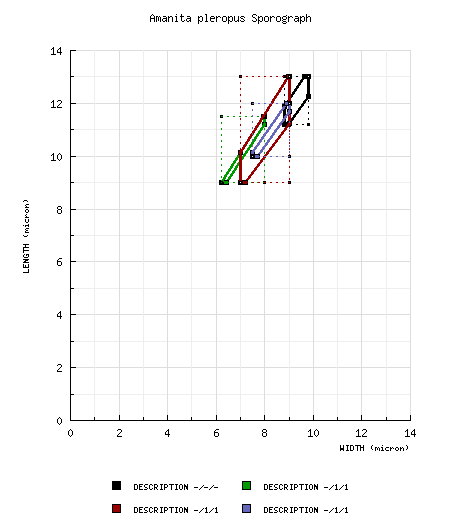

Text and User-Generated Sporographs are published under the Creative Commons License.

In the case of a taxon page, image credits are on the 'image' tab.