
| name | Amanita roseophylla |
| name status | nomen acceptum |
| author | Dav. T. Jenkins |
| english name | "Jenkins' Pink-Gilled Amanita" |
| intro |
The following description is based on Jenkins (1985). |
| cap |
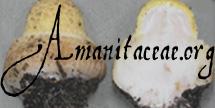
The cap of A. roseophylla is 20 - 40 mm wide, convex to plano-convex, golden-blonde in the center, lightly to near putty on margin, glabrous, with a slightly striate, slightly incurved margin. The volval remnants are thin, very sparse, pale grayish, relatively delicate, and usually disappearing with age. The cap skin is easily separable from flesh. The flesh is white, 1 - 3 mm thick over stem, unusually thickened at cap margin. |
| gills |
The gills are pinkish-white, moderately close, narrow, remote from stem, with floccose edges. The short gills are moderately abundant and truncate. |
| stem |
The stem is up to 50 × 7 - 8 mm, cylindric, mostly smooth, white to pale cream, stuffed to hollow. Volval remnants often absent, but if present they are slightly floccose, pale grayish patches. The ring is whitish, narrow, striate above, floccose below, delicate, disappearing with age. The basal bulb is subabrupt, egg-shaped, with narrow end pointing down, up to 20 × 17 mm. The flesh is white. |
| odor/taste |
The mushroom has no odor or taste. |
| spores |
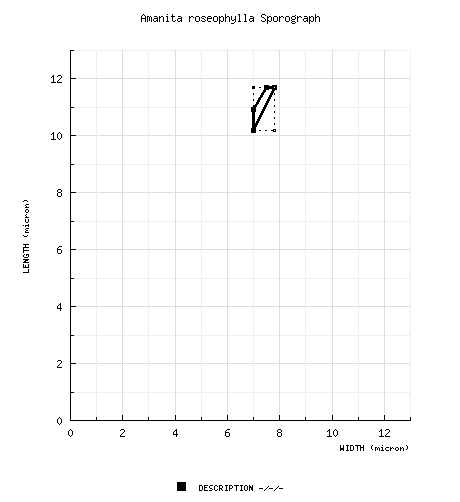
The spores measure 10.2 - 11.7 × 7.0 - 7.8 µm and are ellipsoid and inamyloid. Clamps are present at bases of basidia. |
| discussion |
Originally described from Alabama, USA where it occurred under loblolly pine (Pinus taeda) and mixed hardwoods. It is still only known from the type locality in Talladega. The pink gills are unusual in section Amanita, but see several species with and without rings in sect. Vaginatae (e.g., A. ristichii Tulloss), A. hygroscopia Coker (sect. Phalloideae), and A. carneiphylla O.K. Mill (sect. Lepidella).—R. E. Tulloss |
| brief editors | RET |
| name | Amanita roseophylla | ||||||||||||||||||||
| author | Dav. T. Jenkins. 1985. Mycotaxon 24: 283 - 286 fig. 1. | ||||||||||||||||||||
| name status | nomen acceptum | ||||||||||||||||||||
| english name | "Jenkins' Pink-Gilled Amanita" | ||||||||||||||||||||
| MycoBank nos. | 103992 | ||||||||||||||||||||
| GenBank nos. |
Due to delays in data processing at GenBank, some accession numbers may lead to unreleased (pending) pages.
These pages will eventually be made live, so try again later. Search:
Showing 0 to 0 of 0 entries | ||||||||||||||||||||
| holotypes | in herb. Dr. D. T. Jenkins, Univ. Alabama, Birmingham | ||||||||||||||||||||
| intro |
The following text may make multiple use of each data field. The field may contain magenta text presenting data from a type study and/or revision of other original material cited in the protolog of the present taxon. Macroscopic descriptions in magenta are a combination of data from the protolog and additional observations made on the exiccata during revision of the cited original material. The same field may also contain black text, which is data from a revision of the present taxon (including non-type material and/or material not cited in the protolog). Paragraphs of black text will be labeled if further subdivision of this text is appropriate. Olive text indicates a specimen that has not been thoroughly examined (for example, for microscopic details) and marks other places in the text where data is missing or uncertain. The following description is based entirely on the protolog. | ||||||||||||||||||||
| pileus | 20 - 40 mm diam, convex to plano-convex; golden-blonde on disc, lighter to near putty on margin; context white, 1 - 3 mm thick at center, tapering toward margin; margin very slightly striate, usually slightly incurved; universal veil very sparse, as thin, floccose patches, pale grayish, randomly distributed, relatively delicate, usually disappearing with age. | ||||||||||||||||||||
| lamellae | pinkish white, moderately close, narrow, widely free, edges floccose from remnants of partial veil; lamellulae moderately abundant, truncate. | ||||||||||||||||||||
| stipe | up to 50 × 7 - 8 mm, cylindric, mostly glabrous, white to pale cream; partial veil; context stuffed to hollow, white; bulb ovoid, submarginate to marginate, up to 20 × 17 mm; universal veil few or absent, or if present, as slightly floccose-membranous, striate above, floccose below, delicate, disappearing with age. | ||||||||||||||||||||
| odor/taste | Odor not distinct. Taste not distinct. | ||||||||||||||||||||
| macrochemical tests |
none recorded. | ||||||||||||||||||||
| basidiospores | [-/-/-] 10.2 - 11.7 × 7.0 - 7.8 µm, (Q = 131 - 1.56; Q’ = 1.49), ellipsoid, adaxially flattened, thin-walled, hyaline, inamyloid; apiculus sublateral, cylindric; contents guttulate; white in deposit. | ||||||||||||||||||||
| ecology | Solitary to gregarious. Alabama: Under loblolly pine and mixed hardwoods. | ||||||||||||||||||||
| material examined | U.S.A.: ALABAMA—Talladega Co. - Talladega, Lay Lake, prop. Dr. John Farmer, 18.ix.1983 Dav. T. Jenkins 1755 (paratype, in herb. Dav. T. Jenkins, Univ. Alabama, Birmingham), 15.ix.1984 Jenkins 2594 (holotype, in herb. Dav. T. Jenkins, Univ. Alabama, Birmingham), 16.ix.1984 Dav. T. Jenkins 2595 (paratype, in herb. Dav. T. Jenkins, Univ. Alabama, Birmingham). | ||||||||||||||||||||
| citations | —R. E. Tulloss | ||||||||||||||||||||
| editors | RET | ||||||||||||||||||||
Information to support the viewer in reading the content of "technical" tabs can be found here.
| name | Amanita roseophylla |
| bottom links | [ Keys & Checklists ] |
| name | Amanita roseophylla |
| bottom links | [ Keys & Checklists ] |
 Spore data sets and their composite
Each spore data set is intended to comprise a set of measurements from a single specimen made by a single observer; and explanations prepared for this site talk about specimen-observer pairs associated with each data set. Combining more data into a single data set is non-optimal because it obscures observer differences (which may be valuable for instructional purposes, for example) and may obscure instances in which a single collection inadvertently contains a mixture of taxa.

Text and User-Generated Sporographs are published under the Creative Commons License.

In the case of a taxon page, image credits are on the 'image' tab.