
| name | Amanita carneiphylla |
| name status | nomen acceptum |
| author | O. K. Mill. |
| english name | "Miller's Pink-Gilled Lepidella" |
| images |
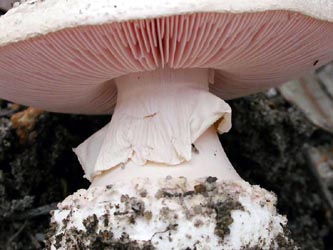  1. Amanita carneiphylla - W. Australia - photo by Katrina Symes 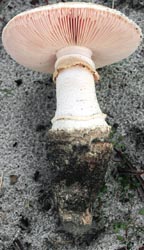 2. Amanita carneiphylla - W. Australia - Dr. Elaine Davison 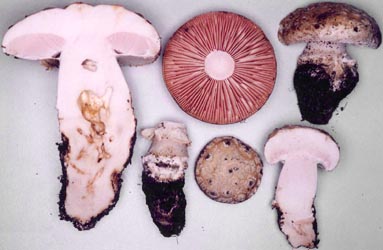 3. Amanita carneiphylla - W. Australia - photo by Katrina Symes 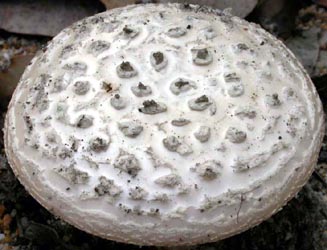 4. Amanita carneiphylla - W. Australia - photo by Katrina Symes 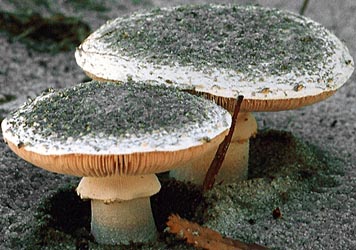 5. Amanita carneiphylla - W. Australia - Dr. Elaine Davison |
| intro | The following description is based on Miller (1992). The information here has been based on the protolog of Amanita carneiphylla. |
| cap | The fruit bodies of this species occur deeply inserted in sandy soil, usually with only the cap and uppermost stem exposed. The cap of Amanita carneiphylla is 50 - 75 mm wide, broadly convex, dry, dull white, with a nonstriate and appendiculate margin. The cap is sand-covered with low, soft, white volval warts over the center becoming less frequent or absent of the margin. The flesh is firm and white tinted pink, especially in age. |
| gills | The gills are subdistant, broad, adnate, very light pink at first, gradually becoming pink. The short gills are of diverse lengths, approximately one for each normal gill. |
| stem |
The stem is 135 - 150 × 15 - 20 mm, tapering, dull white, with an extensively rooting base, 60 - 90 × 25 - 35 mm. The ring is white, membranous, apical, striate on the upper surface, skirt-like. The volva is present as soft, white warts over the base of the stem and above the rooting bulb. The flesh is firm and white tinted pink, especially in age. |
| odor/taste | Odor is absent. |
| spores | The spores measure 10 - 12 × 5 - 6 µm and are cylindric and amyloid. Clamps are present at bases of basidia but the frequency is unknown. |
| discussion |
Originally described from Western Australia in association with Eucalyptus, Banksia, and Allocasuarina growing in sandy soil. At one site, Mediterranean pine (Pinus) was also found. In Amanita, elongate bulbs, narrow spores, and fruiting bodies deeply inserted in the soil are often associated with "leaky" ecosystems (Tulloss 2005). For Miller's description of the volva, Bas' keys direct us to stirps Chlorinosma. This stirps is divided between pallid Northern hemisphere temperate taxa and Southern hemisphere tropical taxa. Amanita carneiphylla has the lack of pigment of the Northern hemisphere taxa but the narrow spores present in A. lanosula Bas known from the Republic of Congo. The pink gills and pink tint of the flesh are unknown in stirps Chlorinosma. In addition, the volval warts are much too coherent and well-formed (see above photos) for that stirps. It seems appropriate not to attempt placement of A. carneiphylla in Bas' system until more is known about it.—R. E. Tulloss |
| brief editors | RET |

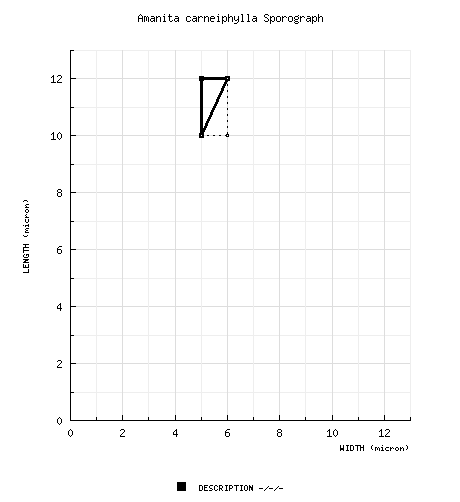
 Spore data sets and their composite