| name |
Amanita porphyria |
| author |
Alb. & Schwein. : Fr. 1805. Consp. Fung.: 142, taf. 11 (fig. 1). |
| name status |
nomen acceptum |
| english name |
"Porphyry Amanita" |
| synonyms |
≡ Agaricus porphyrius (Alb. & Schwein. : Fr.) Fr. 1821. Syst. Mycol. 1: 14.
≡ Venenarius porphyrius (Alb. & Schwein. : Fr.) Murrill. 1913. Mycologia 5: 81.
≡ Amanitina porphyria (Alb. & Schwein. : Fr.) E.-J. Gilbert. 1940. Iconogr. Mycol. (Milan) 27, suppl. (1): 78, tab. 37 (figs. 5-6).
≡Agaricus gracilis Schumach. nom. illeg. 1803. Enumerat. Plant. Part. Saelland. 2: 252. [Avowed replacement for validly published name. ICBN §52.1] ≡ Amanita recutita var. gracilis (Schumach.) Sacc. 1887. Syll. Fung. 5: 12. ≡ Amanita porphyria [var. recutita] f. gracilis (Schumach.) E.-J. Gilbert. 1918. Gen. Amanita Pers.: 59.
≡ Agaricus ( Amanita) porphyrius var. tenuior Fr. 1874. Hymenomyc. Eur.: 19. ≡ Amanita porphyria var. tenuior (Fr.) Sacc. 1887. Syll. Fung. 5: 11. ≡ Amanita porphyria f. tenuior (Fr.) E.-J. Gilbert. 1918. Gen. Amanita Pers.: 57. ≡ Amanita porphyria f. tenuior (Fr.) Killerm. 1931. Denkschr. Bayer. Bot. Ges. Regensburg 18(neue Folg. 12): 5. [Superfluous combination.] ≡ Amanita porphyria f. tenuior (Fr.) Veselý. 1933. Ann. Mycol 31(4): 235. [Superfluous combination.]
?= Fungus colubrinus Paulet. 1793. Trait. Champ. 2: 317, index [7]. ≡ Hypophyllum colubrinum Paulet nom. inval. 1808-1835. Ibid.: pl. 152 (fig. 2). [Devalidated name. The name Amanita Pers. is conserved against Amanita Boehm. of which Hypophylum is an isonym. (Donk. 1962. Beih. Nova Hedwigia 5: 145.)]
≡Amanita ophites Léveillé. 1855. Icon. Champ.: 83.
=Amanita tomentella Krombh. 1836. Naturgetreue Abbild. Essbar. Schädl. Undverd. Schwäm. 4: pl. 29 (figs. 6-9).
= Agaricus ( Amanita) recutitus Fr. 1838. Epicr.: 6. ≡ Amanita recutita (Fr.) Bertillon in Dechambre. 1866. Dict. Encycl. Sci. Médic.: 500. ≡ Amanita recutita (Fr.) Gillet. 1884 (February). Tabl. Anal. Hymenomyc.: 7. [Superfluous combination.] ≡ Amanita porphyria var. recutita (Fr.) Quél. 1888. Fl. Mycol.: 308. ≡ Amanita porphyria f. recutita (Fr.) E.-J. Gilbert. 1918. Gen. Amanita Pers.: 57. ≡ Venenarius recutitus (Fr.) Murrill. 1913. Mycologia 5: 81.
≡ Agaricus porphyrius var. major Fr. 1874. Hymenomyc. Eur.: 19. ≡Agaricus sinuatus Schumach. 1803. Enumerat. Plant. Part. Saelland. 2: 249. [1834. Fl. Dan. 36??: ??, pl. 2415.] ≡ Amanita porphyria var. major (Fr.) Sacc. 1887. Syll. Fung. 5: 11. ≡ Amanita porphyria f. major (Fr.) E.-J. Gilbert. 1918. Gen. Amanita Pers.: 56. ≡ Amanita porphyria f. major (Fr.) Veselý. 1933. Ann. Mycol. 31(4): 235. [Superfluous combination.]
= Amanita porphyria var. purpurascens Gillet. 1874. Champ. (Hyménomyc.) Croiss. France: 36. [Subsumed within type variety by Gillet ( 1884 (February). Tabl. Anal. Hyménomyc.: 5).] ≡ Amanita porphyria f. purpurascens (Gillet) E.-J. Gilbert. 1918. Gen. Amanita Pers.: 56. ≡ Amanita porphyria f. purpurascens (Gillet) Veselý. 1933. Ann. Mycol. 31(4): 235. [Superfluous combination.]
=Agaricus mappa var. lilacina Britzelm. 1890. Ber. Naturhist. Ver. Augsburgs 30: 6, [pl. 50] (fig. 330). [Republished by von Höhnel. Hymenomyc. Südbayer. 6: 176.]
=Agaricus porphyrius f. major Britzelm. 1893. Bot. Centralbl. 54(2): 33, [pl. 88] (fig. 470). [Republished by von Höhnel. Hymenomyc. Südbayer. 9. Mat. Beschr. Hymenomyc.: 223.] ≡ Amanita porphyria f. major (Britzelm.) Killerm. nom. illeg. 1931. Denkschr. Bayer. Bot. Ges. Regensburg 18(neue Folg. 12: 5. [Posterior homonym. ICBN §53.1]
= Amanita porphyria var. tenera Boud. 1902. Bull. Soc. Mycol. France 18: 259. ≡ Amanita porphyria f. tenera (Boud.) Veselý. 1933. Ann. Mycol. 31(4): 236.
For more taxonomic synonyms see the Amanita Nomenclator (t.b.d.).
The editors of this site owe a great debt to Dr. Cornelis Bas
whose famous cigar box files of Amanita nomenclatural information
gathered over three or more decades were made available to RET for computerization
and make up the lion's share of the nomenclatural information presented on this site.
|
| MycoBank nos. |
171128, 284107, 534555, 161496, 508883, 476723, 169063 |
| GenBank nos. |
Due to delays in data processing at GenBank, some accession numbers may lead to unreleased (pending) pages.
These pages will eventually be made live, so try again later.
|
| lectotypes |
Albertini and Schweinitz. 1805. op. cit.: taf. 11 (fig. 1). [It is possible that this lectotype could be rejected because it does not conform with the protolog with regard to the stipe and the lamellae being white [at least at first]. |
| lectotypifications |
Neville and Poumarat. 2004. Fungi Europeaei 9: 820. [The authors express reservations that the selected plate does not conform with the text of the protolog.] |
| intro |
Olive text indicates a specimen that has not been
thoroughly examined (for example, for microscopic details) and marks other places in the text
where data is missing or uncertain.
Coloring of the habit illustration is clearly incorrect
in copies I have seen—e.g., having a brown stipe.
Schweinitz prepared water colors of many of the species
that appear in his works. These water colors are
often very good quality technical illustrations and are
clearly based on individual collections. The water
color of A. porphyria is in a bound volume in the
Ewell Sale Stewart Library, of the Philadelphia Academy
of Natural Sciences, Pennsylvania, U.S.A. For some
reason it shows an entirely gray fruiting body (gray
pileus and gray stipe). Possibly this is due to
sulfides or other compounds forming in the pigments over
the series since the painting's creation; however, no
cause has been assigned scientifically. |
| pileus |
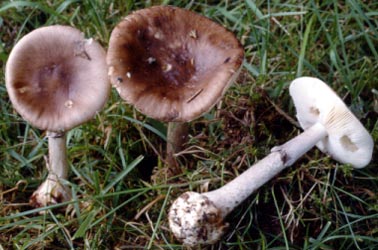
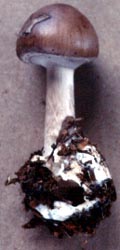
29 - 101 mm wide, virgate, at first with darker streaks
brown to umbrinous brown (e.g. 6D3), often with lavender
or purple or reddish cast when young (this, at least
sometimes, due to paler pinkish brown ground color, e.g.,
ca. 6C3), with pink tint disappearing with age and brown
becoming darker (e.g., 6F4 or darker), often gray (in
Schweinitz’ water color cited above) to grayish brown to
sepicaceous at
maturity, sometimes rain-soaked specimens becoming pallid
(e.g. very pale tan-gray, with buff disc, sometimes with
citrin ground color) or depigmented, unchanging when cut
or bruised,
hemispheric to broadly campanulate to convex,
then planoconvex to shallowly
depressed with umbo in depression, becoming concave in
age, tacky, shiny, subshiny when dry;
context white except for
thin brownish gray layer below pileipellis, unchanging
when cut or bruised, 2 - 8 mm thick, thinning evenly to
margin or thinning rather rapidly for about 0.75 pileus
radius and then thinning evenly to margin; margin
nonstriate, nonappendiculate; universal veil
absent or in small, friable patches, detersile, white
or very pallid at first, becoming concolorous with
pileus or grayer. |
| lamellae |
narrowly adnate at first, then free, seceding, sometimes
with short decurrent lines on stipe apex, sometimes
lacking such lines, crowded to subcrowded, buff
to cream to off-white to white in mass, pale cream to
white in side view, unchanging when cut or bruised,
2.5 - 7.5 mm broad, broadest at about 75% of distance
from stipe to pileus margin, ??;
lamellulae attenuate to subattenuate to truncate,
unevenly distributed, of diverse lengths,
plentiful. |
| stipe |
60 - 110 × 3 - 14 mm, white, becoming off-white to
brown with handling, narrowing upward or subcylindric
or cylindric, flaring just at apex,
at times somewhat sinuate, faintly longitudinally
striatulate, often with areas of
brownish gray or gray fibrils (sometimes joined at tips)
below partial veil or with smears of gray thin material
(limbus internus?), with all decoration tending
to darken
with age; bulb 10 - 23 × 7 - 35 mm,
subglobose to
ovoid, often
submarginate to marginate, vertically split
sometimes,
often abrupt or subabrupt; context off-white to
pale cream, sometimes stained yellow-brown in center of
bulb, hollow to stuffed to solid, with central cylinder
0+ - 4 mm wide, with larval tunnels
concolorous;
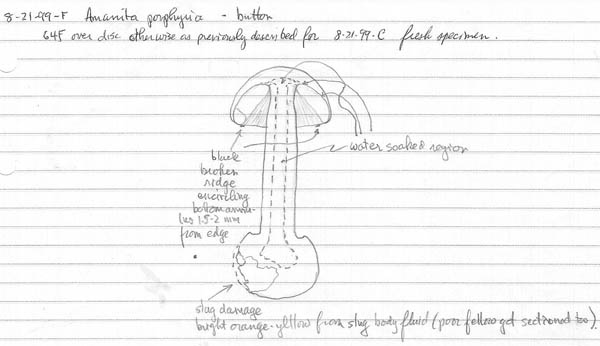
partial veil superior to median,
gray-brown to
gray, becoming blackish with age (from free edge
upward),
membranous, persistent, striate above, having dark
ring of universal veil materil on underside near
margin, with this ring breaking up into dark to
black dashes with stretching during cap expanion,
collapsing on
stipe; universal veil absent or occasionally as
short submembranous limb or narrow ridge attached at
bulb margin, whitish,
sometimes graying and then black with age as with
gray material left on stipe below partial
veil. |
| odor/taste |
Odor of potatoes or raphanoid, sometimes faintly. Taste not recorded. |
macrochemical
tests |
Spot test for laccase (syringaldazine) - negative throughout basidiome. Spot test for tyrosinase (paracresol) - positive in scattered samll spots on stipe and bulb surfaces and in context of same and on lamella edge near stipe apex. Test voucher: Tulloss 8-21-87-G. Similar results for phenoloxidase spot tests with L-tyrosine, paracresol, and syringaldazine are reported by Marr et al. (1986). All tests were performed on North American material. |
| subhymenium |
wst-near = 25 µm (?); wst-far = 35 µm (?); comprising irregularly shaped branched cells (uninflated or partially inflated) and partially inflated cells and ellipsoid to ovoid to subglobose inflated cells (up to 25 × 16.0 µm, but mostly under two thirds this length) in (3-) 4 - 5 layers in branching structure (usually smallest near bases of basidia) and uninflated hyphal segments, with basidia usually arising from small inflated cells, but also arising from cells of other listed types. |
| basidia |
30 - 46 × 9.2 - 14.5 µm, dominantly 4-, infrequently 2-sterigmate, with sterigmata up to 7.5 × 4.5 µm; clamps rare(?) to absent. |
| basidiospores |
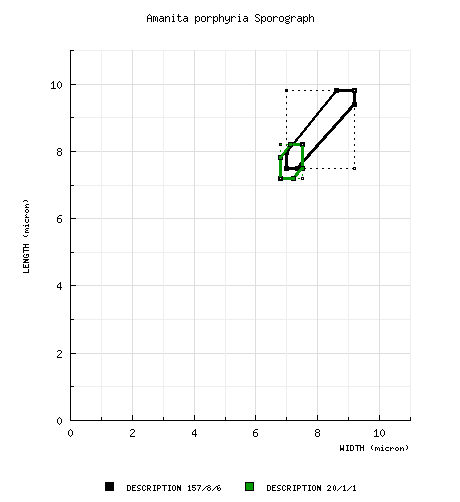
RET: [157/8/6] (7.2-) 7.5 - 9.8 (-11.2) ×
(6.8-) 7.0 - 9.2 (-11.0) µm,
(L = (7.8-) 8.5 - 8.9 µm;
L’ = 8.7 µm; W = (7.1-) 8.0 - 8.5 µm;
W’ = 8.1 µm; Q = (1.0-) 1.02 - 1.14 (-1.26);
Q = 1.05 - 1.07 (-1.10);
Q’ = 1.07), hyaline,
colorless, smooth, thin-walled, amyloid, globose to
subglobose, often at least slightly adaxially flattened,
occasionally expanded at one end; apiculus
sublateral, small, cylindric; contents dominantly
monoguttulate, occasionally multiguttulate to granular;
white in deposit.
[Note: The abnormally small spores from RET 245-6
have affected the above data unduly because the overall
sample size is small. The data from
the small spores are provided here:
[20/1/1] 7.2 - 8.2 (-8.5) × 6.8 - 7.5 (-10.5) μm,
(L = 7.8 μm; W = 7.1 μm;
Q = 1.0 - 1.15 (-1.17); Q = 1.10).]—ed. |
| ecology |
Solitary to subgregarious. Norway: In
oligotrophic Pinus sylvestris forest in humus with
pH = 4.0± or in Picea abies
forest. Switzerland: At 1000 m elev. Under
Fagus and Picea. California, U.S.A.:
In sand with some organic content with
Arctostaphylos, Castanopsis, Pinus,
and Quercus. New York, U.S.A.: At ca.
500 m elev. Vermont, U.S.A.: In duff in
sandy road cut with Tsuga canadensis, F.
grandifolia, and Acer sp. Washington,
U.S.A.: Under T. heterophylla or in conifer duff
at about 30 m elev. in old growth Tsuga
forest.
A. H. Smith’s notes in MICH say: "Solitary to scattered
on rich humus, especially in hemlock [Tsuga]
forests, frequent in its favorite habitat in the
eastern, central and western states [of the
U.S]."
Gulden et al. (1985)
report that A. porphyria is one of the few
species of Amanita not in Amanita
section Vaginatae found rather commonly in
treeline forests of northern Europe. |
| material examined |
Zhang et al. (2004) voucher for sequencing: GERMANY: UNKN. STATE—Schwarzwald, s.d. unkn. coll. s.n. (HKAS 31531).
RET:
CANADA: NEW
BRUNSWICK—Charlotte Co. - Campobello
Isl.,
...more....
NEWFOUNDLAND &
LABRADOR—Isl. of Newfoundland - Gros Morne Nat.
Pk., Trout Lake Campground, 30.ix.2003 Dr. Kuulo
Kalamees s.n. [Tulloss 9-30-03-B] (RET 370-9, nrITS
& nrLSU seq'd.); Kill Devil Anglican Church Camp,
17.ix.2004 Noah Siegel s.n. (RET 384-8, nrITS &
nrLSU seq'd.); Lomond, Stuckless
Pond, 14.ix.2004 R. E. Tulloss, Maria Voitk ∓
K .J. Harrison [Tulloss 9-14-04-A] (RET 383-4);
Stanleyville [49.4665° N/ 57.7805° W, 30 m elev.],
13.ix.2004 Maria Voitke & R. E. Tulloss s.n.
(RET 383-9); unkn. loc., 28.ix.2003 Velo
Soots & Pat Burchell s.n. [Tulloss 9-28-03-B]
(RET 370-10, nrITS & nrLSU seq'd.).
CZECH REPUBLIC: SOUTH
BOHEMIA—Nadějov, 2.x.2006 Dr. Jan Borovička 25
(RET 404-9, nrITS & nrLSU seq'd.); Široké Blato
Nature Reserve, 3.x.2006 J. Borovička 26 (RET 404-2,
nrITS & nrLSU seq.'d.), 4.x.2006
J. Borovička 28 (RET 404-1).
NORWAY:
AUST-AGDER—Gjerstad, Svarttjern For. Reserve
[UTM: ML 9135], 18.viii.1987 T. E. Brandrud 439-87
(O).
BUSKERUD—Kongsberg, Efteløt prestegård
[UTMWGS84 NM 455,012-013], 20.viii.1999 L.
Winter, S. Aasrum & M. Nuñez s.n. [Tulloss
8-20-99-G] (O 36126; RET 309-7, nrITS seq'd.);
Kongsberg, Jondalseva i Jondalen [UTMWGS84
NM 30-31,18], 21.viii.1999 Even W. Hanssen, B. Krømer,
R. Kristiansen & V. Timmerman s.n. [RET 8-21-99-F]
(O 36126; RET 309-6); Kongsberg, Lindåskroken
[UTMWGS84 NM 35,01-02, 350 m], 21.viii.1999
P. Marstad, H. Myhre & T. Torjesen s.n.
[Tulloss 8-21-99-C] (O 35658; RET 311-2, nrITS seq'd.);
Kongsberg, SW side Store Lauarvann
[UTMWGS84 NM 379,025], 20.viii.1999 R. E.
Tulloss 8-20-99-B (O 35964; RET 309-8, nrITS &
nrLSU, seq'd.).
SWITZERLAND: ZUG—Zug,
10.ix.1992 Carmine Lavorato 920910-35 (in herb. C.
Lavorato; RET 079-1, nrITS & nrLSU seq'd.).
U.S.A.: CALIFORNIA—Santa
Cruz Co. - Henry Cowell Redwoods St. Pk., campgrd. area
ca. Graham Hill Rd., 15.i.2003 D. Arora & R. E.
Tulloss [Tulloss 1-15-03-B] (RET 366-3, nrITS &
nrLSU seq'd.).
MAINE: Washington Co. -
S of Steuben, ca Eagle Hill Institute, 12.ix.2013
Igor Safonov et al. s.n. (RET 578-2).
MASSACHUSETTS—Berkshire Co., Savoy Mills St.
For., 15.viii.1986 Len Frank s.n. [Tulloss 8-15-86-G]
(RET 669-10).
NEW HAMPSHIRE—Cheshire Co. - Rindge, campus
of Franklin Pierce College [42.7788° N/ 72.0555° W, 319
m], 18.viii.1989 Beryl Stevenson s.n. [Tulloss
8-18-89-G] (RET 245-6, nrITS & nrLSU seq'd.).
NEW YORK—Franklin Co. -
Paul Smith’s [44°26'02" N/ 74°15'06" W, 500 m],
21.viii.1987 Bruce Vansant s.n. [Tulloss 8-21-87-B]
(RET 018-5), David C. & R. E. Tulloss 8-21-87-G
(RET 018-6).
OREGON—Coos Co. - North
Bend, Horsfall Beach [ca. 48°26’60” N/ 124°15’20” W,
ca. 9 m], 19.x.2013 Laurel Caplan s.n. (RET
589-9). Multnomah Co. - Larch Mtn.,
23.x.2010 Sava Krstić s.n. [mushroomobserver #56515
] (RET 456-9, nrITS & nrLSU seq'd.).
VERMONT—Pownal Co. - County Rd, 29.viii.1981 NEMF81 participant s.n. [Tulloss 8-29-81-H] (RET 166-9).
WASHINGTON—Klickitat Co. - GPNF, W side Cascade Crk., 8.ix.1990 J. E. Lindgren 90-28 (RET 083-2). Skamania Co. - GPNF, Pacific Crest Tr., Trout Crk., 8.ix.1990 J. E. Lindgren 90-48 (RET 083-1). Skagit Co. - Rockport St. Pk., 18.x.1992 Kathi Marlowe s.n. [B. McAdoo 215#6] (RET 077-1). |
| discussion |
All the information that I have collected here is
from material with a purplish brown to brown to ??
to (rarely, in the U.S Pacific Northwest) white
pileus and both partial and universal veils soon
becoming gray.
I have examined Schweinitz’s watercolor of this
species at the Library of the Academy of Natural
Sciences, Philadelphia. It is believed that
this watercolor was made during the period of
Scwheinitz’s time in Germany and his association
with Albertini—not during
Schweinitz's time in North America.
Schweinitz
was a fine draftsman and used color with
subtlety. On the whole, the watercolors are
very well preserved; and familiar taxa can be
judged to be lifelike and accurate. As a
consequence, one
would believe the painting of
Amanita porphyria
to be an accurate representation of the species and
more valuable than the obviously improperly colored
illustration that appears in the protolog.
The watercolor depicts a pair of basidiomes with
gray, umbonate pilei having nonstriate
margins. The
pilei are completely without remnants of
universal
veil. The lamellae are white with
concolorous
edges. The stipe is notably (although
palely)
grayish. The annulus appears white on the
upper
surface; the lower surface may be showing in part
and
should be re-examined with greater care than I was
able
to give it during the exhibition at which I was
able to
examine the painting. The basal bulbs of the
stipes are white and sublimbate to subabrupt; one
is white; the other is white with raised ochraceous
tan, verruculose patches.
The watercolor, although more subtly colored than
the
protolog's illustration still does not depict the
fungus
described in the protolog text—a fungus with a
pileus that is
purplish at first and that becomes livid and an
annulus
that becomes livid on a white stipe. It would
appear that neither the published plate nor the
watercolor can serve as a lectotype.
Moreover,
the date of the watercolor is (so far as I know)
unknown; if this is true, the painting cannot be
demonstrated to be a syntype.
As far as the they have been compared to date, the
match
between the European material and the specimens
from the
Pacific Northwest of the United States is
excellent. There is essentially no
difference in
the anatomy of the hymenium, subhymenium, and
lamella
trama between specimens in the two geographic
groups.
The pileus of McAdoo 215#6 was rather pallid for
this
species (very pale tan-gray, with buff disc);
however,
anatomically, the material is identical with the
other
specimens of the present taxon that were examined;
moreover, the typical grayish annulus was noted
by the collector.
In eastern North America, porphyry-capped material
that
appears very similar to that illustrated on this page
from Norway and Switzerland has occasionally been
reported; however, there are also specimens commonly
referred to A. porphyria by eastern North
American mycologists that have distinctly different
pileus coloration. For example, the pilei of
material
from the Island of Newfoundland that Tulloss has
seen
in the field have a tan pileus with a warm brown
disc. However, collections with the two
variations
of cap pigmentation have been found to yield
identical
nrITS and nrLSU sequences (posted on GenBank and
listed near the top of this tab).
Tulloss has referred to some collections of this
species
as "sp. NW6" in correspondence and local
checklists. Material from New York and New
Hampshire with cap coloring not porphyry have
previously
been called A. sp-N17
on this site. Prior to development of this
site,
these name was written "sp. N17"
in correspondence, keys, and draft
descriptions.
A collection of this latter
"possible taxon" has yielded DNA nrITS and nrLSU
sequences that are those of the present
taxon.
A. H. Smith’s notes (MICH) indicate that he felt
that
there was "intergrading" between the present
species
and "Amanita citrina". Tulloss has not
seen any evidence of this. To date there is
no supporting
genetic evidence that A. porphyria has
crossed with any other taxon of stirps
Citrina. |
| citations |
—R. E. Tulloss |
| editors |
RET |
|




 Spore data sets and their composite