
| name | Amanita pumatona |
| name status | nomen acceptum |
| author | G. S. Ridl. |
| english name | "Maori Gray Lepidella" |
| intro |
The following description is based on Ridley (1991). |
| cap |
The cap of Amanita pumatona is 50 - 80 mm wide, convex to plano-convex, eventually depressed in the center, viscid when young or wet, pale buff, buff, or sordid buff, with an appendiculate margin with friable volva remnants. The volval remnants form a thick covering of pale grayish sepia to pale smoke-gray warts, either isolated or connected at the base to form "sheets." The volval remnants are easily removed when handling, tending to litter the substrate around specimens. When removed, they leave a "reticulate pattern of shallow depressions." The flesh is white. |
| gills |
Gills are crowded, free, white 5 - 11 mm wide; the short gills are subtruncate. |
| stem |
Its stem is 80 - 97 × 9 - 20 mm, solid, from clavate to bulbous, sparsely floccose or breaking into fine bands, white above the ring, white to smoke-gray and finely scaled below ring. Volva as concentric rings of thick, fleshy scales or warts form at the base, rarely leaving a band around the lower stem. The base is occasionally radicating. The bulb is 22 - 44 mm wide. The ring friable, finely striate, tending to break up, often lost, white, then pale yellowish. The flesh is white. |
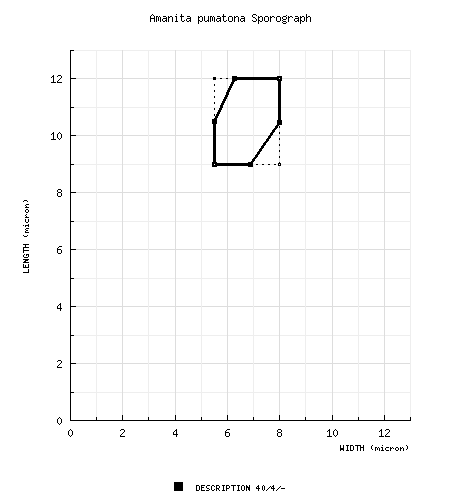
| spores | The spores measure 9 - 12 × 5.5 - 8 µm and are ellipsoid to elongate and amyloid. Clamps are frequent at bases of the basidia. |
| discussion |
Originally described from the southern part of the North Island, New Zealand associated with Southern Beech (Nothofagus). Known only from the type locality. Ridley associated this species with Bas' stirps Microlepis.
In particular, he compares it to A. atkinsoniana
Coker. Members of stirps Microlepis had previously been
reported only from eastern and southern North America and far-eastern Asia. |
| brief editors | RET |
| name | Amanita pumatona | ||||||||||||||||||||
| author | G. S. Ridl. 1991. Austral. Syst. Bot. 4: 342, fig. 8(a-i). | ||||||||||||||||||||
| name status | nomen acceptum | ||||||||||||||||||||
| english name | "Maori Gray Lepidella" | ||||||||||||||||||||
| etymology | puma (Maori), "gray" + tona (Maori), "wart"; referring to abundant, gray pileal warts | ||||||||||||||||||||
| MycoBank nos. | 355196 | ||||||||||||||||||||
| GenBank nos. |
Due to delays in data processing at GenBank, some accession numbers may lead to unreleased (pending) pages.
These pages will eventually be made live, so try again later. Search:
Showing 0 to 0 of 0 entries | ||||||||||||||||||||
| holotypes | PDD | ||||||||||||||||||||
| intro |
The following text may make multiple use of each data field. The field may contain magenta text presenting data from a type study and/or revision of other original material cited in the protolog of the present taxon. Macroscopic descriptions in magenta are a combination of data from the protolog and additional observations made on the exiccata during revision of the cited original material. The same field may also contain black text, which is data from a revision of the present taxon (including non-type material and/or material not cited in the protolog). Paragraphs of black text will be labeled if further subdivision of this text is appropriate. Olive text indicates a specimen that has not been thoroughly examined (for example, for microscopic details) and marks other places in the text where data is missing or uncertain. The following is based entirely upon the protolog of the present species. Basidiomes medium-sized. | ||||||||||||||||||||
| pileus | 50 – 80 mm, pale buff to buff to sordid buff, viscid when young or wet, drying with age, convex to plano-convex, then plano-depressed; context white; margin appendiculate with friable volva remnants, tending to be lost with age; universal veil as thick covering of pale grayish sepia to pale smoke-gray warts, either isolated or connected at base (then forming sheets), easily removed when handled, tending to litter surrounding substrate, and leaving reticulate pattern of shallow depressions [when lost—ed.]. | ||||||||||||||||||||
| lamellae | free, crowded, white, 5 – 11 mm broad; lamellulae subtruncate. | ||||||||||||||||||||
| stipe | 80 - 97 × 9 - 20 mm, surface above annulus white, sparsely floccose or breaking into fine bands, below annulus white to very pale smoke-gray, finely scaled; bulb from simply clavate stipe base to discernibly distinct from stipe, occasionally radicating, 22 - 44 mm wide; contextwhite, solid; partial veil friable, finely striate, tending to break up into sections and often lost, white then pale luteous; universal veil at stipe base forming concentric rings of thick, fleshy scales or warts, rarely forming ring below annular zone. | ||||||||||||||||||||
| pileipellis | 50 – 70 µm thick, with gelatinized suprapellis and non-gelatinized subpellis. | ||||||||||||||||||||
| basidia | 41 – 60 × 10.5 – 13.0 µm, 4-spored; clamps abundant. | ||||||||||||||||||||
| universal veil | On pileus: filamentous hyphae to 9.0 µm wide; inflated cells in chains, small, hyaline, globose to ellipsoid cells, 16.0 - 32 × 9.0 - 19.0 µm [near—ed.] tip [of wart—ed.] and at [near—ed.] base, larger, 17.0 - 66 × 14.5 - 40 µm; clamps abundant. | ||||||||||||||||||||
| lamella edge tissue | inflated cells numerous, 16.0 - 32 × 10.5 - 16.0 µm, clavate, hyaline (seen only in Ridley 576). | ||||||||||||||||||||
| basidiospores | From protolog (Ridley 1991): [40/4/-] 9.0 - 12.0 × 5.5 - 8.0 µm, (Q = 1.31 - 1.91; Q' = 1.55), hyaline, amyloid, ellipsoid to elongate; apiculus not described; contents not described; white in deposit. | ||||||||||||||||||||
| ecology | From protolog (Ridley 1991): Solitary to subgregarious. Under Nothofagus truncata. Known only from southern North Island, New Zealand. | ||||||||||||||||||||
| material examined |
From protolog (Ridley 1991): NEW ZEALAND: WELLINGTON—Rimutaka For. P.k., Orongorongo Track, | ||||||||||||||||||||
| discussion |
From protolog (Ridley 1991): This species belongs to Amanita subsect. Solitariae, due to the appendiculate pileus and friable, non-membranous volva. It is best placed in stirps Microlepis because of its clamp connections, volva warts composed chiefly of inflated cells and the presence of warts or scales at the base of the stipe. Amanita pumatona is morphologically and microscopically most similar to A. atkinsoniana Coker (Bas 1969) in stirps Microlepis. Amanita atkinsoniana differs by having reddish brown, pale brown or grayish volva remnants on the pileus and stipe, and a [relatively—ed.] persistent annulus, and is known only from eastern...North America. The remaining members of the stirps are found principally in eastern and southern North America (Bas 1969) and Japan (Bas and Hatanaka 1984). Members of stirps Microlepis have not yet been reported from Australia or South America. | ||||||||||||||||||||
| citations | —R. E. Tulloss | ||||||||||||||||||||
| editors | RET | ||||||||||||||||||||
Information to support the viewer in reading the content of "technical" tabs can be found here.
 Spore data sets and their composite
Each spore data set is intended to comprise a set of measurements from a single specimen made by a single observer; and explanations prepared for this site talk about specimen-observer pairs associated with each data set. Combining more data into a single data set is non-optimal because it obscures observer differences (which may be valuable for instructional purposes, for example) and may obscure instances in which a single collection inadvertently contains a mixture of taxa.

Text and User-Generated Sporographs are published under the Creative Commons License.

In the case of a taxon page, image credits are on the 'image' tab.