| name |
Amanita atkinsoniana |
| author |
Coker. 1917. J. Elisha Mitchell Sci. Soc. 33: 84, pl. 58-59. |
| name status |
nomen acceptum |
| english name |
"Atkinson's Lepidella" |
| synonyms |
≡ Lepidella atkinsoniana (Coker) E.-J. Gilbert & Kühner. 1928. Bull. Trimestriel Soc. Mycol. France 44: 151.
≡ Armillaria atkinsoniana (Coker) Locq. 1952. Bull. Trimestriel Soc. Mycol. France 68: 167.
The editors of this site owe a great debt to Dr. Cornelis Bas
whose famous cigar box files of Amanita nomenclatural information
gathered over three or more decades were made available to RET for computerization
and make up the lion's share of the nomenclatural information presented on this site.
|
| etymology |
Atkinson + -ana, suffix indicating possession; hence, "of Atkinson" |
| MycoBank nos. |
209902, 292690 |
| GenBank nos. |
Due to delays in data processing at GenBank, some accession numbers may lead to unreleased (pending) pages.
These pages will eventually be made live, so try again later.
|
| holotypes |
NCU |
| revisions |
Bas. 1969.
Persoonia 5: 427, figs. 152-156. |
| intro |
The following text may make multiple use of each data field.
The field may contain magenta text presenting data from a type study
and/or revision of other original material cited in the protolog of the present taxon.
Macroscopic descriptions in magenta are a combination of data from the protolog and
additional observations made on the exiccata during revision of the cited original material.
The same field may also contain black text, which is data from a revision of the present
taxon (including non-type material and/or material not cited in the protolog).
Paragraphs of black text will be labeled if further subdivision of
this text is appropriate.
Olive text indicates a specimen that has not been
thoroughly examined (for example, for microscopic details) and marks other places in the text
where data is missing or uncertain.
The following material is derived from (Bas 1969)and other cited works as well as on original research of R. E. Tulloss. |
| pileus |
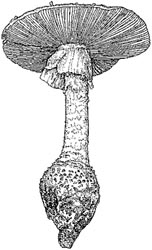
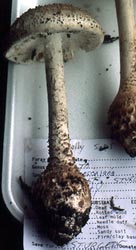
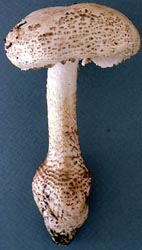
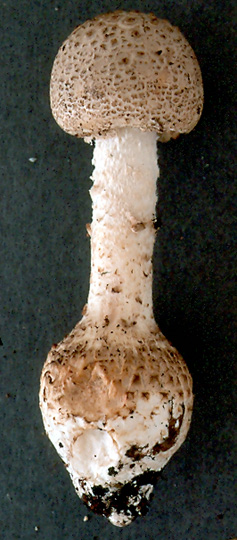
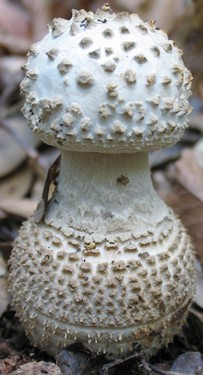
75 - 121 mm wide, white or whitish to sordid white (especially over disc), changing to brownish brick color when wounded, convex with low broad umbo to plano-convex, dry or very slightly tacky, shiny; context white, unchanging when cut or bruised, 5 - 10 mm thick over stipe, evenly to margin; margin nonstriate, decurved, appendiculate with soft brownish gray material (sometimes as relatively large rectangular fragments) and white flocculence; universal veil as regularly distributed small and crumblike or more or less pyramidal warts, pale gray at first, then brownish gray to mouse gray, tending to more reddish brown with age, 1 - 3 mm high, pulverulent to floccose, detersile, verruculose (lens). |
| lamellae |
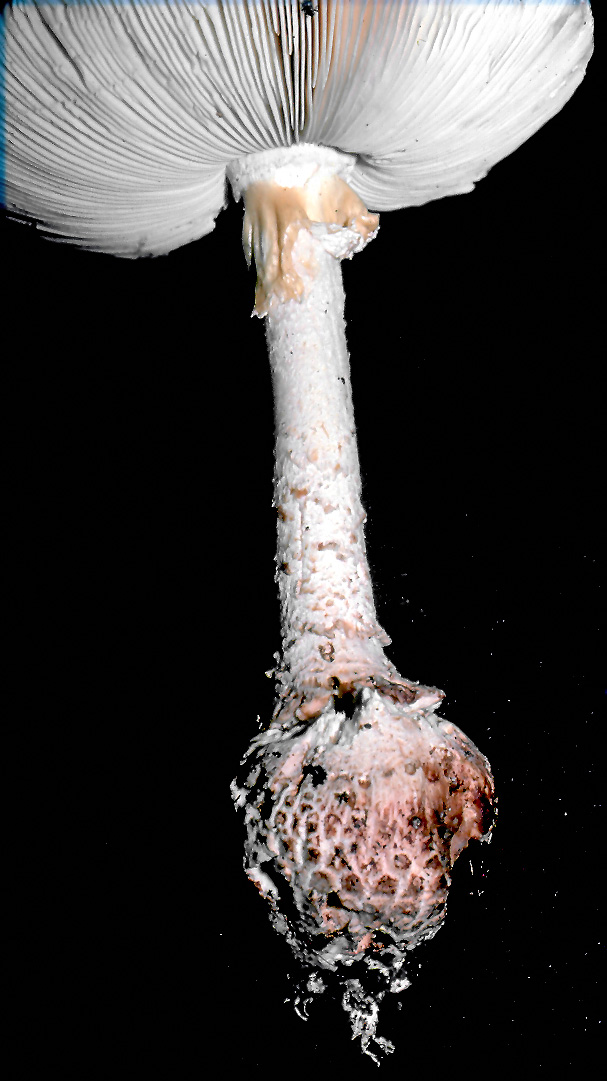
free to narrowly adnate to adnate without decurrent line on stipe, crowded to subcrowded to close to subdistant, white to creamy white in mass, white to creamy white in side view, unchanging when cut or bruised, 5 - 8 mm broad, broadest at mid-radius and of relatively constant breadth from this point to near margin, not forking, with smooth edge; lamellulae rounded truncate to subtruncate, of diverse lengths, plentiful, occasionally adjacent neither to stipe nor to pileus margin. |
| stipe |
40 - 105 × 16 - 20 mm, off-white to somewhat creamy, unchanging when cut or bruised or bruising brick color with handling, narrowing toward midpoint, decorated with brownish gray floccose material at least in upper portion, either with similar decoration below or coarsely fibrillose below (with fibrils becoming dark brown from handling); bulb 50 - 65 × 28 - 40 mm, napiform to elongate-napiform, radicating, at least sometimes completely submerged in substrate, with white mycelial threads at very base; context solid or with soft stuffing or hollow in part, white, unchanging when cut or bruised or becoming pinkish quickly in top of bulb and in mid-stipe, pale brick color in old wounds, with larva tunnels concolorous or faintly brownish; partial veil apical to subapical, white, striate above, with large grayish felted rectangular warts below margin, floccose on undersurface, submembranous, easily ruptured and then falling away in pieces or falling to supramedian position and appearing as brownish gray band adhering to stipe; universal veil as many small brownish gray to red-brown warts forming fine concentric rings (at least six) from top of bulb to at least midheight or broadest point of bulb, with uppermost warts largest (up to 2 mm wide) and often subpyramidal, not usually assocated with subtending recurved scales of bulb context. |
| odor/taste |
Odor “chloride of lime” or like chlorine bleach or disagreeable (Araujo s.n.). Taste lacking (Araujo s.n.). |
macrochemical
tests |
Spot test for tyrosinase (L-tyrosine) - slowly positive on surfaces of lower stipe and upper bulb (possibly in association with universal veil material in those areas) and in pileipellis. H2SO4 - negative on lamellae. KOH - negative on lamellae. NH4OH - negative on lamellae. Phenol - negative on lamellae. Test vouchers: Araujo s.n. and Tulloss 8-16-86-G. |
| pileipellis |
Bas (1969): filamentous hyphae (2-) 4 - 10 μm wide, interwoven to subradial, slightly to strongly gelatinized at surface, yellowish to yellow in alkaline solution. |
| lamella trama |
Bas (1969): bilateral; with diverging hyphae up to 20 μm wide; "hymenopodial cells up to 50 × 35 μm. |
| subhymenium |
Bas (1969): ramose to subcellular. |
| basidia |
Bas (1969): 40 - 60 × 9 - 13 μm, 4-sterigmate; clamps present. |
| universal veil |
Bas (1969): On pileus: dense tissue of erect elements, dingy yellow-brown in alkaline solution; filamentous hyphae rather scarce, ca. 4 - 8 μm wide; inflated cells in rather long chains, mainly subglobose to ellipsoid, also clavate and elongate, up to 70 × 45 μm; vascular hyphae scattered, abundant. |
| stipe context |
Bas (1969): longitudinally acrophysalidic; filamentous hyphae scattered; acrophysalides large, abundant. |
| lamella edge tissue |
Bas (1969): largely comprising abundant ellipsoid to clavate cells, 16 - 40 (-50) × 8 - 30 μm, sometimes in chains. |
| basidiospores |
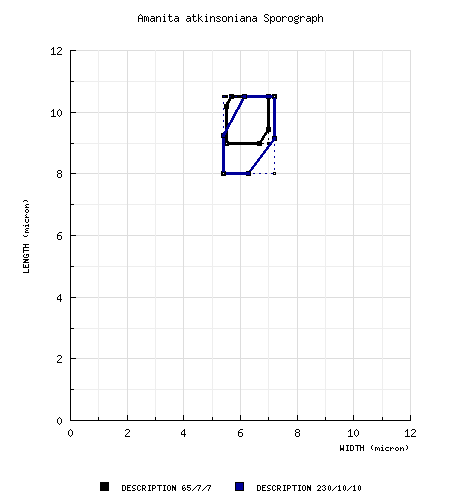
Bas (1969): [65/7/7] 9.0 - 10.5 (-12.5) × 5.5 - 7.0 (-8.0) μm, (Q = 1.35 - 1.85; Q = 1.45 - 1.70), colorless, hyaline, thin-walled, amyloid, ellipsoid to elongate; apiculus not described; contents multi-guttulate; white to pale cream in deposit.
composite of data from all material revised by RET: [230/10/10] (6.8-) 8.0 - 10.5 (-14.3) × (5.0-) 5.4 - 7.2 (-8.5) µm, (L = (8.2-) 9.0 - 9.7 µm; L’ = 9.2 µm; W = 5.7 - 6.6 (-6.9) µm; W’ = 6.2 µm; Q = (1.17-) 1.27 - 1.71 (-1.95); Q = 1.36 - 1.57 (-1.67); Q’ = 1.50), colorless, hyaline, colorless, thin-walled, smooth, amyloid, ellipsoid, occasionally broadly ellipsoid, occasionally elongate, infrequently lachrimiform, often at least somewhat adaxially flattened, infrequently swollen at one end; apiculus sublateral, cylindric, often proportionately small; contents granular to multiguttulate; white in deposit. |
| ecology |
Solitary. Canada: Pomerleau (1966, 1980) reports the northern limit of this taxa from the southern part of Prov. Québec, Canada. Michoacan edo., México: At 2090 m elev. In Pinus-Quercus forest (Araujo s.n.). Connecticut: In mixed deciduous foreset with Quercus spp., Fagus grandifolia, Castanea dentata, Betula, Acer, Sassafras, etc. Maine: In mixed woods under F. grandifolia and Abies balsamea. Massachusetts: In loamy soil of mixed woods or under Quercus and Pinus. North Carolina: In bare clayey loam with some leaf litter and little herbaceous growth on lower drainage area of gentle slope with Quercus phellos and Pinus taeda. West Virginia: ??. |
| material examined |
Bas (1969):
U.S.A.:
ALABAMA—Elmore Co. - unkn. loc.,
3.xii.1921 Burke (MICH).
MASSACHUSETTS—Franklin Co. - Mt. Toby,
25.viii.1963 C. Bas 3801 (L).
MICHIGAN—Oakland Co. - Highland
Recreation Area, Haven Hill Natural Area,
16.ix.1961 A. H. Smith 64290 (MICH), 23.ix.1961
A. H. SMith 64412 (MICH). Washtenaw Co. - Mill
Lk., 17.ix.1965 A. H. Smith 72631 (MICH; L);
Pinckney St. Recreation Area, 7.x.1961 A. H. Smith
64127 (MICH).
NORTH
CAROLINA—Orange Co. - Chapel Hill, Battle's
Pk., 14.ix.1913 W. C. Coker 759 p.p. (holotype,
NCU).
RET: MÉXICO:
MICHOACAN—Parq. Nac. "Insurgente José
Ma. Morelos," Mpio. Charo, 19.viii.1983 Reza
Araujo s.n. (FCME).
U.S.A.:
CONNECTICUT—Middlesex Co. - E. Haddam,
Devil's Hopyard St. Pk.
[41.4756° N/ 72.3403° W, 72 m], 25.ix.1999 Arnold s.n. [Tulloss 9-25-99-P] (RET 301-1); Meshomasic St. For., 19.ix.1998 Peter Kukle s.n. [Tulloss 9-19-98-A] (RET 288-2).
MAINE—Cumberland Co. -
Falmouth, 12.ix.1983 S. S.
Ristich s.n. [Tulloss 9-12-83-SSR1] (RET 208-3);
S. Windham, 25.viii.1984 S. S. Ristich s.n.
[Tulloss 8-25-84-SSR-A] (RET 235-6).
Knox Co. - Washington, ca. Camp
Medomak, off McDowell Rd., 10.vii.2008 Wm. Bakaitis
s.n. (RET 421-3). Washington Co. - Perry,
South Meadow Rd. [44.9790° N/ 67.1096° W, 24m],
18.viii.2013 Teresa Clements TAC195 [mushroomobserver
#143135
(RET 575-5, nrLSU seq'd.).
MASSACHUSETTS—Berkshire Co. - Pittsfield St. For., 16.viii.1986 Wes Faust s.n. [Tulloss 8-16-86-G] (RET 137-7). Worcester Co. - Worcester, Mill St. & Swan St., 26.viii.2012 Dr. Laszlo Nagy 5122 (RET 646-7, nrITS seq'd.).
NEW JERSEY—Morris Co. - Hacketstown Reservoir, 13.viii.1984 Robert Peabody & Roger Phillips s.n. [Tulloss 8-13-84-PPA] (RET 113-8).
NEW YORK—Dutchess Co. - Pine Plains, Thompson Pond Preserve [41°57’52” N/ 73°40’57” W, ca. 140-410 m elev.], 4.viii.1996 W. Bakaitis s.n. (NYS D1592). Queens Co. (Long Isl.) - Bethpage Pk., 30.vii.1982 A. Norarevian s.n. [Tulloss 7-30-82-AN1] (RET 215-6).
NORTH CAROLINA—Granville Co. - Butner, John Umstead Hospital picnic area, 18.xi.1994 Owen L. McConnell s.n. (RET 139-6). McDowell Co. - ca. Little Switzerland, Wildacres Resort [35.8246° N/ 82.1065° W, 971 m], 27.ix.2008 Jay Justice NC-AM12 (RET 445-1). Orange Co. - Chapel Hill, Battle's Pk., 14.ix.1913 W. C. Coker 759 p.p. (holotype, NCU).
TEXAS—Newton Co. - Bleakwood, Co. Rd. 3062, D. P. Lewis prop. [30°42.270 N/ 93°49.741 W, 30 m elev.], 20.xi.2012 Jay Justice TX-AM-2 (RET 502-5).
WEST VIRGINIA—Greenbrier Co. - Monongahela Nat. For., Lake Sherwood Recreation Area [38°00'24" N/ 80°06'40" W, 825 m], 31.viii.1982 R. E. Tulloss 8-31-82-D (RET 226-2). Tucker Co. - Dolly Sods, 1.viii.1985 W. Sturgeon s.n. [Tulloss 8-1-85-B] (RET 201-6).
[One additional NC collection in SFSU. The 9-12-83-SSR1 (1A84A) was supposed to have nearly black warts in the immature state and to have recurved scales on the bulb. Another questionable determination—7-30-82-AN1 (A782).] |
| discussion |
Bas (1969): "Because of the coloured volva A. atkinsoniana from eastern North America resembles A. onusta, which occurs in the same area, but A. atkinsoniana has a thinner volva breaking up earlier into smaller, more scattered warts which have more brownish and fewer greyish tinges than those in A. onusta. Moreover, its pileipellis shows a stronger tendency to gelatinize and under the microscope the cells of the volva are paler than in A. onusta and usually intermixed with more abundant oleiferous [vascular] elements. In addition the ring of A. atkinsoniana is more coherent and the base of the stem rarely rooting.
"Pale forms of A. atkinsoniana strongly resemble A. microlepis, also occurring in the same regions, but that species has a whitish to brownish cream or dingy cream cap with concolorous warts and greyish cream, dingy buff or ashy grey gills, whereas A. atkinsoniana has cream-white gills."
t.b.d.
This species was assigned to his stirps Microlepis by Bas (1969). Within that group, the present species is most similar to A. onusta and A. costaricensis.
The Bakaitis collection in NYS is immature. |
| citations |
—R. E. Tulloss |
| editors |
RET |
|


 Spore data sets and their composite