

| name | Amanita pseudogemmata |
| name status | nomen acceptum |
| author | Hongo |
| english name | "East Asian False Gemmed Amanita" |
| images |
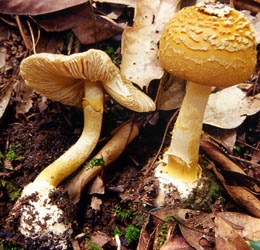 1. Amanita pseudogemmata, Yunnan Prov., China. 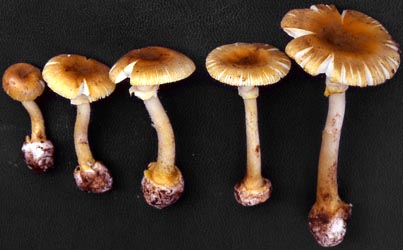  2. Amanita pseudogemmata, Yunnan Prov., China. |
| intro | The following is based on the original research of Zhu L. Yang. |
| cap | The fruiting bodies of A. pseudogemmata are small to medium-sized. The cap is 40-90 mm wide, convex to applanate, yellowish to pale yellow-brown, paler towards the margin; its margin is short-striate; it is covered with brownish grey to olivaceous brown verrucouse to farinose volval remnants. Its trama is white. |
| gills | The gills of this species are free, crowded, cream-colored; and the short gills are truncate, and of diverse lengths. |
| stem | The stem is 60 - 100 × 5 – 15 mm, subcylindrical to attenuate upwards; its surface is cream-colored to white, and covered with yellow to brownish yellow squamules; the stem''s basal bulb is 15 - 40 mm wide, limbate to subtruncate. The annulus is persistent, its upper surface is white and its lower surface, yellowish. |
| spores | Spores of A. pseudogemmata measure (6.0-) 7.0-9.5 (-10.5) × (5.5) 6.0-8.5 (-9.5) µm and are broadly ellipsoid to ellipsoid, and inamyloid. Clamps are not present at the bases of basidiae. |
| discussion |
Amanita pseudogemmata was originally described from Japan. It occurs in broad-leaved forests with fagaceous plants. It has been known from China and Japan. Amanita pseudogemmata is characterized by its yellowish to brownish yellow pileus with brownish grey to olivaceous brown verrucouse to farinose volval remnants; limbate to subtruncate basal bulb; inamyloid, broadly ellipsoid to ellipsoid spores; and the absence of clamps. The reader may wish to make comparison with A. gemmata (Fr.) Bertillon in Dechambre and A. orientigemmata> Zhu L. Yang & Yoshim. Doi. –- Zhu L. Yang |
| brief editors | RET |

 Spore data sets and their composite