
| name | Amanita orientigemmata |
| name status | nomen acceptum |
| author | Zhu L. Yang & Yoshim. Doi |
| english name | "East Asian Gemmed Amanita" |
| intro |
The original description of this species can be found in (Zhu L. Yang & Yochim. Doi, 1999). |
| cap |
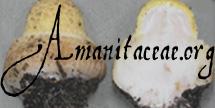
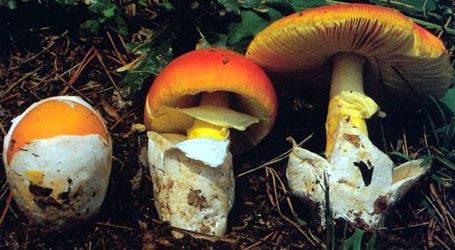
The fruiting bodies of A. orientigemmata are small to medium-sized. The cap is 50 - 100 mm wide, at first hemispherical, then becomes convex to plano-convex, occasionally slightly depressed at center, moderate greyish yellow to light yellow, and somewhat darker in the center. It is covered with felty, floccose patches or small subconical warts which are 1 - 4 mm wide, up to 1.5 mm high, and whitish. The cap's margin is short-striate and nonappendiculate. Its flesh is white. |
| gills |
The gills of this species are free, crowded, white to cream-colored; and the short gills are truncate and of diverse lengths. |
| stem |
The stem is 50 - 110 × 10 - 15 mm, subcylindric to attenuate upwards; its surface is whitish to white and covered with fibrillose squamules. The stem's basal bulb is 20 - 30 mm wide, ovate to subglobose; and its volva is short and appressed limbate or is a floccose, white to yellowish group of patches or warts near the bulb's apex. The annulus is white to yellowish, and often torn from the stem during expansion of the pileus. |
| spores |
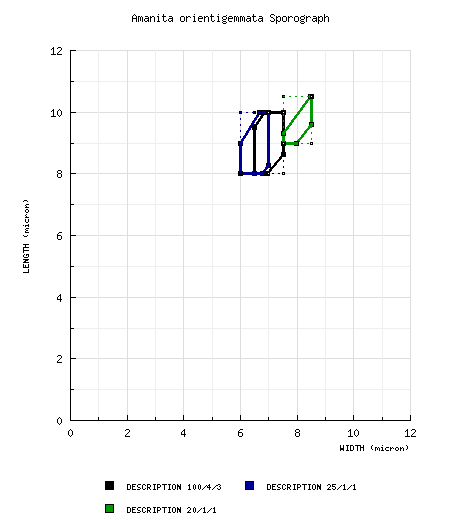
Spores of A. orientigemmata measure (7.5-) 8.0 - 10.0 (-11.0) x (6.0-) 6.5 - 7.5 (-8.0) µm and are broadly ellipsoid to ellipsoid and inamyloid. Clamps are present on the bases of basidia. |
| discussion |
Amanita orientigemmata occurs in mixed forests with broad-leaved trees and conifers. Its distribution range is from Japan to China. Amanita orientigemmata is characterized by its grayish yellow to light yellow pileus with whitish, felted volval patches or warts, inferior and fugacious annulus, limbate volva, inamyloid, broadly ellipsoid to ellipsoid spores, and the presence of basidial clamps. It differs from A. gemmata (Fr.) Bertillon in its presence of clamps, slightly smaller spores, and different structure of volval remnants on the cap. The volval remnants on cap of Amanita gemmata from Europe dominantly consist of irregularly to subradially arranged, filamentous hyphae, mixed with scattered to locally fairly abundant inflated cells. In Japan, the species was originally described from Fir-Chinkapin (Abies- |
| brief editors | RET |
| name | Amanita orientigemmata |
| author | ["orientogemmata"] Zhu L. Yang & Yoshim. Doi. 1999. Bull. Natl. Sci. Mus., Tokyo, Ser. B 25(3): 107, figs. 1-4. |
| name status | nomen acceptum |
| english name | "East Asian Gemmed Amanita" |
| MycoBank nos. | 459919 |
| GenBank nos. |
Due to delays in data processing at GenBank, some accession numbers may lead to unreleased (pending) pages.
These pages will eventually be made live, so try again later. |
| holotypes | TNS |
| intro |
The following text may make multiple use of each data field. The field may contain magenta text presenting data from a type study and/or revision of other original material cited in the protolog of the present taxon. Macroscopic descriptions in magenta are a combination of data from the protolog and additional observations made on the exiccata during revision of the cited original material. The same field may also contain black text, which is data from a revision of the present taxon (including non-type material and/or material not cited in the protolog). Paragraphs of black text will be labeled if further subdivision of this text is appropriate. Olive text indicates a specimen that has not been thoroughly examined (for example, for microscopic details) and marks other places in the text where data is missing or uncertain. The following material not directly from the protolog of the present taxon and not cited as the work of Dr. Z. L. Yang or another researcher is based on original research by R. E. Tulloss. NOTE: Spore measurements from papers by Z. L. Yang use his "Times New Roman" face for "Q" and "Q'"—respectively, " |
| basidiospores |
from the protolog: [100/4/3] (7.5-) 8.0 - 10.0 (-11.0) × (6.0-) 6.5 - 7.5 (-8.0) μm, ( from Yang et al. (2001): [25/1/1] (7.0-) 8.0 - 10.0 (-10.5) × (5.5-) 6.0 - 7.0 (-7.5) μm, ( from Yang (2002a): [20/1/1] (8.5-) 9.0 - 10.5 × 7.5 - 8.5 (-9.0) μm, ( |
| ecology | Solitary to gregarious. China: On soil in forest. Japan: In Abies-Castanopsis forest. |
| material examined |
from the protolog:
JAPAN:
HONSHU—Tottori Prefecture - Tottori City, Ôchidani [Pk.?], 8.ix.1979 E. & F. Nagasawa s.n. (paratype, TNS-F-198540), 9.ix.1979 E. & F. Nagasawa s.n. (paratype, TNS-F-198546), 12.ix.1979 E. & F. Nagasawa s.n. (holotype, TNS-F-198537). Yang et al. (2001): CHINA: HAINAN—Ledong Li Autonomous Co. - Jianfengling, 26.ix.1987 T. H. Li s.n. (HMIGD 12446a, as "Amanita bingensis" in Bi et al (1997)). Yang (2002a): CHINA: JILIN—Yanbian Korean Autonomous Prefecture - Antu Co., Mt. Changbai, s.d. Y. Wang 811333 (IFP). Zhang et al. (2004) voucher for sequencing: CHINA: YUNNAN—Unkn. loc., s.d. unkn. coll. s.n. (HKAS 38345). |
| citations | —Z. L. Yang and R. E. Tulloss |
| editors | RET |
Information to support the viewer in reading the content of "technical" tabs can be found here.
| name | Amanita orientigemmata |
| bottom links | [ Keys & Checklists ] |
| name | Amanita orientigemmata |
| bottom links | [ Keys & Checklists ] |
 Spore data sets and their composite
Each spore data set is intended to comprise a set of measurements from a single specimen made by a single observer; and explanations prepared for this site talk about specimen-observer pairs associated with each data set. Combining more data into a single data set is non-optimal because it obscures observer differences (which may be valuable for instructional purposes, for example) and may obscure instances in which a single collection inadvertently contains a mixture of taxa.

Text and User-Generated Sporographs are published under the Creative Commons License.

In the case of a taxon page, image credits are on the 'image' tab.