
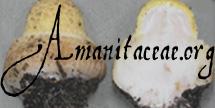

| name | Amanita aporema |
| name status | nomen acceptum |
| author | Boedijn |
| english name | "Sumatran Mystery Caesar" |
| intro |
The following description is based on the original description by Boedijn (1951). |
| cap |
The cap of A. aporema is 80 - 140 mm wide, plano-convex, red-brown, paler towards the margin, smooth, with a sulcate-striate margin (striations extend nearly half the radius of the cap). The flesh is white, 5- 8 mm thick over the stem, rapidly thinning towards the margin. |
| gills |
The gills are free, dirty white, and 7 - 11 mm broad in the middle. |
| stem |
The stem is 120 - 200 × 12 - 20 mm, narrowing upward, hollow, dirty white, and smooth. The central cylinder of the stem is 8 - 14 mm wide. The saccate volva is large, 40 - 60 x× 25 - 35 mm. |
| spores |
The spores measure 9 -12.5 µm in diameter and are globose. Zhu L. Yang's examination of the type (Yang et al. 2004) yields the following measurements: (9.0-) 9.5 - 11.0 (-12.5) × (8.0-) 8.5 - 10.5 (-12.0) µm and are globose to subglobose and inamyloid. Clamps are present at bases of basidia. |
| discussion |
This species was originally described from Sumatra. Its natural habitat is unknown. Yang observed (Yang et al. 2004) that due to the plentiful clamps in the fruiting body, Amanita aporema is more closely related to A. princeps Corner & Bas than to similar exannulate species in section Vaginatae. Because the holotype is preserved in alcohol and because tissue so preserved tends to shrink, the spore measurements provided by Yang may be smaller than those that are found in fresh material, dried material, or material preserved in a formaldehyde-alcohol solution. Given the above and the fact that macroscopic colors, dimensions, and spore measurements and shape are so similar in the two species, also given that Boedijn never saw A. aporema fresh and based his description on a twenty-six year-old specimen preserved in alcohol that Yang reports to be presently in poor condition, it is possible that A. princeps is a synonym of A. aporema. However, this may be unprovable given the existing material.—R. E. Tulloss and L. Possiel |
| brief editors | RET |
| name | Amanita aporema | ||||||||||||||||||||
| author | Boedijn 1951. Sydowia 5: 319, fig. 2(2). | ||||||||||||||||||||
| name status | nomen acceptum | ||||||||||||||||||||
| english name | "Sumatran Mystery Caesar" | ||||||||||||||||||||
| MycoBank nos. | 292441 | ||||||||||||||||||||
| GenBank nos. |
Due to delays in data processing at GenBank, some accession numbers may lead to unreleased (pending) pages.
These pages will eventually be made live, so try again later. Search:
Showing 0 to 0 of 0 entries | ||||||||||||||||||||
| holotypes | BO (implicit, in liquid) | ||||||||||||||||||||
| intro |
The following text may make multiple use of each data field. The field may contain magenta text presenting data from a type study and/or revision of other original material cited in the protolog of the present taxon. Macroscopic descriptions in magenta are a combination of data from the protolog and additional observations made on the exiccata during revision of the cited original material. The same field may also contain black text, which is data from a revision of the present taxon (including non-type material and/or material not cited in the protolog). Paragraphs of black text will be labeled if further subdivision of this text is appropriate. Olive text indicates a specimen that has not been thoroughly examined (for example, for microscopic details) and marks other places in the text where data is missing or uncertain. The following material not directly from the protolog of the present taxon and not cited as the work of Dr. Z. L. Yang or another researcher is based upon original research by R. E. Tulloss. NOTE: Spore measurements from papers by Z. L. Yang use his "Times New Roman" face for "Q" and "Q'"—respectively, " from revision of type in Yang, Weiss & Oberwinkler (2004): "...clamps are common in all parts of the fruit body." The authors also cite the basidiome of the holotype as "poorly preserved." | ||||||||||||||||||||
| basidiospores |
from revision of type in Yang, Weiss & Oberwinkler (2004): [35/1/1] (9.0-) 9.5 - 11.0 (-12.5) × (8.0-) 8.5 - 10.5 (-12.0) µm, ( | ||||||||||||||||||||
| material examined | from revision of type in Yang, Weiss & Oberwinkler (2004): INDONESIA: SUMATRA—Batang Paleopoeh, vii.1924 E. Jacobson s.n. (holotype, BO). | ||||||||||||||||||||
| discussion |
With regard to placement of the present species in Amanita sect. Caesareae we cite the following from (Yang et al. 2004): "In the protolog of A. aporema Boedijn, a poorly known species described from Indonesia, it was supposed that A. aporema may be confused with A. fulva (Boedijn 1951: 320). We have studied the only specimen cited by Boedijn under A. aporema [Indonesia, Sumatra, Batang Paleopoeh, exact day unknown. vii. 1924, E. Jacobson s.n., holotype (BO)] It reveals that the basidiospores are inamyloid, [35/1/1] (9.0–)9.5–11.0(–12.5) × (8.0–)8.5–10.5(–12.0) µm [Q = (1.0–)1.02–1.11 (–1.15), Q = 1.08 ± 0.04], and clamps are very common in all parts of the fruitbody. These data indicate that A. aporema is more closely related to A. princeps Corner et Bas, than to A. fulva and its allies. Based on the original description and examination of the poorly preserved holotype, it appears that A. aporema differs from A. orientifulva [a species of section Vaginatae] at least by its dirty white, smooth stipe, smaller basidiospores, and the presence of clamps." | ||||||||||||||||||||
| citations | —Z.-L. Yang & R. E. Tulloss | ||||||||||||||||||||
| editors | RET | ||||||||||||||||||||
Information to support the viewer in reading the content of "technical" tabs can be found here.
| name | Amanita aporema |
| bottom links | [ Keys & Checklists ] |
| name | Amanita aporema |
| bottom links | [ Keys & Checklists ] |
 Spore data sets and their composite
Each spore data set is intended to comprise a set of measurements from a single specimen made by a single observer; and explanations prepared for this site talk about specimen-observer pairs associated with each data set. Combining more data into a single data set is non-optimal because it obscures observer differences (which may be valuable for instructional purposes, for example) and may obscure instances in which a single collection inadvertently contains a mixture of taxa.
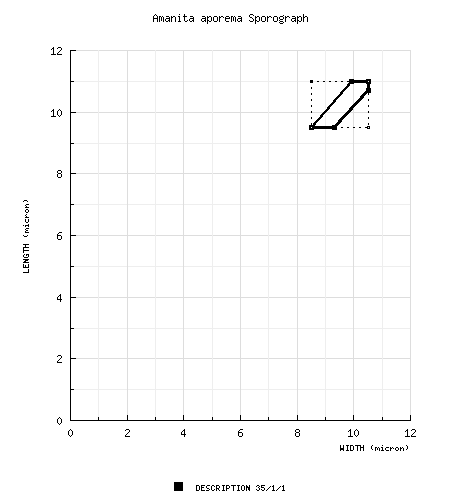

Text and User-Generated Sporographs are published under the Creative Commons License.

In the case of a taxon page, image credits are on the 'image' tab.