
| name | Amanita pegleri |
| name status | nomen provisorum |
| author | Tulloss |
| english name | "Pegler's Lepidella" |
| cap |
The cap of Amanita pegleri is 40 - 50 mm wide, conico-convex to plano-convex to planar, white to whitish ochraceous, dry, with a nonstriate and appendiculate margin. The volva is present as dense covering of small, granulose to pyramidal warts. The flesh is white and soft. |
| gills |
Gills are adnexed to free but not distant from the stem, subcrowded, very pale ochraceous, sometimes with pinkish tints, 4 - 5 mm broad. The short gills are of diverse lengths, with the shorter ones truncate and longer ones attenuate. |
| stem |
The stem is 70 - 80 × 4 - 8 mm, pure white, and cylindric. There is no bulb on the stem, but the stem base is deeply inserted (30 mm more) into the soil. The ring is white, superior, narrow, thin, membranous, fragile, loosely attached to stem, with a toothed margin. The volva only appears as scattered, fibrillose squamules, white. The flesh is solid. |
| odor/taste |
The odor is not distinctive when fresh and is sweet and unpleasant like dried specimens of Amanita nauseosa (Wakef.) D. A. Reid in dried material. |
| spores |
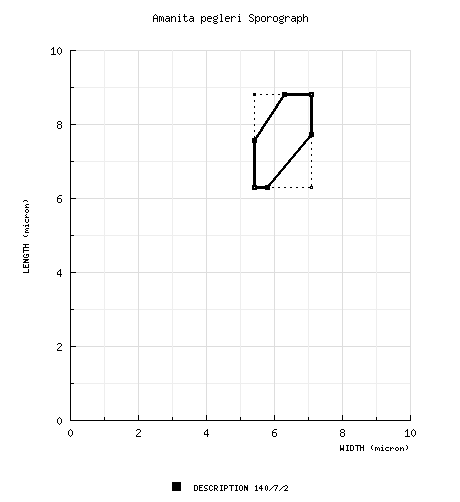
The spores measure (6.2-) 6.3 - 8.8 (-11.2) × (5.0-) 5.4 - 7.1 (-8.4) µm and are subglobose to broadly ellipsoid to ellipsoid and amyloid. Clamps are present at bases of basidia. |
| discussion |
This species is known only from Martinique in "secondary mesophytic forest." The present species is assignable to Bas' stirps Vittadinii
because of the presence of clamps, the shape of the spores, and the
scant remnants of volva on the stem. Within the stirps, A. pegleri belongs
with a group having certain spore size and shape and with a deeply
radicating stem rather than a distinct bulb. The most similar species is
A. lilloi Singer which can be separated by a number of microscopic characters, by having
a relatively thick and double-edged ring on its stem, and by having a strong odor of "chloride of lime" in fresh material. |
| brief editors | RET |
| name | Amanita pegleri | ||||||||||||||||||||
| author | Tulloss | ||||||||||||||||||||
| name status | nomen provisorum | ||||||||||||||||||||
| english name | "Pegler's Lepidella" | ||||||||||||||||||||
| synonyms |
=Amanita lilloi sensu Pegler, 1978. Kew Bull., Add. Ser. 9: 291, fig. 52h-k, pl. 7B. non Amanita lilloi Singer in Singer & Digilio, 1952 ["1951"]. Lilloa 25: 245. The editors of this site owe a great debt to Dr. Cornelis Bas whose famous cigar box files of Amanita nomenclatural information gathered over three or more decades were made available to RET for computerization and make up the lion's share of the nomenclatural information presented on this site. | ||||||||||||||||||||
| etymology | in honor of Dr. David N. Pegler | ||||||||||||||||||||
| GenBank nos. |
Due to delays in data processing at GenBank, some accession numbers may lead to unreleased (pending) pages.
These pages will eventually be made live, so try again later. Search:
Showing 0 to 0 of 0 entries | ||||||||||||||||||||
| holotypes | K [provisional] | ||||||||||||||||||||
| intro | based on research of RET | ||||||||||||||||||||
| pileus | 40–50 mm wide, conico-convex to plano-convex to planar, white to whitish ochraceous, dry; context white, soft, "pubescent"; margin nonstriate, appendiculate; universal veil as dense covering of small, granulose to pyramidal warts. | ||||||||||||||||||||
| lamellae | adnexed to free, but not remote, subcrowded, very pale ochraceous, sometimes with pinkish tints, 4–5 mm broad; lamellulae of diverse lengths, with shorter ones truncate and longer ones attenuate. | ||||||||||||||||||||
| stipe | 70–80 × 4–8 mm, pure white, cylindric; bulb lacking, with stipe base deeply inserted (30 mm or more) in substrate; context solid; partial veil white, superior, narrow, thin, membranous, fragile, with denticulate margin, loosely attached to stipe; universal veil as scattered, fibrillose squamules, white. | ||||||||||||||||||||
| odor/taste | Odor not distinctive when fresh, sweet and unpleasant in exsiccata (like exsiccata of A. nauseosa). Taste not recorded. | ||||||||||||||||||||
| macrochemical tests |
none recorded. | ||||||||||||||||||||
| pileipellis | not well developed, as region dense with hyphae and intergrading with universal veil, above, and pileus context, below. | ||||||||||||||||||||
| pileus context | filamentous, undifferentiated hyphae 1.8–5.6 µm wide, branching, often in fascicles loosely interwoven with inflated cells, some with yellow subrefractive walls (always associated with yellow-walled clamps); acrophysalides dominating, clavate to narrowly clavate to subfusiform to ovoid to broadly clavate to ellipsoid, up to 70 × 35 µm (or larger?), thin-walled; vascular hyphae not observed. | ||||||||||||||||||||
| lamella trama | bilateral, with central stratum rehydrating moderately well in material examined, with all elements thin-walled, with subhymenial base comprising inflated cells [ellipsoid (up to 45 × 15.0 µm) to ovoid to clavate (e.g., 32 × 18.0 µm, many with an angle of divergence of about 45°) to subpyriform to subglobose] arising from hyphae of the central stratum and taking on a steep angle with relation to the central stratum regardless of angle of divergence of originating hypha], occasionally also including hyphal segments (e.g., 9.1–10.5 µm wide, not visible in all mounts) curving smoothly away from central stratum at rather shallow angle; wcs = 30–50 µm; filamentous, undifferentiated hyphae 1.5–4.2 µm wide, with plentiful intercalary cells [narrowly fusiform to fusiform to clavate (largest seen 36 × 13.3 µm)]; terminal, inflated cells not observed; vascular hyphae not observed; clamps observed at base of subhymenial tree. | ||||||||||||||||||||
| subhymenium | rehydrating very well in material examined; wst-near = 15–30 µm; wst-far = 30–45 µm; a branching structure dominated by inflated cells, but with some uninflated branching hyphae, with basidia arising two to three (occasionally up to five) cells from the central stratum (from very small ovoid cells or larger inflated cells of the second rank from central stratum or from partially inflated subclavate or irregular cells of the third or greater rank from central stratum or, occasionally, from an uninflated hyphal segment). | ||||||||||||||||||||
| basidia | 18–43 × 5.6–10.5 µm, but often not reliably measurable in material reviewed, apparently collapsing soon after spores mature, almost always collapsed after spores liberated or when attached spores mature, 4-sterigmate; some basidioles having yellow, imperfectly transparent wall; clamps present. | ||||||||||||||||||||
| universal veil | On pileus: almost entirely with periclinal orientation, but with occasional tufts of elements just at upper surface taking on anticlinal orientation, partially gelatinized at surface; filamentous, undifferentiated hyphae 1.4–4.1 µm wide, branching, relatively scarce; inflated cells dissociated and in chains, dominating, subfusiform to fusiform to subcylindric to clavate, up to 210 × 51 µm, with walls slightly thickened (up to 0.5 µm thick), hyaline and colorless; vascular hyphae not observed; clamps present. On stipe: scant, as very small (those seen less than 150 µm long) squamules of extensively gelatinized tissue like that on pileus. | ||||||||||||||||||||
| stipe context | longitudinally acrophysalidic; filamentous, undifferentiated hyphae 1.5–10.4 µm wide, branching, plentiful, with those of largest diameter often having walls up to 0.5+ µm thick, with some having yellowish subrefractive walls (these up to 8.4 µm wide); acrophysalides plentiful, up to 247 × 29 µm, thin-walled or with slightly thickened walls or with walls up to 0.9 µm thick (quite commonly), with about one-third of acrophysalides arising from an intercalary inflated hyphal segment similar in shape to an acrophysalide, with an occasional acrophysalide appearing dissociated; vascular hyphae not observed (although one hypha interpreted as "yellow-walled" tangled as sometimes seen in vascular hyphae); clamps common, often prominent. | ||||||||||||||||||||
| partial veil | filamentous, undifferentiated hyphae 2.1–7.8 µm wide, branching, often in subradially oriented fascicles connected by loosely interwoven hyphae, partially gelatinized at upper surface, with intercalary clavate segments up to 18.9 µm wide; terminal inflated cells occasional, clavate, e.g. 21 × 8.4 µm; vascular hyphae not observed; clamps plentiful. | ||||||||||||||||||||
| lamella edge tissue | sterile. | ||||||||||||||||||||
| basidiospores | [140/7/2] (6.2–) 6.3–8.8 (–11.2) × (5.0–) 5.4–7.1 (–8.4) µm, (L = 7.0–8.1 µm; L’ = 7.7 µm; W = 5.5–6.8 µm; W’ = 6.2 µm; Q = (1.08–) 1.09–1.40 (–1.56); Q = 1.19–1.32; Q’ = 1.24), hyaline, colorless, thin-walled, smooth, amyloid, subglobose to broadly ellipsoid to ellipsoid, sometimes adaxially flattened; apiculus sublateral, cylindric; contents monoguttulate with additional granules or one or two "oil drops"; color in deposit not recorded. | ||||||||||||||||||||
| ecology | In secondary, mesophytic forest. | ||||||||||||||||||||
| material examined | MARTINIQUE: Anse à Voile, 9.vii.1975 J.-P. Fiard 543A (K) & 544A (K) | ||||||||||||||||||||
| discussion |
Pegler keyed this entity to A. lilloi in Bas’ (1969) key. However, the lamella trama is quite different in the two species. That of A. lilloi was drawn in detail based on examination of the holotype by Bas (1969: 359, fig. 51). In this illustration the subhymenium (comprising rather small cells) is widely separated from the central stratum by occasionally anastomosing, cylindric to narrowly clavate cells which make a broad curve away from the central stratum. Inclusive of these latter cells, the basidia arise from cells at least four ranks away from the central stratum. From Bas’ figure, I estimate wst-near = 85–90 µm for A. lilloi. Bas describes the warts as separated into two layers, with broader cells in the uppermost part having an anticlinal ordering that is not present among thinner, interwoven cells below. The cells of the tufts described for A. pegleri (above) are as slender as those of the lower parts of the A. pegleri volva, which apparently is continuous over all parts of the pilei that were examined. The partial veil of A. lilloi is thick and double-edged, and Bas (1969) says A. lilloi smells "strongly like 'chloride of lime.'" Amanita pegleri can be assigned to Bas’ stirps Vittadinii because of the presence of basidial clamps, the spores with Q fitting Bas’ (1969) definition of broadly ellipsoid, and (in contrast to stirps Nauseosa) only scattered, scant remains of universal veil on the stipe. Within the stirps, the present species belongs to the group with 95% or more of spores less than 9.5 µm long, with Q rarely > 1.45, and with the deeply radicating stipe lacking a distinct bulb. The most similar species in stirps Vittadinii is A. lilloi. | ||||||||||||||||||||
| citations | —R. E. Tulloss | ||||||||||||||||||||
| editors | RET | ||||||||||||||||||||
Information to support the viewer in reading the content of "technical" tabs can be found here.
 Spore data sets and their composite
Each spore data set is intended to comprise a set of measurements from a single specimen made by a single observer; and explanations prepared for this site talk about specimen-observer pairs associated with each data set. Combining more data into a single data set is non-optimal because it obscures observer differences (which may be valuable for instructional purposes, for example) and may obscure instances in which a single collection inadvertently contains a mixture of taxa.

Text and User-Generated Sporographs are published under the Creative Commons License.

In the case of a taxon page, image credits are on the 'image' tab.