

| name | Amanita lilloi |
| name status | nomen acceptum |
| author | Singer In Singer & Digilio |
| english name | "Lillo's Lepidella" |
| images |
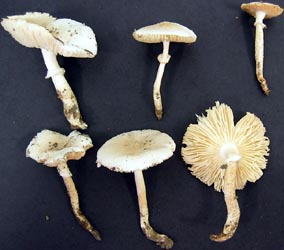  1. Amanita lilloi, Pernambuco St., Brazil. 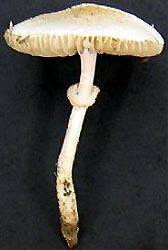 2. Amanita lilloi, Pernambuco St., Brazil. 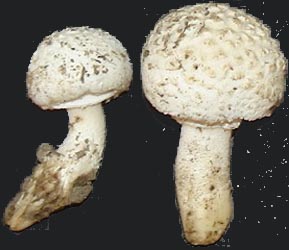 3. Amanita lilloi, Pernambuco St., Brazil. 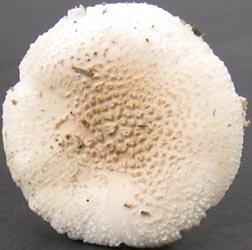 4. Amanita lilloi, Pernambuco St., Brazil. |
| intro | This description is based on Bas' revision (1969) and the recent revision by Wartchow et al. (2007). |
| cap | The cap of Amanita lilloi is (14-) 20 - 95 mm wide, white or somewhat light beige, subglobose or hemispheric to convex-applanate then plano-concave, dry, appendiculate, nonsulcate and nonstriate margin. The volva is present as floccose, subpyramidal to pyramidal warts and squamules, white then cream or yellow ochre or beige, up to 2 mm high in young specimens, densely covering the cap, later becoming subverrucose and scarce in mature specimens, then concentrated mainly over the center. The flesh is up to 5 mm thick above the stem, thinning towards the margin, white, and unchanging. |
| gills | The gills are rather close to crowded, adnexed to nearly free, moderately broad, up to 6 mm broad, white then cream-colored or pale yellowish cream to pale cream, and pale ochraceous after drying. The short gills are attenuate to subtruncate and evenly distributed. |
| stem | The stem is (16-) 23 - 60 × (2-) 4 - 16 mm, cylindric above the soil, white, in some specimens below the ring, the stem is densely covered with erect to recurved floccose warts, scales, or squamules. The bulb is radicating, 10 - 20 × 2 - 9 mm, fusiform then attenuate, with a 35 - 60 mm long tapering root in the soil. The ring is white, moderately thick, with verrucose white squamules on the margin of the lower surface, superior, occasionally deciduous, rather persistent and has a thickened margin. The volva is present as scattered remnants over the surface. The flesh is white, unchanging, and solid. |
| odor/taste | The odor is unpleasant and strongly of "chloride of lime" per Singer (Singer & Digilio 1951). |
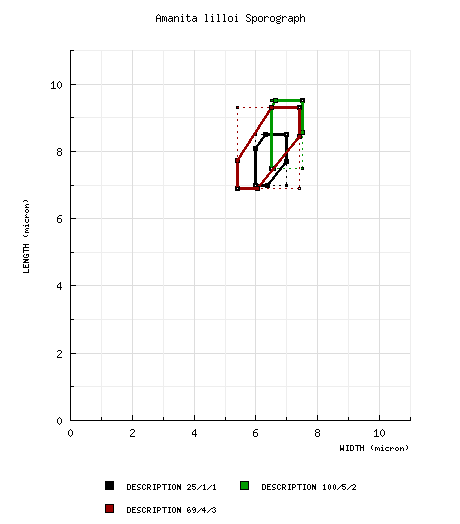
| spores | The spores measure by Bas (1969)were (6.5-) 7 - 8.5 × (5.5-) 6 - 7 (-7.5) µm, amyloid, and subglobose to broadly ellipsoid. Clamps are present at bases of basidia. RET's measurements of spores from material reviewed by Singer and located in the herbarium at Buenos Aires are as follows: (6.5-) 6.7 - 9.0 (-10.5) × 5.0 - 7.0 (-8.0) µm. The material was collected between 1949 and 1951 and is not in good condition, many of the spores are damaged and were not measurable. Measurements according to Wartchow et al. (from recently collected Brazilian specimens) are as follows: (7-) 7.5 - 9.5 (10.5) × (6-) 6.5 - 7.7 (-8.2) µm. These spores are subglobose to broadly ellipsoid to ellipsoid. |
| discussion |
Singer described this species from Argentina, where the type was collected in a garden. Experience with other amanitas found in gardens in South America (e.g., A. singeri Bas) indicate that the species might not be a native one; however, other collections of the present species have been made in open pampas. It is not known whether the Brazilian site (a university campus' lawn) for A. lilloi (a university campus' lawn) is the result of introduction during landscaping or is within the natural range of the species. The only woody plant in the lawn that was near the collecting site was a fig (Ficus). A report of A. lilloi from the Caribbean has proven to involve a misdetermination. Bas placed the present species in his stirps Vittadinii.—R. E. Tulloss and F. Wartchow |
| brief editors | RET |

 Spore data sets and their composite