
| name | Amanita parva |
| name status | nomen acceptum |
| author | (Murrill) Murrill |
| english name | "Smaller Limbed-Lepidella" |
| intro |
This description is largely taken from that of Bas (1969). |
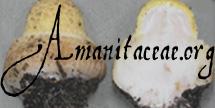
| cap | The cap of Amanita parva is roughly 30 mm wide, convex to plano-convex, white, subviscid, with a nonsulcate margin and (at least sometimes) a projecting sterile rim. The cap is scattered with some very thin, poorly delimited, white, crust-like patches or only some subpulverulent remnants of volva at the center. |
| gills | The gills are rather crowded, adnate or just reaching the stem, relatively broad, and pallid. The short gills are truncate, obliquely truncate, rounded, or subattenuate. |
| stem | The stem is about 50 - 60 × 5 mm, subcylindrical, with a narrow, submembranous volval rim on the top of the bulb. |
| spores | The spores measure (9.2-) 11.2 - 14.0 (-17.1) × (4.7-) 4.9 - 6.0 (-8.6) µm and are amyloid and elongate to cylindric. Clamps are present at bases of basidia. [Note: The clamps are rather thin-walled and can be difficult to see. Definitely use a cell wall stain, and look for the "wedge-" or "V-"shaped lines that mark the interfaces of the clamp to the side of a basidium and to the cell from which the basidium arises.] |
| discussion |
The species was originally described from Florida in association with oak. It has recently
been recollected near Tallahassee. In recent years a solitary specimen of A. parva was found
in the sandy pine-oak barrens of New Jersey. Bas placed A. parva in his stirps Limbatula (see A. limbatula Bas) and noted that it was separated from A. praelongispora (Murrill) Murrill largely because of the unusual sterile rim on the cap margin.—R. E. Tulloss |
| brief editors | RET |
| name | Amanita parva | ||||||||||||||||||||
| author | (Murrill) Murrill. 1945b [“1944”]. Proc. Florida Acad. Sci. 7: 127. | ||||||||||||||||||||
| name status | nomen acceptum | ||||||||||||||||||||
| english name | "Smaller Limbed-Lepidella" | ||||||||||||||||||||
| synonyms |
≡Venenarius parvus Murrill. 1945b [“1944”]. Proc. Florida Acad. Sci. 7: 114. The editors of this site owe a great debt to Dr. Cornelis Bas whose famous cigar box files of Amanita nomenclatural information gathered over three or more decades were made available to RET for computerization and make up the lion's share of the nomenclatural information presented on this site. | ||||||||||||||||||||
| MycoBank nos. | 284066, 291949 | ||||||||||||||||||||
| GenBank nos. |
Due to delays in data processing at GenBank, some accession numbers may lead to unreleased (pending) pages.
These pages will eventually be made live, so try again later. Search:
Showing 0 to 0 of 0 entries | ||||||||||||||||||||
| holotypes | FLAS | ||||||||||||||||||||
| type studies | Jenkins. 1979. Mycotaxon 10: 185. | ||||||||||||||||||||
| revisions |
Bas. 1969. Persoonia 5: 534, figs. 321-324. Tulloss, here. | ||||||||||||||||||||
| intro |
The following text may make multiple use of each data field. The field may contain magenta text presenting data from a type study and/or revision of other original material cited in the protolog of the present taxon. Macroscopic descriptions in magenta are a combination of data from the protolog and additional observations made on the exiccata during revision of the cited original material. The same field may also contain black text, which is data from a revision of the present taxon (including non-type material and/or material not cited in the protolog). Paragraphs of black text will be labeled if further subdivision of this text is appropriate. Olive text indicates a specimen that has not been thoroughly examined (for example, for microscopic details) and marks other places in the text where data is missing or uncertain. The text below is based on the revision of Bas (1969), the work of other authors as cited, and original research of R. E. Tulloss. | ||||||||||||||||||||
| pileus | 55± mm diam., snow white, convex; context white, 0.8 mm thick at stipe, thinning evenly to margin; margin nonstriate, appendiculate, with 1 mm sterile edge; universal veil white, variable from small scales to pulve-rulent-flocculose regions to very thin subverrucose patch to low subpyramidal warts. | ||||||||||||||||||||
| lamellae | adnate, some with a pronounced decurrent tooth, ??, off-white in side view compared to pileus context, drying grayish cream, with floccose edge; lamellulae rounded truncate (shortest) to attenuate. | ||||||||||||||||||||
| stipe | 67± × 12.5± mm, snow white, narrowing upward, flaring at apex, densely floccose; bulb 46± × 26± mm, fusiform; context white, firmly stuffed, with central cylinder 7± mm diam.; exannulate; universal veil as a brief limb, flimsy, submembranous, white, appressed to upper one third to one half of the bulb or only visible as raised ring on top of bulb in exsiccata. Bottom 69± mm of stipe and bulb buried in substrate. | ||||||||||||||||||||
| odor/taste | Odor indistinct. Taste not recorded. | ||||||||||||||||||||
| macrochemical tests |
none?? recorded. | ||||||||||||||||||||
| subhymenium | subcellular to subramose to inflated ramose, ??. | ||||||||||||||||||||
| basidia | 51 - 55 × 10.5 - 11.9 µm, 4-sterigmate, thin-walled; clamps and proliferated clamps rather common, thin-walled and somewhat difficult to view. | ||||||||||||||||||||
| stipe context | longitudinally acrophysalidic; ??; acrophysalides up to 288 × 45 µm, without incrustations; filamentous, ??. | ||||||||||||||||||||
| basidiospores |
Bas (1969): [40/2/1] 9.5 - 12.0 (-13.5) × 4.0 - 5.5 μm, (Q = 1.80 - 2.70 (-2.90); Q = 2.0 - 2.50), pale yellow, thin-walled, smooth, amyloid, elongate to cylindric; apiculus not described; contents subgranular, refractive; color in deposit not recorded. from type study of Jenkins (1979): [-/-/1] 10.2 - 10.9 × 4.7 - 5.5 μm, (Q = 1.85 - 2.32; Q' = 2.03), hyaline, thin-walled, amyloid, elongate to cylindric, often adaxially flattened; apiculus sublateral, truncate-conic to short cylindric; contents guttulate; color in deposit not recorded. composite of data from material revised by RET: [75/4/2] (9.2-) 11.2 - 14.0 (-17.1) × (4.7-) 4.9 - 6.0 (-8.6) µm, (L = 12.1 - 12.7 µm; L’ = 12.5 µm; W = 5.3 - 5.5 µm; W’ = 5.4 µm; Q = (1.44-) 2.09 - 2.60 (-2.76); Q = 2.25 - 2.39; Q’ = 2.32), ??, amyloid, smooth, thin-walled, ??, elongate to cylindric, sometimes constricted, sometimes swollen at one end; apiculus sublateral, cylindric, small; contents guttulate??; white in deposit. | ||||||||||||||||||||
| ecology |
Bas (1969): Terrestrial under Quercus. Solitary to subgregarious. Florida: In sandy soil, associated with Quercus and (apparently) sometimes together with A. cf. limbatula. New Jersey: In sand of Pinus rigida-Quercus barrens. | ||||||||||||||||||||
| material examined |
Bas (1969):
U.S.A.:
FLORIDA—Alachua Co. - Gainesville, 21.vi.1938 W. A. Murrill F 17404 (holotype, FLAS). from type study of Jenkins (1979): U.S.A.: FLORIDA— Alachua Co. - Gainesville, 21.vi.1938 W. A. Murrill F 17404 (holotype, FLAS). U.S.A.: FLORIDA—Leon Co. - Tallahassee, prop. J.B. Hawkins & Rhoden Cove Landing, 15.vii.2007 J. B. Hawkins s.n. [RET 7-15-07-A2] (RET 409-1). NEW JERSEY—Middlesex Co. - Jamesburg Twp., Jamesburg Twp. Pk., ca. Helmetta [40°23’07” N/ 74°25’48” W], 1.viii.1983 A. Norarevian & David Patterson 8-1-82-AN3 (RET 022-8). | ||||||||||||||||||||
| citations | —R. E. Tulloss | ||||||||||||||||||||
| editors | RET | ||||||||||||||||||||
Information to support the viewer in reading the content of "technical" tabs can be found here.
| name | Amanita parva |
| bottom links |
[ Section Lepidella page. ]
[ Amanita Studies home. ]
[ Keys & Checklists ] |
| name | Amanita parva |
| bottom links |
[ Section Lepidella page. ]
[ Amanita Studies home. ]
[ Keys & Checklists ] |
 Spore data sets and their composite
Each spore data set is intended to comprise a set of measurements from a single specimen made by a single observer; and explanations prepared for this site talk about specimen-observer pairs associated with each data set. Combining more data into a single data set is non-optimal because it obscures observer differences (which may be valuable for instructional purposes, for example) and may obscure instances in which a single collection inadvertently contains a mixture of taxa.
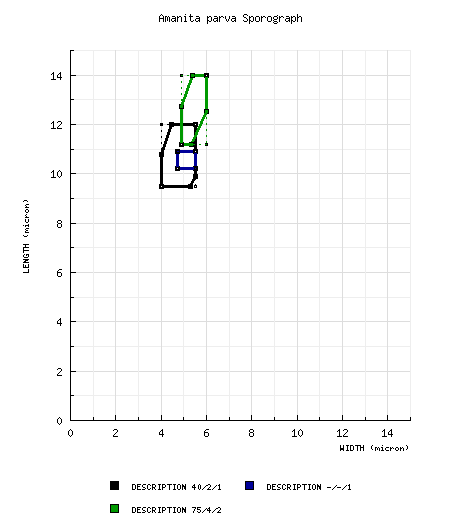

Text and User-Generated Sporographs are published under the Creative Commons License.

In the case of a taxon page, image credits are on the 'image' tab.