| name |
Amanita praelongispora |
| author |
(Murrill) Murrill. 1941. Mycologia 33: 448. |
| name status |
nomen acceptum |
| english name |
"Long-Spored Limbed-Lepidella" |
| synonyms |
≡ Venenarius praelongisporus Murrill. 1941. Mycologia 33: 434.
The editors of this site owe a great debt to Dr. Cornelis Bas
whose famous cigar box files of Amanita nomenclatural information
gathered over three or more decades were made available to RET for computerization
and make up the lion's share of the nomenclatural information presented on this site.
|
| MycoBank nos. |
284069, 291950 |
| GenBank nos. |
Due to delays in data processing at GenBank, some accession numbers may lead to unreleased (pending) pages.
These pages will eventually be made live, so try again later.
|
| holotypes |
FLAS |
| type studies |
Jenkins. 1979. Mycotaxon 10: 187. |
| revisions |
Bas. 1969. Persoonia 5: 532, figs. 325-329.
Tulloss, here. |
| intro |
The following text may make multiple use of each data field.
The field may contain magenta text presenting data from a type study
and/or revision of other original material cited in the protolog of the present taxon.
Macroscopic descriptions in magenta are a combination of data from the protolog and
additional observations made on the exiccata during revision of the cited original
material.
The same field may also contain black text, which is data from a revision of the present
taxon (including non-type material and/or material not cited in the protolog).
Paragraphs of black text will be labeled if further subdivision of
this text is appropriate.
Olive text indicates a specimen that has not been
thoroughly examined (for example, for microscopic details) and marks other places in the text
where data is missing or uncertain.
The following material is derived from the revision of Bas (1969) and original research of R. E. Tulloss. |
| pileus |
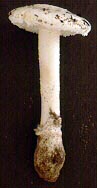
?? - 44 mm wide, white, shiny when dry, ??; context white, unchanging when cut or bruised, 5 mm thick at stipe, thinning evenly for about three-fourths of radius, then membranous to margin; margin nonstriate, appendiculate with partial veil in more or less continuous band or in flaps, white; universal veil as dense warts and small patches, reduced to small scales toward margin, whitish, browning slightly with age, felted to flocculose, detersile. |
| lamellae |
free to narrowly adnate with faint decurrent line on stipe apex, close, cream in mass, pale cream in side view, unchanging when cut or bruised, with edge white and minutely pulverulent; lamellulae truncate to rounded truncate, ??. |
| stipe |
24 - ?? × 5.5 - ?? mm, white, unchanging when handled, narrowest at mid-height, floccose-pulverulent below partial veil, ??; bulb napiform to dauciform, 22 × 16.5 µm; context white, unchanging when cut or bruised, solid, with larva tunnels concolorous, ??; partial veil white, subapical to superior, submembranous or felted to membranous, with many ragged flaps left on pileus margin, sometimes largely lost from stipe; universal veil as flimsy short rim on top or near margin of bulb, white. |
| odor/taste |
Odor like baked bread. Taste not recorded. |
macrochemical
tests |
none recorded. |
| basidia |
??; clamps moderately common. |
| basidiospores |
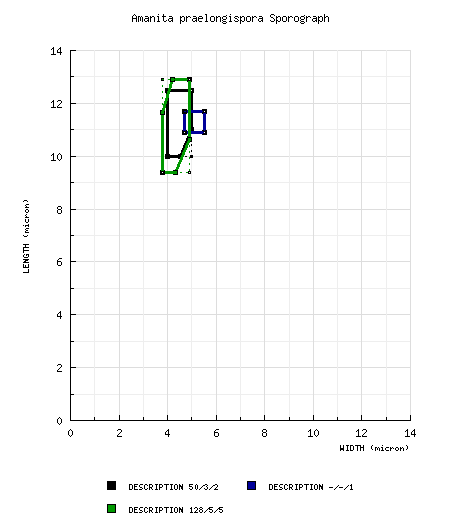
from Bas (1969): [50/3/2] 10.0 - 12.5 (-13.5) × 4.0 - 5.0 μm, (Q = 2.20 - 3.20; Q = 2.45 - 2.70), very pale yellowish, thin-walled, smooth, amyloid, cylindric to bacilliform; apiculus not described; contents subgranular, refractive; white in deposit.
from type study of Jenkins (1979): [-/-/1] (10.2-) 10.9 - 11.7 (-14.1) × 4.7 - 5.5 μm, (Q = 1.98 - 2.56; Q' = 2.34), hyaline, thin-walled, amyloid, elongate to cylindric, often adaxially flattened; apiculus sublateral, cylindric; contents guttulate;
color in deposit not recorded.
composite of data from all material revised by RET: [128/5/5] (8.7-) 9.4 - 12.9 (-19.0) × (3.5-) 3.8 - 4.9 (-6.0) µm, (L = 10.7 - 12.1 µm; L’ = 11.3 µm; W = 4.1 - 4.6 µm; W’ = 4.3 µm; Q = (1.81-) 2.17 - 3.07 (-3.65); Q = 2.49 - 2.84; Q’ = 2.64), hyaline, colorless, thin-walled, smooth, amyloid, cylindric to bacilliform, occasionally narrowed toward one end, occasionally constricted; apiculus sublateral, subcylindric to cylindric, proportionately small; contents granular to multiguttulate with additional small granules; white in deposit. |
| ecology |
Bas (1969): Florida: Terrestrial under Quercus. North Carolina: in open woods in dunes.
RET: Florida: Under Quercus laurifolia Michx. or in sandy soil under Pinus. Mississippi: In sandy soil. Texas: In sand. |
| material examined |
Bas (1969): U.S.A.:
FLORIDA—Alachua Co. - Gainesville, 16.v.1938 W. A. Murrill F 16108 (holotype, FLAS).
NORTH CAROLINA—Horry Co. - Myrtle Beach, vii.1945 W. C. Coker 13789 (NCU).
from type study of Jenkins (1979):
U. S. A.: FLORIDA— Alachua Co. - Gainesville,
16.v.1938 W. A. Murrill F 16108 (holotype, FLAS).
U.S.A.:
FLORIDA—Alachua Co. - Gainesville, 28.v.1938 W. A. Murrill s.n. (NYS), 10.vii.1949 W. A. Murrill s.n. (MU F21776). Palm Beach Co. - W. Palm Beach, Lytel Pk., vii.2000 Hanna Tschekunow s.n. (RET 314-8).
GEORGIA—Unkn. Co. - unkn. loc., s.d. Dr. Richard E. Baird 5359 (RET 546-5).
MISSISSIPPI—Perry Co. - Black Creek Wilderness Area, 16.vii.1987 James Tinius s.n. [Tulloss 7-16-87-J] (RET 001-8).
TEXAS—Harden Co. - Lumberton, Village Crk. St. Pk., 8.vi.2000 NAMA2000 participant s.n. [Tulloss 6-8-00-A] (RET 312-7). |
| citations |
—R. E. Tulloss |
| editors |
RET |
|


 Spore data sets and their composite