
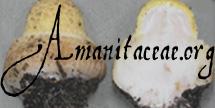

| name | Amanita pantherinoides |
| name status | nomen acceptum |
| author | (Murrill) Murrill |
| english name | "Western American False Panther" |
| synonyms |
≡Amanita pantherina var. pantherinoides (Murrill) Dav. T. Jenkins |
| intro | The following description is based on Jenkins (1977), notes found with holotype, and data on recent collections. |
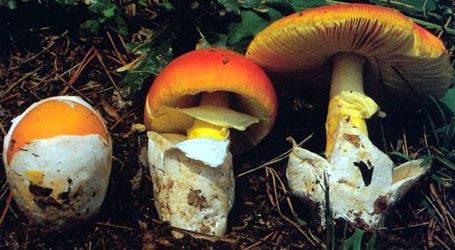
| cap | The cap of Amanita pantherinoides is 30 - 100 mm wide, globose to hemispherical, becoming planar, honey-colored to dirty-cream colored with brown to chestnut to honey-tan in the center, viscid when wet, glabrous, with a faintly striate to nonstriate margin. The volval remnants are present as soft, small, white, floccose-fibrillose patches and warts, numerous and randomly distributed until falling away. The flesh is thin. |
| gills | Gills are white, narrowly adnexed to free, when free, connected to the stem by an extremely heavy, floccose line, crowded; the short gills are truncate. |
| stem | Its stem is 20 - 110 × 5 - 11 mm, tapering upward, often slightly expanded at the top, white to whitish, and stuffed to hollow, glabrous. The basal bulb is ovoid, white, smooth to minutely floccose. The ring is relatively large, white, superior, not apical, and persistent. The volva is present as a submembranous, short, thin limb around the stem base and/or as floccose material on the upper part of the bulb. |
| odor/taste | No information is available about the odor or taste of this mushroom. |
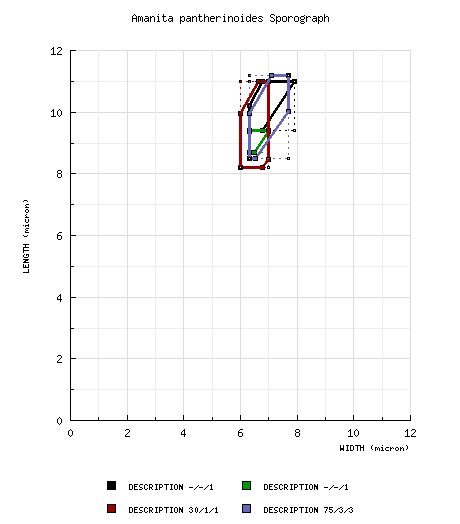
| spores | RET measured spores from three collections of this species including Murrill's type. The spores measure (8.1-) 8.5 - 11.2 (-12.2) × (6.0-) 6.3 - 7.7 (-8.5) µm and are mostly ellipsoid (with about 5% elongate and 5% broadly ellipsoid) and are inamyloid. Clamps are rarely present at bases of basidia. |
| discussion |
Originally described from the state of Washington, USA under the two names cited at the top of the page. The synonymy was proposed by Jenkins (1977). This species was originally found under conifers and hardwoods in wet, coastal forests. Jenkins emphasizes the possibility of a close relationship between the present taxon and A. pantherina (DC. : Fr.) Krombh. The present taxon seems more gemmatoid than pantherinoid given the limbate volval remnants on the bulb and occasional clamp connections on basidia. I don't see a reason for it to be considered to be a variety of pantherina at the moment; however, I have not yet studied material of the present species in detail.—R. E. Tulloss |
| brief editors | RET |
| name | Amanita pantherinoides | ||||||||||||||||||||
| author | (Murrill) Murrill. 1912. Mycologia 4: 262. | ||||||||||||||||||||
| name status | nomen acceptum | ||||||||||||||||||||
| english name | "Western American False Panther" | ||||||||||||||||||||
| synonyms |
≡Venenarius pantherinoides Murrill. 1912. Mycologia 4: 242.
≡Amanita pantherina var. pantherinoides (Murrill) Dav. T. Jenkins. 1977. Biblio. Mycol. 57: 69.
=Venenarius praegemmatus Murrill. 1912. Mycologia 4: 243. ≡Amanita praegemmata (Murrill) Murrill. 1912. Mycologia 4: 262. The editors of this site owe a great debt to Dr. Cornelis Bas whose famous cigar box files of Amanita nomenclatural information gathered over three or more decades were made available to RET for computerization and make up the lion's share of the nomenclatural information presented on this site. | ||||||||||||||||||||
| etymology |
pantherina, here treated as the species epithet + -oides, "similar to" prae-, "before" or "in front" or "very" + gemmata, here treated as the species epithet | ||||||||||||||||||||
| MycoBank nos. | 245051, 200249, 517064, 171278, 199901 | ||||||||||||||||||||
| GenBank nos. |
Due to delays in data processing at GenBank, some accession numbers may lead to unreleased (pending) pages.
These pages will eventually be made live, so try again later. Search:
Showing 0 to 0 of 0 entries | ||||||||||||||||||||
| holotypes | NY (V. pantherinoides & V. praegemmata) | ||||||||||||||||||||
| type studies | Jenkins. 1979. Mycotaxon 10: 184 (V. pantherinoides), 186 (V. praegemmata). | ||||||||||||||||||||
| intro |
The following text may make multiple use of each data field. The field may contain magenta text presenting data from a type study and/or revision of other original material cited in the protolog of the present taxon. Macroscopic descriptions in magenta are a combination of data from the protolog and additional observations made on the exiccata during revision of the cited original material. The same field may also contain black text, which is data from a revision of the present taxon (including non-type material and/or material not cited in the protolog). Paragraphs of black text will be labeled if further subdivision of this text is appropriate. Olive text indicates a specimen that has not been thoroughly examined (for example, for microscopic details) and marks other places in the text where data is missing or uncertain. The following material not directly from the protolog of the present taxon and not cited as the work of Dr. David T. Jenkins or another researcher is based on original research by R. E. Tulloss. | ||||||||||||||||||||
| pileus |
protolog of V. pantherinoides: up to 10 mm wide, melleous to sordid cremeous, brown or chestnut over disc, globose at first becoming planar, sticky when wet; context thick, fleshy; margin slightly striate in age; universal veil as small white patches, numerous, "regular and regularly distributed," detersile. protolog of V. praegemmatus: Up to 60 mm wide, melleous-avellaneous over disc, dark melleous near margin, smooth; context not described; margin not striate, splitting in older specimens; universal veil as white cottony gemmate warts, densely placed, persistent. type study of V. pantherinoides (Jenkins 1977, 1979): up to 45 mm wide, melleous or sordid cremeous, with brown or chestnut over disc, convex to planar; context relatively thin; margin nonstriate; universal veil as thin, floccose patches, white. type study of V. praegemmatus (Jenkins 1977, 1979): ca. 40 mm wide, melleous-avellaneous over disc, dark melleous toward margin, convex to plano-convex; context not described; margin nonstriate; universal veil as floccose-fibrillose patches or (occasionally) angular warts covering most of pileus, white. | ||||||||||||||||||||
| lamellae |
protolog of V. pantherinoides: sinuate, crowded, white. protolog of V. praegemmatus: free, crowded, white, ventricose. type study of V. pantherinoides (Jenkins 1977, 1979): free, crowded, white. type study of V. praegemmatus (Jenkins 1977, 1979): free, crowded, white. | ||||||||||||||||||||
| stipe |
protolog of V. pantherinoides: up to 110 × 20 mm; bulb 30 mm wide; context not described; partial veil large, white, superior, persistent; universal veil limbate, "tough," persistent, as entire or undulate free limb. protolog of V. praegemmatus: up to 70 × 15 mm, white, narrowing upward, smooth; bulb 30 mm wide; context not described; partial veil white, ample, persistent, supramedian; universal veil "closely attached to" bulb, possibly suggesting volval material of A. muscaria, scarcely free from stipe, no friable remnants seen in substrate. type study of V. pantherinoides (Jenkins 1977, 1979): up to 70 × 7 mm, white, narrowing upward slight; bulb ovoid; context stuffed; partial veil as remnants ca. 20 mm from stipe apex; universal veil as small free limb (margin) and occasional floccose material at apex of bulb. type study of V. praegemmatus (Jenkins 1977, 1979): 40 × 3 - 5 mm, tapering slightly upward, stuffed, white; bulb ovoid; context not described; partial veil as slight remnants 10 mm from stipe apex, superior, white; universal veil appressed and as free margin on bulb. [Note: apparently mistranscribed from (Jenkins 1977) in the later publication. All information included here.—ed.] | ||||||||||||||||||||
| odor/taste | not recorded. | ||||||||||||||||||||
| macrochemical tests |
none recorded. | ||||||||||||||||||||
| pileipellis |
type study of V. pantherinoides (Jenkins 1977, 1979): filamentous hyphae densely interwoven, 3 - 8 μm wide, gelatinized. type study of V. praegemmatus (Jenkins 1977, 1979): filamentous hyphae interwoven to subradially oriented, 3 - 8 μm wide, gelatinized. | ||||||||||||||||||||
| pileus context | not described. | ||||||||||||||||||||
| lamella trama |
type study of V. pantherinoides (Jenkins 1977, 1979): bilateral; inflated cells up to 160 × 32 μm, clavate to irregularly elongate. type study of V. praegemmatus (Jenkins 1977, 1979): bilateral; filamentous hyphae 2 - 7 μm wide, moderately branched; inflated cells elongate, terminal singly or in short chains; clamps rare. | ||||||||||||||||||||
| subhymenium |
type study of V. pantherinoides (Jenkins 1977, 1979): inflated ramose to ramose; clamps rare. type study of V. praegemmatus (Jenkins 1977, 1979): ramose; clamps occasional. | ||||||||||||||||||||
| basidia |
type study of V. pantherinoides (Jenkins 1977, 1979): 39 - 47 × 4.5 - 11 μm, 4-sterigmate; clamps not observerd. type study of V. praegemmatus (Jenkins 1977, 1979): 39 - 47 × 4.5 - 12.5 μm, 4-sterigmate; clamps occasional. | ||||||||||||||||||||
| universal veil |
type study of V. pantherinoides (Jenkins 1977, 1979): On pileus: filamentous hyphae up to 8 μm wide, scarcely to moderately branched; inflated cells up to 83 × 58 μm, subglobose to ovoid to broadly ellipsoid to ellipsoid to oblong-ellipsoid to clavate, terminally in chains, usually disordered; clamps not observed. At stipe base: filamentous hyphae up to 7 μm wide, moderately branched; inflated cells up to 105 × 38 μm, primarily clavate to oblong-ellipsoid, with lesser number broadly ellipsoid to ovoid, terminal singly or in short chains; clamps not observed. type study of V. praegemmatus (Jenkins 1977, 1979): On pileus: as fairly loose tissue, with elements irregularly disposed or anticlinally organized; filamentous hyphae 3 - 8 μm wide, sparsely to moderately branched; inflated cells globose to subglobose to ovoid to broadly ellipsoid (up to 64 × 45 μm) and clavate to ellipsoid to oblong-ellipsoid (up to 115 × 38 μm), in terminal chains; clamps rare. On stipe base: similar to that on pileus; filamentous hyphae 3 - 7 μm wide, moderately branched; inflated cells primarily elongate to ovoid (up to 127 × 31 μm), less frequently very small and broadly ellipsoid to ovoid, terminal singly or in short chains; clamps rare. | ||||||||||||||||||||
| stipe context |
type study of V. pantherinoides (Jenkins 1977, 1979): longitudinally acrophyalidic; filamentous hyphae inconspicuous; acrophysalides up to 286 × 32 μm, clavate. type study of V. praegemmatus (Jenkins 1977, 1979): longitudinally acrophysalidic; filamentous hyphae 3 - 7 μm wide, moderately conspicuous, sparsely branched; acrophysalides up to 221 × 35 μm; clamps rare. | ||||||||||||||||||||
| partial veil |
type study of V. pantherinoides (Jenkins 1977, 1979): filamentous hyphae 1.5 - 6 μm wide, moderately branched; inflated cells ca. 130 × 25 μm, clavate to ellipsoid, usually terminal singly; clamps rare. type study of V. praegemmatus (Jenkins 1977, 1979): filamentous hyphae 3 - 7 μm wide, dominant, moderately branched; inflated cells sparse, clavate up to 126 × 20 μm; clamps rare. | ||||||||||||||||||||
| lamella edge tissue | not described. | ||||||||||||||||||||
| basidiospores |
from type study of V. pantherinoides by Jenkins (1977): [-/-/1] 9.4 - 11.0 × 6.3 - 7.9 μm, (Q = 1.39 - 1.62; Q' = 1.59), hyaline, smooth, thin-walled, inamyloid, ellipsoid to elongate, often adaxially flattened; apiculus sublateral, usually cylindric; contents guttulate; color in deposit not recorded. [Note: The spore data was mistranscribed in (Jenkins 1979).—ed.] from type study of V. praegemmatus by Jenkins (1977, 1979): [-/-/1] 8.7 - 9.4 × 6.3 - 7.0 μm, (Q = 1.34 - 1.49; Q' = 1.43), hyaline, thin-walled, nonamyloid, ellipsoid, often adaxially flattened; apiculus sublateral, cylindric to truncate-conic; contents guttulate; color in deposit not recorded. From RET's study of the type of V. pantherinoides: [30/1/1] (8.1-) 8.2 - 11.0 (-11.8) × 6.0 - 7.0 (-8.0) μm, (L = 9.7 μm; W = 6.7 μm; Q = (1.16-) 1.21 - 1.66 (-1.69); Q = 1.46). composite of data from material revised by RET: [75/3/3] (8.1-) 8.5 - 11.2 (-12.2) × (6.0-) 6.3 - 7.7 (-8.5) μm, (L = 9.7 - 10.2 μm; L' = 10.0 μm; W = 6.7 - 7.2 μm; W' = 6.9 μm; Q = (1.16-) 1.30 - 1.58 (-1.69); Q = 1.42 - 1.46; Q' = 1.44), hyaline, colorless, smooth, thin-walled, inamyloid, dominantly ellipsoid, infrequently broadly ellipsoid or elongate, adaxially flattened; apiculus sublateral, cylindric; contents guttulate ["oil drop" form] with multiple additional granules; color in deposit not known. | ||||||||||||||||||||
| ecology |
protolog of V. pantherinoides: On south slope in woods. protolog of V. praegemmatus: Scattered. On sandy soil in open woods. type study of V. pantherinoides (Jenkins 1979): On south slope in woods. type study of V. praegemmatus (Jenkins 1979): On sandy soil in open woods. | ||||||||||||||||||||
| material examined |
From type study of V. pantherinoides by Jenkins (1979): U. S. A.:
WASHINGTON—King? Co. - ca. Seattle, Hayti, 20.x-1.xi.1911 W. A. Murrill 399 (holotype of V. pantherinoides, NY). from type study of V. praegemmatus by Jenkins (1979): U. S. A.: WASHINGTON—King Co. - Seattle, 20.x.-1.xi.1911 W. A. Murrill s.n. (holotype, FLAS). RET: U.S.A.: OREGON—Lane Co. - ca. Florence, Honeyman St. Pk., xi.1989 Harley Barnhart 89-149 (RET 043-1). WASHINGTON—Clallam Co. - La Push, 21.ix.1985 Roger Phillips 3086 (in herb. R. Phillips, London; RET 210-10). King? Co. - ca. Seattle, Hayti, 20.x-1.xi.1911 W. A. Murrill 399 (holotype of V. pantherinoides, NY). | ||||||||||||||||||||
| discussion |
The following figure provides a sporograph comparison between the present species and A. ameripanthera Tulloss & J. Lindgr. nom. prov.: | ||||||||||||||||||||
| citations | —R. E. Tulloss | ||||||||||||||||||||
| editors | RET | ||||||||||||||||||||
Information to support the viewer in reading the content of "technical" tabs can be found here.
| name | Amanita pantherinoides |
| bottom links |
[ Keys & Checklists ] |
| name | Amanita pantherinoides |
| bottom links |
[ Keys & Checklists ] |
 Spore data sets and their composite
Each spore data set is intended to comprise a set of measurements from a single specimen made by a single observer; and explanations prepared for this site talk about specimen-observer pairs associated with each data set. Combining more data into a single data set is non-optimal because it obscures observer differences (which may be valuable for instructional purposes, for example) and may obscure instances in which a single collection inadvertently contains a mixture of taxa.

Text and User-Generated Sporographs are published under the Creative Commons License.

In the case of a taxon page, image credits are on the 'image' tab.