| name |
Amanita ameripanthera |
| author |
Tulloss, J. Lindgr., Kudzma, S. D. Russell, Haelew. & Geml |
| name status |
nomen provisorum |
| english name |
North American Panther |
| etymology |
elision of “America” with panthera, "panther"; hence, “American Panther Amanita” |
| GenBank nos. |
Due to delays in data processing at GenBank, some accession numbers may lead to unreleased (pending) pages.
These pages will eventually be made live, so try again later.
|
| intro |
The following text may make multiple use of each
data field.
The field may contain
magenta text presenting data from a type study
and/or revision of other original material
cited in the protolog of the present taxon.
Macroscopic descriptions in magenta are a
combination of data from the protolog and
additional observations made on the exiccata
during revision of the cited original
material.
The same field may also contain black text,
which is data from a revision of the present
taxon (including non-type material and/or
material not cited in the protolog).
Paragraphs of black text will be labeled if
further subdivision of
this text is appropriate.
Olive text indicates
a specimen that has not been
thoroughly examined (for example, for
microscopic details) and marks other places in the text
where data is missing or
uncertain.
The following material is based on materials,
notes,
and photographs of the persons listed in the
"material
examined" data field (below); molecular results
are
the work of Linas Kudzma (Annandale, NJ) and Stephen
Russell et al. (Purdue Univ.); other original
research is by R. E. Tulloss and Janet E.
Lindgren. |
| pileus |
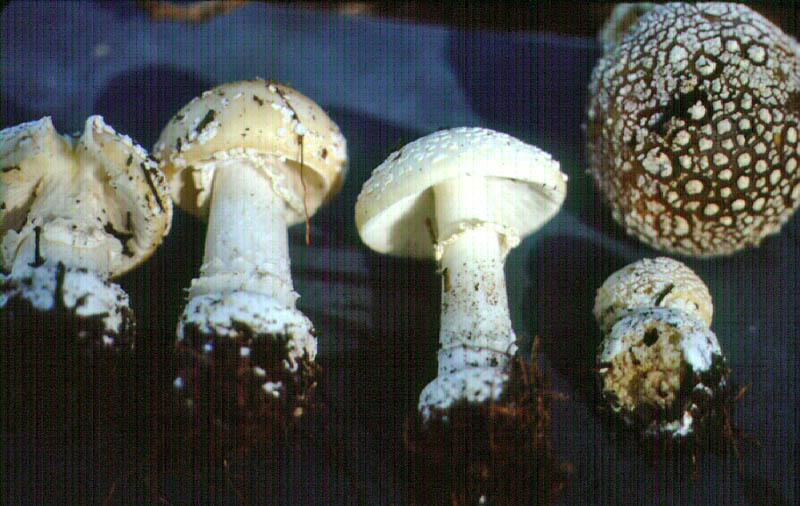
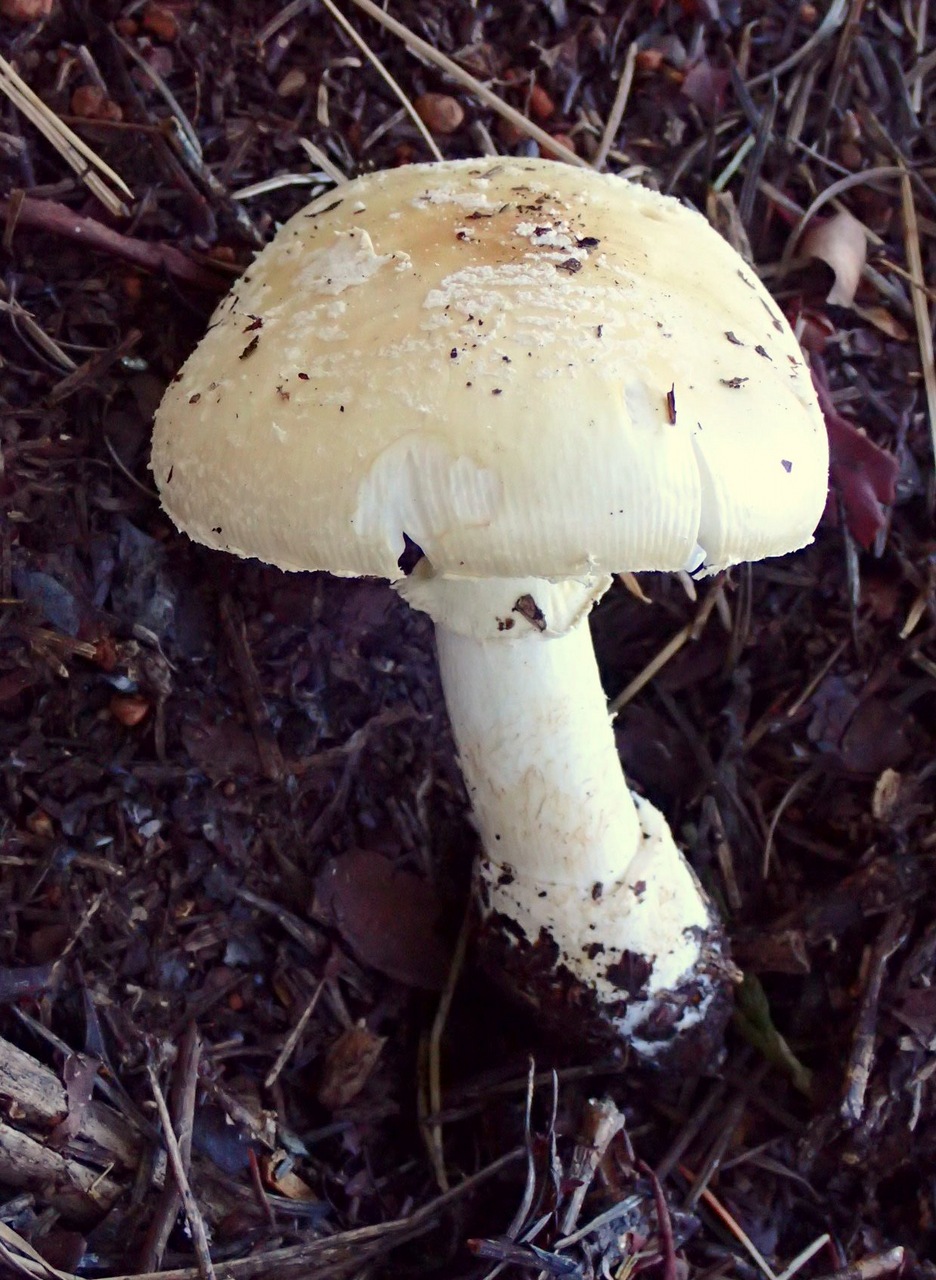
54–91 mm wide, nearly cream to pale tan to light
gray-brown to tan to brown to dark brown
(2.5YR3/4-6, 10YR7/4-6, 2.5YR3/4),
convex to planoconvex to planar,
glabrous, viscid and shiny when wet; context
white, sometimes watersoaked above lamellae, yellowish
tan under pileipellis, unchanging when cut or bruised,
9–15 mm thick at stipe, thinning evenly to margin;
margin very faintly striate, downcurved at first, sometimes with short
sterile extension beyond ends of lamellae;
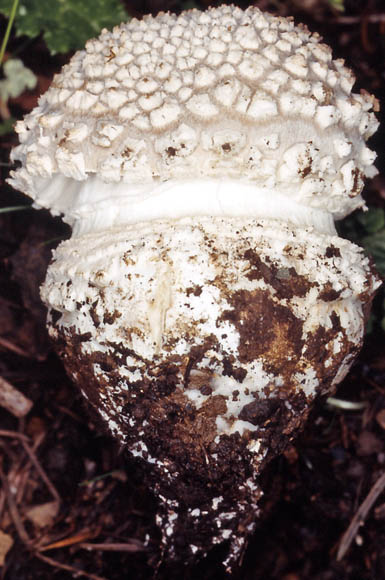
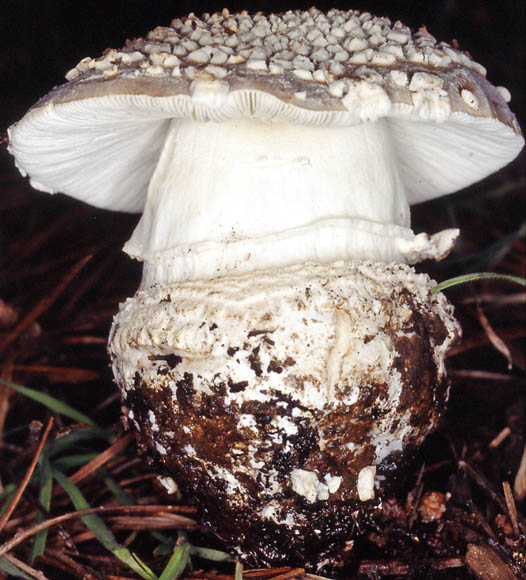
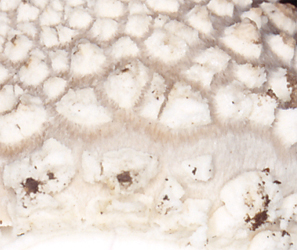
universal veil as felted warts (originally
pyramidal) and patches, white to
off-white at first then cream to pale tan, darkening
with age, becoming
flattened, very finely verruculose (lens),
detersile. |
| lamellae |
free to narrowly adnate, sometimes with faint decurrent line on stipe apex, close to crowded, off-white in mass, white to off-white or faintly sordid in side view, unchanging when cut or bruised, 6–8 mm broad, with fimbriate edge; lamellulae truncate, sometimes with attenuate tooth, ??. |
| stipe |
54–90 × 10+–20 mm, white, becoming slightly
brown from handling, narrowing upward, flaring at
apex, longitudinally striatulate, sometimes silky
fibrillose; bulb 24–31 × 21–33 mm, ovoid,
occasionally subnapiform (pointed below or with
slight narrow radical), not so
markedly distinct from stipe in age; context
off-white, unchanging when cut or bruised, stuffed
with firm white material, with central cylinder
2–6 mm
wide, with larva tunnels concolorous; partial
veil membranous, white, skirt-like, submedian,
occasionally lost, usually collapsing
on stipe;
universal veil as short collar-like roll of
tissue) at top of bulb, off-white to white. |
| odor/taste |
Odor not recorded. Taste pleasant, according to persons poisoned by ingesting this taxon. POISONOUS. |
macrochemical
tests |
Spot test for tyrosinase (paracresol) - positive in pileipellis, surface of stipe, center of bulb context, much (not all) of stipe context after 13 min. in old specimen (Tulloss 1-3-87-BS2). |
| pileipellis |
292 µm thick, with
upper layer extensively gelatinized and
72 µm thick, with lower layer
ungelatinized and 220 µm thick, with
strongest pigmentation in 65–70 µm
immediately below gelatinized layer;
filamentous, undifferentiated hyphae
?? µm wide,
branching, densely
interwoven, dominantly subradially
arranged; vascular hyphae
not observed, infrequent. |
| pileus context |
not described. |
| lamella trama |
bilateral, divergent;
??; subhymenial base having
inflated cells up to 57 × 17.5 μm; clamps not
obseved. |
| subhymenium |
wst-near = 30–45 µm
and wst-far = 50–65 µm
(moderately inflated). |
| basidia |
not described. |
| universal veil |
On pileus: filamentous undifferentiated
hyphae ??; inflated cells
48 - 82 × 26 -47
μm, color less to brown;
vascular hyphae ??; clamps
??. |
| stipe context |
longitudinally acrophysalidic. |
| partial veil |
not described. |
| lamella edge tissue |
sterile. |
| anatomical figures |
|
| basidiospores |
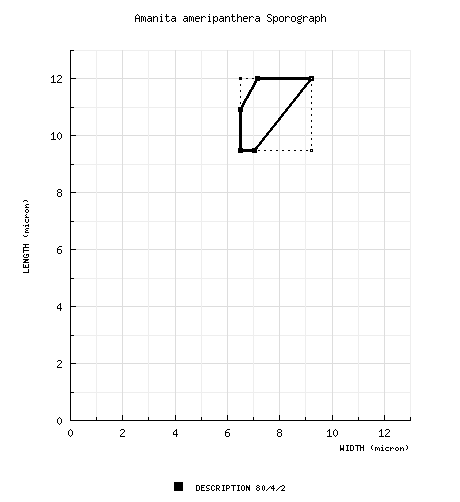
[80/4/2] (8.8–) 9.5–12.0 (–12.8) ×
(5.5–) 6.5–9.2 (–10.5) µm,
(L = 10.3–11.3 µm;
L’ = 10.8 µm;
W = 6.9 - 7.6 µm;
W’ = 7.2 µm;
Q = (1.28–) 1.35–1.68 (–1.77);
Q = 1.43–1.59;
Q’ = 1.49), hyaline, colorless,
thin-walled, smooth, inamyloid, ellipsoid to
elongate, occasionally broadly ellipsoid,
sometimes lachrimiform, occasionally somewhat
flattened adaxially; apiculus sublateral,
cylindric; contents monoguttulate;
probably white in deposit. |
| ecology |
Subgregarious.
California: At 25 to ?? m elev.
Under ?? or under
Pinus and Quercus agrifolia or under
Eucalyptus globulus Labill. (not
endemic).
Idaho: At 1910 m elev. Under Abies,
Picea, and Pinus ponderosa.
Oregon: ??.
Washington: Under introduced Cedrus deodara
or ??. |
| material examined |
U.S.A.:
CALIFORNIA—Contra Costa Co. - Hercules,
prop. D. Bojantchev, 2007 Dimitar
Bojantchev s.n. (RET 418-9, nrITS & nrLSU seq'd.),
ii or iii.2008
Dimitar Bojantchev s.n. (RET 423-1, nrITS &
nrLSU seq'd.).
Los Angeles Co. - Santa
Monica Mtns., Malibu Cyn.,
Tapia Co. Pk., 3.i.1987 Barry Silver s.n.
[Tulloss 1-3-87-BS??]
(RET ??);
Santa Monica Mtns., Stunt Cyn.,
3.i.1987 Barry Silver s.n. [Tulloss 1-3-87-BS2]
(RET 091-10, nrITS seq'd.).
Marin Co. - Bon Tempe Lk., 21.i.2005 Ron Pastorino
1-21-05E (RET 387-10, multiple genes seq'd.).
Monterey Co. - Asilomar Conf.
Ctr. [36.6203° N/ 121.9364° W, 25 m], 14.ii.1998
coll. unkn., s.n. [Tulloss 2-14-98-A]
(RET 274-9, nrITS & nrLSU seq'd.).
Orinda Co. - Briones Overlook staging area,
2.ii.2011 Mike McCurdy B-M-A008 (RET 656-4,
nrITS seq'd.); unkn. loc., 25.i.2011 Mike McCurdy
B-M-A 001 (RET 655-10 nrITS seq'd.).
Placer Co. - Sugar Pine Lk.
[39.1302° N/ 120.790° W, 1119 m],
10.v.2019 Ron Pastorino
5-10-19A [mushroomobserver
#366221}
(RET 869-5, nrITS-LSU seq'd.).
Santa Cruz Co. - Aptos Hills, S border of Aptos,
2.iii.1989 John Feci & R. E. Tulloss 3-2-89-E
(RET 042-3. nrITS seq'd.); Aptos Hills, N border of
Watsonville, 2.iii.1989 J. Feci s.n. [Tulloss
3-2-89-H] (RET 042-1, nrITS seq'd.).
San Francisco Co. - San
Francisco, Land’s End, 6.iii.1982 David C., Mark H.
& R. E. Tulloss & Mycol. Soc. San Francisco
foray participants 3-6-82-A (RET 174-10, nrITS-LSU
seq'd.),
-B (RET 173-10, nrITS seq'd.),
-C (RET 174-9).
IDAHO—Valley Co. - Payette Nat. For., ca.
McCall, Brundage Reservoir
[45°3.331" N/ 116°6.726" W], 5.ix.2008 Kathy
Richmond s.n. [NAMA 2008-180] (F;
RET 423-9, nrITS seq'd.).
OREGON—Coos Co. - Coos Co. For., Seven
Devils area, 27.iii.1992 Catherine Ardrey 1779 (RET
047-5, nrITS & nrLSU seq'd.).
Washington
Co. - Portland, NW Leahy Road, 27.iv.2009 Richard
Tullis s.n. [Janet E. Lindgren 09001] (RET
684-5).
WASHINGTON—Clark Co.
- Vancouver, Ellen Davis Tr., 30.iv.1990 J. E.
Lindgren s.n. [Tulloss 4-30-90-JEL1] (RET
014-8, nrITS & nrLSU seq'd.); Vancouver, NE
75th St., 27-28.iv.2009 Sue
Aberle s.n. [J. E. Lindgren 09002] (RET
684-10, ITS & nrLSU seq'd.).
Thurston Co. - Lacey, LOTT Hawk Prairie Satellite
[47.0741° N/ 122.767° W, 63 m], 18.iv.2019 Drew T.
Hendersson s.n. [mushroomobserver
#364195]
(RET 868-1, nrITS-LSU seq'd.).
Unkn. Co. -
unkn. loc., 5.vi.1990 J. & W. Caruthers s.n. [J. E.
Lindgren 90-16] (RET 014-7, nrLSU seq'd.), 7.vi.1990
Janet E. Lindgren 90-20
(RET 015-3, nrLSU seq'd.).
[NOTE: See also Thiers 32154 (SFSU).]
Additional possible reports of “A.
ameripanthera” come from:
CANADA:
BRITISH COLUMBIA—Vancouver, 1.vii.1959 R.
J. Bandoni 494 (UBC).
U.S.A.:
CALIFORNIA—Mendocino Co. - unkn. loc.,
18.xi.1961 Thiers 882 (SFSU); Trinidad, 5.vii.1935
A. H. Smith 3831 (MICH). San Mateo Co. -
Pacifica, 21.viii.1976 S. Pollock 1325 (DTJ),13223
(DTJ); unkn. loc., 5.ii.1965 Thiers 12170
(SFSU). Sierra Co. - unkn. loc.?,
s.d.? W. J. Sundberg and G. Breckon 356 (SFSU).
WASHINGTON—Unkn. Co. - Olympic Mtns.,
2.xii.1941 A. H. Smith 17515 (MICH).
[Doubtful: Ontario, Pembroke, 26.ix.1968 E. J.
Klatt and J. W. Groves 124783 (DAOM, ?doubtful
determination?).] |
| discussion |
under development
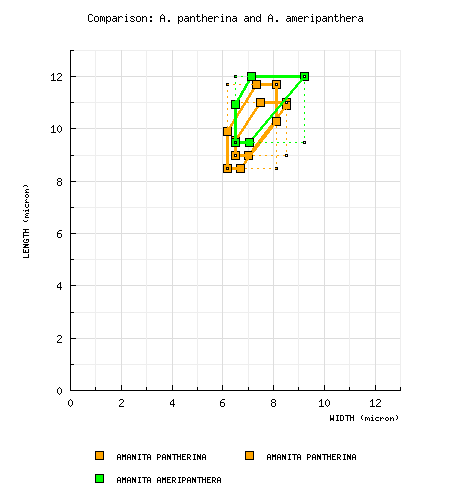
The spores of Amanita ameripanthera are narrower
and larger than those of the European entity to which
it has been referred for decades in western North
America.
The existence of the morphological treatment on this
page has had very little effect on the common
application of "A. pantherina" to the
present species; however, hopefully, the addition of
genetic data will motivate change.
A comparison of sporographs for
A. pantherina
and the present species follows:
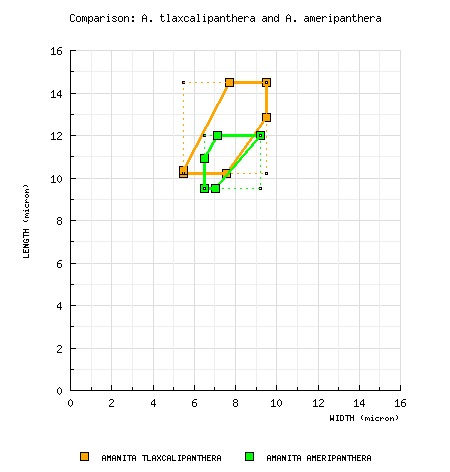
The following image provides a sporograph comparison
of the present species with A. tlaxcalipanthera:
RET 387-10 was originally misidentified as
A. magniverrucata and this error led to its
being sampled for molecular study by Wolfe et al.
(2012),
who reported their sequencing results under that
name originally.
The present species has been treated in the past under
the following temporary codes: Amanita sp-C17
and A. sp-NW01. |
| citations |
—R. E. Tulloss & J. E. Lindgren |
| editors |
RET |
|




 Spore data sets and their composite