
| name | Amanita pagetodes |
| name status | nomen acceptum |
| author | D. A. Reid |
| english name | "Frosted Biscuit Lepidella" |
| intro |
The description is based on Reid (1980). |
| cap |
The cap of Amanita pagetodes is up to 70 mm wide, convex then plano-convex, whitish, appendiculate, with a smooth margin. The cap is entirely covered with thin, pulverulent or subfloccose, pallid to buff-colored volval remnants. The volva is easily removed, e.g. by rain. The flesh is white. |
| gills |
The gills are whitish to cream. |
| stem |
The stem is up to 90 × 15 mm, whitish, covered with whitish or buff-colored flocci, especially in the upper part of the bulb. The basal bulb is immarginate and 30 mm wide, whitish. The ring falls off the stem. The flesh is white. |
| spores |
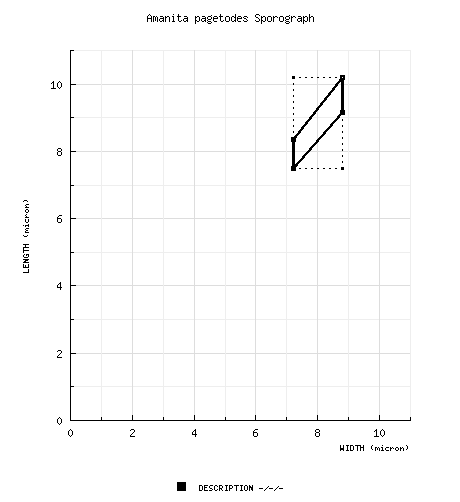
The spores measure 7.0 - 10.2 × 7.2 - 8.8 (10.0) µm and are subglobose to broadly ellipsoid and amyloid. Clamps are present at bases of basidia. |
| discussion |
This species was originally described from the state of Victoria, Australia. No ecological information was provided concerning the type. Reid states in another specimen that may be the same species was collected under eucalyptus. For reasons of general macroscopic apearance, Reid suggests comparison to Amanita farinacea (Cooke & Massee) Cleland & Cheel. Amanita farinacea differs in the structure of its volva and its having narrower spores and was placed in Bas' stirps Grossa, a group comprising entirely of Australian taxa. Amanita pagetodes keys to Bas' stirps Chlorinosma. For information on other species in the stirps, see A. chlorinosma (Austin) Lloyd. Wood (1997) agrees upon placement of this species in stirps Chlorinosma.—R. E. Tulloss |
| brief editors | RET |
| name | Amanita pagetodes | ||||||||||||||||||||
| author | D. A. Reid. 1978. Victorian Naturalist 95: 49. | ||||||||||||||||||||
| name status | nomen acceptum | ||||||||||||||||||||
| english name | "Frosted Biscuit Lepidella" | ||||||||||||||||||||
| synonyms |
double click in markup mode to edit. The editors of this site owe a great debt to Dr. Cornelis Bas whose famous cigar box files of Amanita nomenclatural information gathered over three or more decades were made available to RET for computerization and make up the lion's share of the nomenclatural information presented on this site. | ||||||||||||||||||||
| MycoBank nos. | 308575 | ||||||||||||||||||||
| GenBank nos. |
Due to delays in data processing at GenBank, some accession numbers may lead to unreleased (pending) pages.
These pages will eventually be made live, so try again later. Search:
Showing 0 to 0 of 0 entries | ||||||||||||||||||||
| holotypes | K | ||||||||||||||||||||
| selected illustrations | Reid. 1980. Austral. J. Bot., Suppl. Ser. 8: 46, figs. 29(a-c), 30, 85-86, 104. | ||||||||||||||||||||
| intro |
The following text may make multiple use of each data field. The field may contain magenta text presenting data from a type study and/or revision of other original material cited in the protolog of the present taxon. Macroscopic descriptions in magenta are a combination of data from the protolog and additional observations made on the exiccata during revision of the cited original material. The same field may also contain black text, which is data from a revision of the present taxon (including non-type material and/or material not cited in the protolog). Paragraphs of black text will be labeled if further subdivision of this text is appropriate. Olive text indicates a specimen that has not been thoroughly examined (for example, for microscopic details) and marks other places in the text where data is missing or uncertain. The following material is derived from the protolog and from (Reid, 1980). | ||||||||||||||||||||
| pileus | from protolog: up to 70 mm wide, whitish, convex then plano-convex; context white; margin smooth, conspicuously appendiculate with white material [attributed by Reid to parital veil—ed.]; universal veil as complete thin covering of pileus, pulverulent to subfloccose, pallid to buff-colored [rather dark brown in part, in Reid's photograph (fig. 104)—ed.], "may be fugacious according to weather conditions." | ||||||||||||||||||||
| lamellae | from protolog: whitish to cream. | ||||||||||||||||||||
| stipe | from protolog: up to 90 × 15 mm, whitish, "covered with whitish or buff-colored flocci especially in...upper part"; bulb immarginate, up to 30 mm wide; context white; partial veil "separating from stem at...very early age and appendiculate from...cap margin"; universal veil "none." | ||||||||||||||||||||
| odor/taste | not recorded. | ||||||||||||||||||||
| macrochemical tests |
none recorded. | ||||||||||||||||||||
| pileipellis | not described in protolog. | ||||||||||||||||||||
| pileus context | not described in protolog. | ||||||||||||||||||||
| lamella trama | not described in protolog. | ||||||||||||||||||||
| subhymenium | not described in protolog. | ||||||||||||||||||||
| basidia | from protolog: up to 76 × 15.4 μm, 4-sterigmate; clamps present. | ||||||||||||||||||||
| universal veil | from protolog: hyphae up to 8 μm wide, scant, thin-walled, hyaline, branched; inflated cells predominating, irregularly arranged, spherical or ovoid or clavate or ellipsoid, up to 70 × 60 μm, terminal. | ||||||||||||||||||||
| stipe context | not described in protolog. | ||||||||||||||||||||
| partial veil | not described in protolog. | ||||||||||||||||||||
| lamella edge tissue | from protolog: inflated cells clavate or ovoid, up to 19 μm wide, sometimes in short chains. [Note: originally misdecribed by Reid as "cheilocystidia."] | ||||||||||||||||||||
| basidiospores | from protolog: [-/-/-] 7.5 - 10.2 × 7.2 - 8.8 (-10.0) μm, (est. Q = 1.04 - 1.16), amyloid, subglobose to broadly ellipsoid; apiculus not recorded; contents not recorded; color in deposit not recorded. | ||||||||||||||||||||
| ecology | not described in protolog. | ||||||||||||||||||||
| material examined | from protolog: AUSTRALIA: VICTORIA—Unkn. LGA - Healesville, Dom Dom Saddle, 29.v.1976 D. A. Reid s.n. (holotype, K). | ||||||||||||||||||||
| discussion |
t.b.d. Reid (1980) mentions a second collection that he assigns to this species (not a paratype): AUSTRALIA: VICTORIA—Unkn. LGA - ca. Warburton, Britannia Crk., 8.v.1976 G. Beaton s.n. (K).However, the basidiome of this collection is described as entirely creamy white with a marginate bulb. Moreover, although Reid says that the universal veil has the same microscopic structure as does the universal veil of the type, the case is not well-supported by the illustrations he provides in the two cases. Therefore, we think that revision of the type and the other collection would be worthwhile before accepting conspecificity of the two collections. | ||||||||||||||||||||
| citations | —R. E. Tulloss | ||||||||||||||||||||
| editors | RET | ||||||||||||||||||||
Information to support the viewer in reading the content of "technical" tabs can be found here.
 Spore data sets and their composite
Each spore data set is intended to comprise a set of measurements from a single specimen made by a single observer; and explanations prepared for this site talk about specimen-observer pairs associated with each data set. Combining more data into a single data set is non-optimal because it obscures observer differences (which may be valuable for instructional purposes, for example) and may obscure instances in which a single collection inadvertently contains a mixture of taxa.

Text and User-Generated Sporographs are published under the Creative Commons License.

In the case of a taxon page, image credits are on the 'image' tab.