| name |
Amanita farinacea |
| author |
(Cooke & Massee) Cleland & Cheel. 1914. Agric. Gaz. New South Wales 25: 888, pl. 1 (fig. 3). |
| name status |
nomen acceptum |
| english name |
"Australian Flour Lepidella" |
| synonyms |
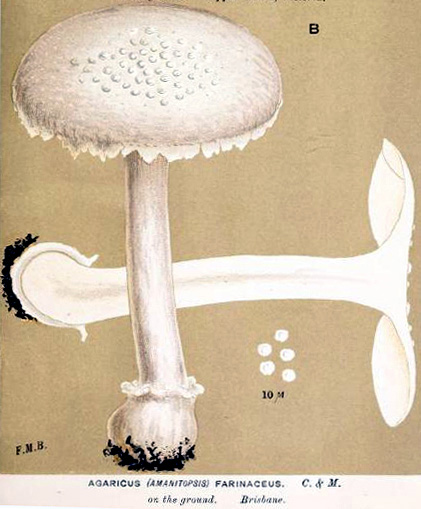
≡ Agaricus ( Amanitopsis) farinaceus Cooke & Massee in Cooke. 1889. Grevillea 18 (fasc. 85): 1. [Repeated in the same volume, 1890, fasc. 88, [page numbering restarts at 1 following p. 360] 2, pl. 2 (fig. B).]
≡ Amanitopsis farinacea (Cooke & Massee) Sacc. 1891a. Syll. Fung. 9: 2.
≡ Vaginata farinacea (Cooke & Massee) Kuntze. 1898. Rev. Gen. Plant. 3(2): 539.
≡ Aspidella farinacea (Cooke & Massee) E.-J. Gilbert. 1940. Iconogr. Mycol. (Milan) 27, suppl. (1): 79, tab. 61 (fig. 6), tab. 62 (figs. 1-2).
The editors of this site owe a great debt to Dr. Cornelis Bas
whose famous cigar box files of Amanita nomenclatural information
gathered over three or more decades were made available to RET for computerization
and make up the lion's share of the nomenclatural information presented on this site.
|
| etymology |
farinaceus, "starchy"; because of the flour-like nature of the volva |
| MycoBank nos. |
277580, 134266, 158302, 296056, 284324 |
| GenBank nos. |
Due to delays in data processing at GenBank, some accession numbers may lead to unreleased (pending) pages.
These pages will eventually be made live, so try again later.
|
| holotypes |
K |
| type studies |
Bas. 1969. Persoonia 5: 504, figs. 275-277.
Reid. 1980. Austral. J. Bot. suppl. ser. 8: 24, figs. 11, 50. |
| intro |
The following text may make multiple use of each data field.
The field may contain magenta text presenting data from a type study
and/or revision of other original material cited in the protolog of the present taxon.
Macroscopic descriptions in magenta are a combination of data from the protolog and
additional observations made on the exiccata during revision of the cited original
material.
The same field may also contain black text, which is data from a revision of the present
taxon (including non-type material and/or material not cited in the protolog).
Paragraphs of black text will be labeled if further subdivision of
this text is appropriate.
Olive text indicates a specimen that has not been
thoroughly examined (for example, for microscopic details) and marks other places in the text
where data is missing or uncertain.
The text which follows is based on the revision of Bas (1969).
The original description of the present species comprises a brief Latin diagnosis as follows:
"Albus, fungus totus farinaceus. Pileo carnoso, convexo, applanato, (2½-3 ...[unc.], albido, verrucis erectis prominulis, praecipue disco ornato, margine tenui, velo adnato, frimbriato, stipite aequali (3-4 × ½ unc.), exannulato, farcto, albo, volva bulbosa, margine libero crispato. Lamellis liberis, sublatis, confertis, albo-lutescentibus. Sporis globosis, 10 μ diam.
"On the ground. Brisbane[, Queensland, Australia]. (Bailey, 690)"
from Bas (1969): Basidiomes of medium size, rather slender.
Reid (1980) argues that Cooke and Massee altered the description of this species in comparison to the field notes and "rough pencil sketch" that are deposited with the holotype. For Reid's comments, see discussion data field, below. |
| pileus |
from Bas (1969): ca. 60 - 70 mm wide, whitish, plano-convex, probably viscid when moist (judging by gelatinized pileipellis); context not described; margin nonsulcate, appendiculate; universal veil concolorous, puleverulent verrucose over disc, with thin pulverulent crust-like areas at margin.
|
| lamellae |
from Bas (1969): free, crowded, white, becoming yellowish, moderately broad; lamellulae not described. |
| stipe |
from Bas (1969): ca. 70 - 100 × 12 mm, white, cylindric, fibrillose; bulb small, globose "(base of only type specimen badly damaged)"; context not described; exannulate; universal veil as as "rather thick, subflocculose...rim at top of bulb." |
| odor/taste |
not recorded. |
macrochemical
tests |
none recorded. |
| pileipellis |
from Bas (1969): outer layer almost completely gelatinized; filamentous hyphae 3 - 7 (-10) μm, interwoven, with very slightly thickened walls. |
| pileus context |
not described. |
| lamella trama |
from Bas (1969): bilateral. |
| subhymenium |
from Bas (1969): ramose. |
| basidia |
from Bas (1969): 45 - 55 × 10 - 12 μm, 4-sterigmate; clamps abundant. |
| universal veil |
from Bas (1969): On pileus: filamentous hyphae, 3 - 6 μm wide, branching, probably irregularly disposed; inflated cells abundant, mostly pyriform to clavate, also ellipsoid to globose, upt to ca. 60 × 40 μm, terminal singly or in short chains. On stipe bulb: similar to tissue on pileus.
from Reid (1980): On pileus: elements irregularly disposed; filamentous hyphae ca. 3 μm wide, scant, thin-walled, hyaline, branching; inflated cells sphaeropedunculate (up to 44 × 37 μm) or occasionally elongate (up to 60 × 20 μm). |
| stipe context |
from Bas (1969): longitudinally acrophysalidic; filamentous hyphae up to 12 μm wide; acrophysalides abundant. |
| partial veil |
absent. |
| lamella edge tissue |
from Bas (1969): inflated cells dominant, small, globose to clavate, up to 30 μm wide. |
| basidiospores |
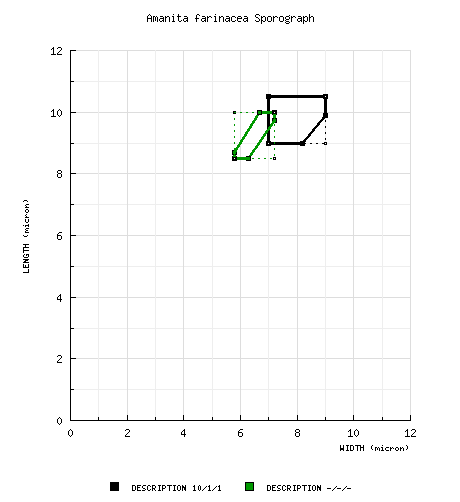
from Bas (1969): [10/1/1] 9.0 - 10.5 × (6.5-) 7.0 - 9.0 μm, (Q = 1.10 - 1.50; Q = 1.30), colorless, hyaline, thin-walled, [amyloid], subglobose to broadly ellipsoid to ellipsoid; apiculus not described; contents "mostly" as one large refractive body; color in deposit not recorded.
from Reid (1980): [-/-/-] (7.5-) 8.5 - 10.0 × (5.5-) 5.8 - 7.2 μm, (est. Q = 1.35 - 1.50). |
| ecology |
from Bas (1969): Terrestrial. |
| material examined |
from Bas (1969): AUSTRALIA: QUEENSLAND—City of Brisbane - Brisbane, s.d. F. M. Bailey 690 (holotype, K). |
| discussion |
from Bas (1969): "Amanita farinacea is very closely related to or identical with A. ananaeceps. It has similar spores, a similar pileipellis, and the same type of tissue in the volva, while in both species clamps are present.
"Judging by the original descriptions, macroscopically the main difference is to be found in the remnants of the volva on the cap. In A. ananaeceps the cap has been described as areolate with an angular, conical wart on each area; and in A. farinacea, as entirely farinaceous with erect, slightly projecting warts, epecially at the centre of the cap.
"Among the five type specimens of A. ananaeceps; however, there is only one in which the centre of the cap is areolate, which in this cae means that the warts of volva are situated on rounded elevations of the cap. I am fairly certain that these elevations have been caused by drying. In the other type specimens of A. ananaeceps small warts occur scattered over a nearly smooth cap, or else the cap is glabrous.
"Unfortunately the type of A. farinacea consists of only one specimen with a badly damaged base of the stem while we do not know the original colours of the type collection of A. ananaeceps. I do not wish to identify the two species before more information is available from specimens collected at or near the two type localities."
Bas assigned the present species to his stirps Grossa.
Reid (1980): "The holotype of A. farinacea, accompanied by a rough pencil-sketch of the fresh specimen with field notes, is preserved at Kew. Reference to these notes raises the question as to why Cooke and Massee described the macroscopic features in the way they did. For example, they described the fungus as wholly mealy when in fact there is no evidence of this from the notes or specimen. They also described the cap as 'sprinkled with erect prominent warts, chiefly at the disc.' The field notes merely state 'Pileus white, warty and mealy. The veil torn and hanging in rags to the edge of the pileus.' Cooke and Massee seem to have overemphasized the mealiness and the prominence of the warts. The sketch merely shows a convex pileus with a number of small warts (16) at the centre and a very conspicuously appendiculate shaggy margin. It also shows the stem with a rim of volval tissue at the slightly bulbous base, but whether this is intended to indicate a volva with free 'crispate' margin is open to question. The gills were noted as being 'of a very light yellow shade.'"
Reid further cites Bas' comments on possible synonymy and is in agreement—only going so far as to place the present name with a question mark in the synonym list for A. ananiceps while maintaining separate descriptions for the two taxa and keying them out separately. |
| citations |
—R. E. Tulloss |
| editors |
RET |
|


 Spore data sets and their composite