| name |
Amanita pachycolea |
| author |
D. E. Stuntz in Thiers & Ammirati. 1982. Mycotaxon 15: 158. |
| name status |
nomen acceptum |
| english name |
"Stuntz's Great Ringless Amanita" |
| etymology |
παχυς, thick + κολεος, sheath; hence, "thick volva"
[Note: Thanks to Dr. Rob Hallock for his help on the etymology.—ed.] |
| MycoBank nos. |
109592 |
| GenBank nos. |
Due to delays in data processing at GenBank, some accession numbers may lead to unreleased (pending) pages.
These pages will eventually be made live, so try again later.
|
| holotypes |
SFSU |
| type studies |
Tulloss. 1994. Mycotaxon 52: 361, figs. 35-36. |
| selected illustrations |
Thiers. 1982. Agaricales Calif. I. Amanitaceae: two unnumbered figs. |
| intro |
The following text may make multiple use of each data field.
The field may contain magenta text representing a type study
or a study of original material by Tulloss.
The same field may also contain black text, which will represent a revision of the
species by Tulloss. Paragraphs of black text will be labeled if further subdivision of
this text is appropriate.
Olive text indicates a specimen that has not been
thoroughly examined (for example, for microscopic details) and marks other places in the text
where data is missing or uncertain.
The macroscopic description below is largely derived from the protolog; data not from the protolog is NOT in magenta type. The microscopic anatomy described in the following is based upon original research by R. E. Tulloss (1994); data from specimens that are not original material are NOT in magenta type. |
| pileus |
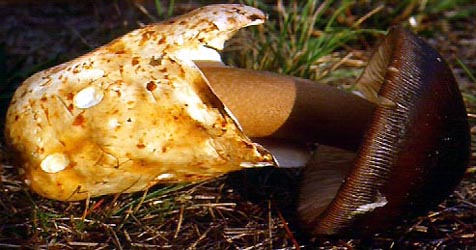
Tulloss (1994): 70 - 120 mm wide, dark brown, Carob Brown (2.5YR 2.0/4.0) to Chestnut-Brown (2.5YR 3.4/3.0) to Mummy Brown (10YR 3.4/3.0) on disc, fading toward margin to brown or grayish brown, Hazel (2.5YR 4.4/5.5) to Sayal Brown (8.5YR 5.2/5.0) to Tawny-Olive (1Y 5.2/4.5), sometimes with a ring of dark pigment at inner end of striation, convex to near campanulate when young, becoming convex to plano-convex to umbonate to sometimes irregular in outline with undulating margin in age, viscid to subviscid; context white, floccose, 5 - 10 mm thick in disc, thinning toward margin, unchanging when bruised or exposed; margin decurved, unchanging or becoming plane to uplifted in age, entire, typically becoming rimose and eroded, conspicuously striate or tuberculate striate (0.3 - 0.4R); universal veil usually absent or leaving only a few fibrils, rarely as a solitary white to whitish patch.
non-type: 141 mm wide, very dark brown, redder/warmer than chocolate brown with very dark (nearly black) band zone over inner ends of striations, broadly subcampanulate, tacky, dull; context white except sordid in disc and with watery line at interface to lamellae, unchanging, thinning even to a point ca. 15 mm from margin, then membranous to margin; margin striate (0.2 R when basidiome not fully expanded), nonappendiculate; universal veil absent. |
| lamellae |
Tulloss (1994): adnate to decurrent by a short inconspicuous hook, usually free in age, close to subdistant or occasionally crowded, white when young, unchanging or becoming tawny to orange-brown or orange-yellow with age, sometimes with spots of these colors, usually drying yellow to buff to orangish tan (e.g., 7.5YR 6/8, 7.5YR 7-8/6, or a little paler than 10YR 7/8), ventricose, broad, with edges fimbriate and usually grayish to slightly drab or dark brown; lamellulae truncate to subtruncate, of diverse lengths, plentiful, unevenly distributed.
free to subdistant, subcrowded, off-white in mass, faintly sordid cream in side view, unchanging when cut or bruised, without decurrent line on stipe apex, 11.5 mm broad, brown-marginate; lamellulae truncate to subtruncate, sometimes anastomosing to lamellae. |
| stipe |
Tulloss (1994): 110 - 240 mm long, 9 - 17 mm wide at apex, white to olive buff to sometimes as dark as orange brown or darker, cylindric or narrowing upward, dry, typically with appressed fibrils or fibrillose scaly, sometimes only slightly farinaceous at apex; context white, stuffed, becoming hollow in age; exannulate; universal veil as a very large felted to membranous volva, up to 5 mm thick, white on inner surface, on outer surface white to off-white and usually developing rust colored to brown to yellow-brown spots with age, sometimes becoming entirely ferruginous or dingy yellowish white, up 80 mm from stipe base to top of highest limb, persistent, but collapsing in age.
173 × 26 mm (not fully expanded), ground color very pallid beige or off-white, decorated densely with brown fibrils, staining/bruising not observed, narrowing upward, barely or not flaring at apex; context white above, grayish below, graying possibly from age or from refrigeration, stuffed with white material, hollow in part, with 12 mm wide central cylinder, with larval tunnels concolorous; exannulate; universal veil as saccate volva 113 × 66 mm, 6.5 mm thick at mid-height of limb, exterior soft and leathery (beginning to dry slightly), originally white, but dotted and stained with orange-brown when annotated, white in cross-section, with scattered brown staining, with inner surface pale grayish-brownish, with margin of limb browning with age, with limbus internus at or slightly above point of attachment to stipe, relatively robust, graying. |
| odor/taste |
Tulloss (1994): Odor and taste not distinctive. |
macrochemical
tests |
Tulloss (1994): none recorded.
non-type: Spot test for tyrosinase (paracresol) - in 3 min., positive throughout basidome. Spot test for laccase (syringaldazine) - positive in paraclinal band in context of volva (just within surface) at very base of basidiome and in a few adjacent spot below stipe base. Test voucher: Tulloss 11-18-89-MSSF1. |
| pileipellis |
Tulloss (1994): 175± µm thick; upper 20 - 50 µm extensively gelatinized; the lower portion brownish orange, with pigmentation slowly lost (one to two hours) in 10% NH4OH; dominated by filamentous, undifferentiated hyphae 1.5 - 8.5 µm wide, subradially arranged, densely interwoven, some slightly refractive due to gelatinization; vascular hyphae not observed. |
| pileus context |
Tulloss (1994): filamentous, undifferentiated hyphae 1.5 - 7.5 µm wide, loosely interwoven, often in fascicles; acrophysalides, plentiful, narrowly clavate to clavate to elongate to ellipsoid to ovoid, up to 101 × 42 µm, thin-walled; vascular hyphae 1.2 - 12.8 µm, locally frequent, generally uncommon, often strongly sinuous, and locally in knot-like tangles. |
| lamella trama |
Tulloss (1994): bilateral, with angle of divergence less than 30°, but divergence often obscured in tangle of hyphae of the subhymenial base, with wcs = 130 - 170 µm (very well rehydrated) to 35 - 55 µm (poorly rehydrated) or 75 - 110 µm (moderately rehydrated); filamentous, undifferentiated hyphae 1.5 - 11.0 µm, branching, thin-walled, those of the largest diameter dominating and having constrictions at septa and having subventricose segments (up to 58 × 20 µm); terminal inflated cells not observed; vascular hyphae scarce to locally common, 3.5 - 5.2 µm wide, sinuate; clamps present. |
| subhymenium |
Tulloss (1994): wst-near = 5 - 45 (-50) µm; wst-far = 30 - 60 (-70) µm; comprising tightly packed mass of short uninflated or partially inflated hyphal segments and small inflated cells (subglobose to ovoid to clavate, up to about 12 µm major diameter), showing marked contrast to dominant inflated intercalary cells of central stratum when latter well rehydrated; subhymenial elements arising from short uninflated elements bordering and subparallel to central stratum or elements of any of cited types with shallow angle of divergence, within two or three cells curving to nearly perpendicular to central stratum and then giving rise to basidia; basidia arising from all mentioned cell types; at times two basidia arising from single inflated cell. |
| basidia |
Tulloss (1994): 42 - 75 × 12.0 - 19.8 µm, thin-walled, dominantly 4-sterigmate, but also 2- and, occasionally, 1-sterigmate; sterigmata rather robust with bases up to 3.5 µm wide; clamps present [not common] in mature material. |
| universal veil |
Tulloss (1994): On pileus: absent. At stipe base, exterior surface: comprising open lattice 10 - 20 µm thick, composed of fascicles of filamentous, undifferentiated hyphae 1.2 - 6.8 µm wide, impregnated with soil, sublongitudinally oriented; vascular hyphae 3.5 - 7.5 µm wide. At stipe base, interior: filamentous, undifferentiated hyphae 0.8 - 7.0 µm wide, loosely interwoven, branching, dominating except in clusters of inflated cells, mostly in fascicles; inflated cells ovoid to ellipsoid to broadly clavate to clavate to subventricose, locally plentiful to dominant, up to 158 × 85 µm; vascular hyphae 2.2 - 10.0 µm wide, locally common, branching. At stipe base, inner surface: separable, gelatinized layer 30± µm thick, composed mostly of elements seen in interior, with notable addition of thin, straight vascular hyphae like those on surface of pileipellis.
non-type: At stipe base, exterior surface: filamentous undifferentiated hyphae coiling, branching, some with yellowish, slightly thickened walls, with intercalary cells up to 25 μm wide; vascular hyphae not observed. At stipe base, interior: some filamentous undifferentiated hyphae with yellowish walls; vascular hyphae not observed. |
| stipe context |
Tulloss (1994): longitudinally acrophysalidic; filamentous, undifferentiated hyphae 1.8 - 12.5 µm wide, dominant; acrophysalides thin-walled, rather narrow, up to 152 × 35 µm; vascular hyphae not observed. |
| partial veil |
Tulloss (1994): absent. |
| lamella edge tissue |
Tulloss (1994): not described.
sterile. |
| anatomical figures |
|
| basidiospores |
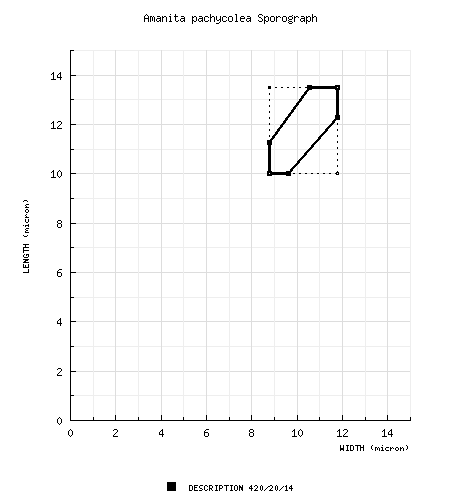
Tulloss (1994): [420/20/14] (7.8-) 10.0 - 13.5 (-16.5) × (7.5-) 8.8 - 11.8 (-14.0) µm, (L = (10.7-) 10.8 - 12.1 (-12.2) µm; L’ = 11.5 µm; W = 9.6 - 11.1 (-11.2) µm; W’ = 10.4 µm; Q = (1.0-) 1.04 - 1.28 (-1.65); Q = 1.06 - 1.20 (-1.21); Q’ = 1.11), inamyloid, hyaline, smooth, thin-walled, globose to subglobose to broadly ellipsoid, in some specimens quite commonly lachrimiform or flask-shaped (then occasionally constricted or contorted), adaxially flattened, sometimes swollen at one end, sometimes flask-shaped when immature; apiculus sublateral, cylindric, short, but occasionally rather broad; contents predominantly monoguttulate, sometimes with numerous small granules; white in deposit. |
| ecology |
Tulloss (1994): Often common in north coastal forests of western North America especially north of Monterey Co., California, found under conifers and in mixed woods often including Quercus or in humus in mixed woods or under conifers (duff in packet with one specimen is identifiable as including Tsuga). |
| material examined |
Tulloss
(1994):
U.S.A.:
CALIFORNIA—Del Norte Co. - Jedediah Smith
St. Pk., 12.xi.1966 G. A. Breckon 568 (paratype,
SFSU). Humboldt Co. - Prairie Creek St. Pk.,
12.xi.1966 G. A. Breckon 564 (paratype, SFSU).
Marin Co. - Alpine Lake, 18.xi.1979 P. Smith 121
(paratype, SFSU). Mendocino Co. - Jackson
St. For., ca. Mendocino, 25.xi.1960 H. D. Thiers
8449 (paratype, SFSU), 9.xi.1961 J. Jensen 22
(paratype, SFSU), 20.xii.1962 H. D. Thiers 9740
(paratype, SFSU), 14.xi.1967 H. D. Thiers 21502
(holotype, SFSU; isotype, NY 00066693), 9.ix.1968
H. D. Thiers 23086 (paratype, SFSU); Mushroom
Corners, 11.xi.1963 G. A. Breckon 211 (paratype,
SFSU); unkn. loc., 17.ix.1961 Largent, Thiers,
Motta & Peters [Largent 577] (paratype,
SFSU). San Mateo Co. - Huddart Pk., s.d.
W. J. Sundberg 33 (paratype, SFSU); San Francisco
Watershed, ca. Water Temple, 12.xii.1975 Roy E.
Halling 1197 (paratype, SFSU), 13.xii.1975 H. D.
Thiers 35612 (paratype, SFSU). Santa Cruz
Co. - Big Basin, Hwy. 236, 15.xi.1975 R. E. Halling
1104 (paratype, SFSU).
Non-type: U.S.A.:
CALIFORNIA—Mendocino Co. - ca. Camp
Gualala, 18.ix.1989 Craig Risser s.n. [Tulloss
11-18-89-MSSF1] (RET 016-7, nrLSU fragment
seq'd.).
Polk Co. - Camp Tapawingo,
7.xii.1992 J. E. Lindgren 92-74 (RET 077-5, nrLSU
seq'd.).
WASHINGTON—Skamania Co. - Gifford
Pinchot Nat For., Pacific Crest Tr., N. Bonneville,
11.xi.1992 J. E. Lindgren 92-78 (RET 078-2, nrLSU
seq'd.). |
| discussion |
t.b.d.
[NOTE: Also, check Tulloss 11-24-89-F (RET 092-8) and Tulloss 11-24-89-H (RET 092-7) which I thought were the present species at the time I labeled the collections.]
[NOTE: See Thiers 43904 (SFSU) and A. H. Smith 16641,
17963, 17503, and 18072 (all in MICH). For
"brown form," see A. H. Smith 83676 (MICH). The
write-up is in his Ms.] |
| citations |
—R. E. Tulloss |
| editors |
RET |
|



 Spore data sets and their composite