
| name | Amanita ochracea |
| name status | nomen acceptum |
| author | (Zhu L. Yang) Yang-Yang Cui, Qing Cai & Zhu L. Yang |
| english name | "Ochraceous Slender Caesar" |
| synonyms |
Amanita hemibapha var. ochracea Zhu L. Yang |
| images |
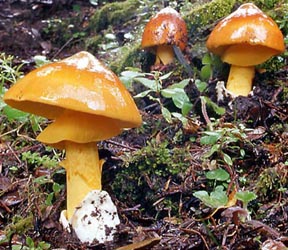  1. Amanita hemibapha var. ochracea - Z. L. Yang (SW China) 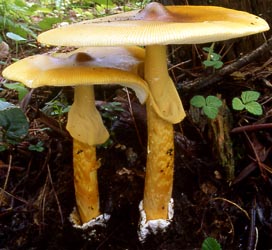 2. Amanita hemibapha var. ochracea - Z. L. Yang (SW China) 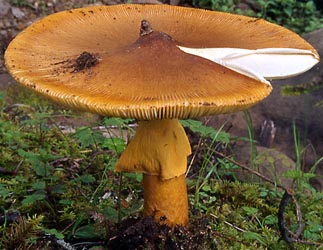 3. Amanita hemibapha var. ochracea - Z. L. Yang (SW China) |
| cap |
The fruiting bodies of Amanita ochracea are large. The cap is 100 - 200 mm wide, convex to plano-convex, distinctly umbonate, brown over disc, becoming ochracous to yellow toward the margin, usually glabrous. The cap margin is tuberculate-striate (30% to 35% of the radius) and non-appendiculate; the context is white. |
| gills |
Gills are free to nearly free, crowded, white, with yellow to yellowish brown edges; the short gills are truncate. |
| stem |
The stem measures 150 - 250 × 15 - 30 mm, usually tapering upward, whitish to yellowish, covered with yellowish brown to yellowish squamules; the context is white, hollow; and the stem lacks a basal bulb. On the stipe base, the volva is saccate, 40 - 80 x 30 - 50 mm and membranous. The outer surface is white to dirty white; and the inner surface is whitish, with a white to yellowish internal limb placed rather high on the inside of volval limb. The annulus is membranous and yellowish. |
| odor/taste |
The present species is edible and often found in markets. |
| spores |
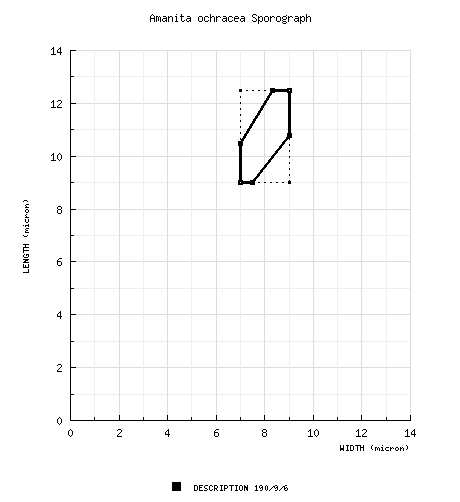
The spores measure (8.0-) 9.0 - 12.5 (-17.0) × (6.0-) 7.0 - 9.0 (-10.0) µm and are broadly ellipsoid to ellipsoid and inamyloid. Clamps are common on the bases of basidia. |
| discussion |
Amanita ochracea was originally described from Yunnan Province, China. This species is common in the subalpine to alpine regions of southwestern China.—Zhu L. Yang For more information on related taxa see A. hemibapha (Berk. & Broome) Sacc. |
| brief editors | RET |

 Spore data sets and their composite