

| name | Amanita oberwinklerana |
| name status | nomen acceptum |
| author | Zhu L. Yang & Yoshim. Doi |
| english name | "Oberwinkler's Destroying Angel" |
| images |
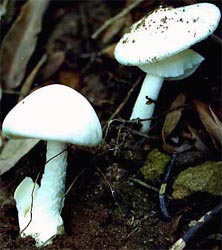 1. Amanita oberwinklerana, Guangzhou City, Guangdong Province, China. 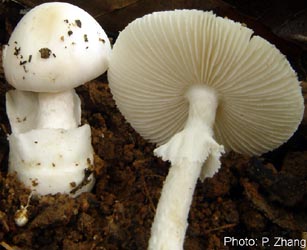  2. Amanita oberwinklerana, Guangzhou City, Guangdong Province, China. |
| cap |
The fruiting bodies of A. oberwinklerana are small to medium-sized. The cap is 30 - 60 (-80) mm wide, convex to applanate,white, occasionally cream over disc, and glabrous or covered with a few white, membranous volval remnants; the cap's margin is smooth and non-appendiculate; the cap's flesh is white and unchanging. |
| gills |
The gills are free, white at first, and become cream to yellowish when over-mature; the short gills are attenuate. |
| stem |
The stem is 50 - 70 (-90) × 5 - 10 (-15) mm, slightly attenuate upwards, with a surface that is white, and glabrous or covered with white fibrillose to somewhat reflexed squamules; the stem's basal bulb is subflobose to napiform and 10 - 20 mm wide. At the base of the stem, the volva is limbate, with a free limb up to 10 mm high, and with both inner and outer surfaces white. The annulus is membranous and white. The response to dilute KOH solution in A. oberwinklerana is negative. |
| odor/taste | Not known. This mushroom should be considered deadly POISONOUS. |
| spores |
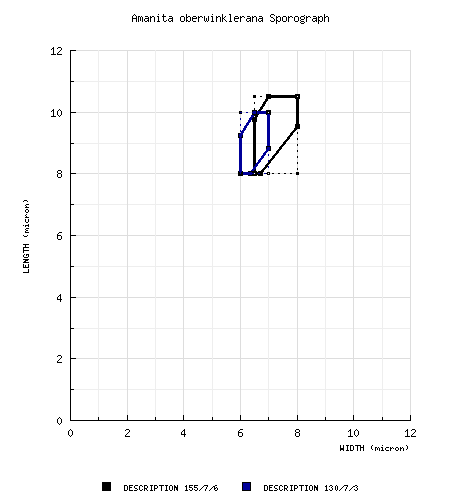
The spores measure (7.5-) 8.0 - 10.5 (-12.0) × (5.5-) 6.0 - 8.0 (-10.5) µm and are ellipsoid or, sometimes, broadly ellipsoid and amyloid. Clamps are absent from the bases of basidia. |
| discussion |
This species was originally described from Japan, but also occurs in China.—Zhu L. Yang [Note: Among the white species of section Phalloideae, the upstanding volval limb accompanied by ellipsoid spores and lack of a response to KOH solution is particularly reminiscent of A. elliptosperma G. F. Atk. of North America.—ed.] |
| brief editors | RET |

 Spore data sets and their composite