| name |
Amanita elliptosperma |
| author |
G. F. Atk. 1909. Ann. Mycol. 7: 366. |
| name status |
nomen acceptum |
| english name |
"Atkinson's Destroying Angel" |
| MycoBank nos. |
211002 |
| GenBank nos. |
Due to delays in data processing at GenBank, some accession numbers may lead to unreleased (pending) pages.
These pages will eventually be made live, so try again later.
|
| holotypes |
CUP |
| intro |
The following text may make multiple use of each data field.
The field may contain magenta text presenting data from a type study
and/or revision of other original material cited in the protolog of the present taxon.
Macroscopic descriptions in magenta are a combination of data from the protolog and
additional observations made on the exiccata during revision of the cited original
material.
The same field may also contain black text, which is data from a revision of the present
taxon (including non-type material and/or material not cited in the protolog).
Paragraphs of black text will be labeled if further subdivision of
this text is appropriate.
Olive text indicates a specimen that has not been
thoroughly examined (for example, for microscopic details) and marks other places in the text
where data is missing or uncertain.
The following material not directly from the protolog of the present taxon and not cited as the work of another researcher is based on original research by R. E. Tulloss. |
| basidia |
from type study of Tulloss: 30 - 45 × 7.5 - 13.5 μm, predominantly 4-, infrequently less than 4-sterigmate; sterigmata ??; neither clamps nor proliferated clamps present.
composite from all material revised by Tulloss: 30 - 51 × 7.5 - 13.5 μm, predominantly 4-, rarely less than 4-sterigmate; sterigmata ??; neither clamps nor proliferated clamps present. |
| universal veil |
from type study of Tulloss: From limb at base of stipe, exterior layer: filamentous undifferentiated hyphae in loosely interwoven mat, gelatinizing; inflated cells few, smaller than in interior; vascular hyphae 1.8 - 3.2 μm wide. From limb at base of stipe, interior: filamentous undifferentiated hyphae 1.5 - 7.5 μm wide, plentiful; inflated cells plentiful, subglobose to ovoid to clavate (e.g., 44 - 68 × 29 - 45 μm); vascular hyphae 1.5 - 2.5 μm wide, frequency not recorded. From limb at base of stipe inner surface: abrupt termination of interior structure at gelatinized surface.
composite of from all material revised by Tulloss: From limb at base of stipe, exterior layer: filamentous undifferentiated hyphae in loosely interwoven mat, partially to extensively gelatinized; inflated cells few, smaller than in interior (visibly only in specimens with partial gelatinization of exterior volval surface); vascular hyphae 1.8 - 3.2 μm wide (visibly only in specimens with partial gelatinization of exterior volval surface). From limb at base of stipe, interior: filamentous undifferentiated hyphae 1.5 - 7.5 (-13.2) μm wide, branching, plentiful to locally dominant; inflated cells plentiful to locally dominant, thin-walled, subglobose to pyriform to to ovoid subventricose to clavate to ventricose to elongate (e.g., 44 - 105 × 14 - 48 μm), terminal; vascular hyphae 1.5 - 6.8 μm wide, frequency not always recorded, sometimes scarce. From limb at base of stipe inner surface: abrupt termination of interior structure at gelatinized surface or with thin gelatinizing layer (from pileipellis?) comprised as follows: filamentous undifferentiated hyphae 2.8 - 7.0 μm wide, sublongitudinally oriented, branching; vascular hyphae 2.1 - 5.6 μm wide, branching, locally tangling. |
| stipe context |
from type study of Tulloss: longitudinally acrophysalidic; filamentous undifferentiated hyphae not described; acrophysalides, e.g., 125 - 183 × 29 - 42 μm; vascular hyphae 5.5 - 15.0 μm wide. |
| partial veil |
from type study of Tulloss: filamentous undifferentiated hyphae 1.8 - 8.5 μm wide, subradially arranged, without coils or twists, dominating; inflated cells thin-walled, ovoid (e.g., 29 - 51 × 16 - 32 μm) to clavate (e.g., 41 - 84 × 20 - 34); vascular hyphae rare or absent; clamps not observed. |
| basidiospores |
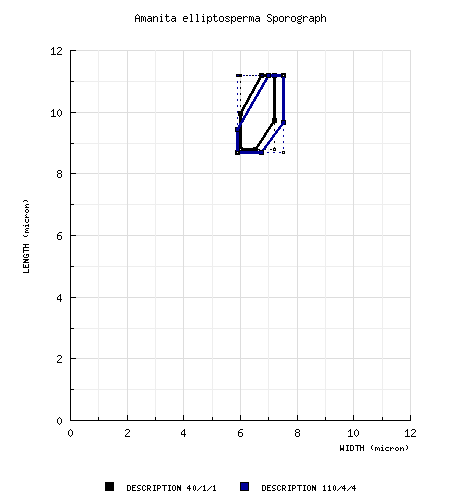
from type study of Tulloss: [40/1/1] (8.0-) 8.8 - 11.2 (-11.5) × (5.8-) 6.0 - 7.2 (-7.8) μm, (L = 9.9 μm; W
= 6.8 μm; Q = (1.29-) 1.35 - 1.66 (-1.69); Q = 1.48), hyaline, colorless, smooth, thin-walled, amyloid, ellipsoid, occasionally elongate, infrequently broadly ellipsoid, adaxially flattened, sometimes swollen at one end; apiculus sublateral, cylindric, proportionately small; contents granular to guttulate; color in deposit not recorded.
composite from all material examined by RET: [110/4/4] (8.0-) 8.7 -11.2 (-11.5) × (5.8-) 5.9 - 7.5 (-7.8) μm, (L = 9.6 - 9.9 μm; L' = 9.8 μm; W = 6.5 - 6.9 μm; W' = 6.8 μm; Q = (1.25-) 1.29 - 1.60 (-1.71); Q = 1.40 - 1.50; Q' = 1.45), hyaline, colorless, smooth, thin-walled, amyloid, ellipsoid, infrequently broadly ellipsoid, rarely elongate, sometimes slightly swollen toward one end, adaxially flattened; apiculus sublateral, cylindric, proportionately small; contents granular to guttulate; ?? in deposit. |
| material examined |
Jenkins (1982): U.S.A.:
NORTH CAROLINA—Orange Co. - Chapel Hill, 1908 W. C. Coker 22631 (holotype, CUP).
RET: U.S.A.:
CONNECTICUT—Middlesex
Co. - Devil's Hopyard St. Pk.
[41.4756° N/ 72.3403° W, 72 m], 4.ix.2011 Kevin Scalzo s.n. [Tulloss 9-4-11-K] (RET 490-1).
INDIANA—Monroe Co. - Bloomington, Griffey Lk., 27.ix.2012 Stephen Russell s.n. [mushroomobserver.org #111423] (RET 535-5).
NORTH CAROLINA—Orange Co. - Chapel Hill, 1908 W. C. Coker 22631 (holotype, CUP).
WEST VIRGINIA—Randolph Co. - Alpena, Shaver's Mtn., Alpena Gap [USGS Bowden Quad. 616:4308], 2.viii.1985 Sylvia Stein s.n. [Tulloss 8-2-85-A] (RET 201-1). Tucker Co. - Mongahela Nat. For., Dolly Sods Scenic Area [39°01’58” N/ 79°18’55”W], 3.viii.1985 Don Huffman s.n. [Tulloss 8-3-85-F] (RET 200-10); N fork of Red Run [USGS Mozark Mtn. Quad.616:4305], 3.viii.1985 Richard L. Blanton s.n. [Tulloss 8-3-85-H] (RET 203-1). |
| discussion |
(t.b.d.)
Spore measurements from the type study of Jenkins (1982) follow: [-/-/1] 9.4 - 10.9 × 6.2 - 8.6 μm, (Q = 1.27 - 1.75; Q' = 1.49), hyaline, thin-walled amyloid, broadly ellipsoid to ellipsoid to elongate; apiculus sublateral, cylindric; contents guttulate;
color in deposit not recorded. |
| citations |
—R. E. Tulloss |
| editors |
RET |
|




 Spore data sets and their composite