| name |
Amanita nothofagi |
| author |
G. Stev. 1962. Kew Bull. 16: 67, pl. 3/2. |
| name status |
nomen acceptum |
| english name |
"Southern Beech Amanita" |
| synonyms |
= Amanita excelsa sensu Stevenson ( 1962) p.p.
The editors of this site owe a great debt to Dr. Cornelis Bas
whose famous cigar box files of Amanita nomenclatural information
gathered over three or more decades were made available to RET for computerization
and make up the lion's share of the nomenclatural information presented on this site.
|
| MycoBank nos. |
326104 |
| GenBank nos. |
Due to delays in data processing at GenBank, some accession numbers may lead to unreleased (pending) pages.
These pages will eventually be made live, so try again later.
|
| holotypes |
K |
| revisions |
Ridley. 1991. Austral. Syst. Bot. 4: 337, fig. 6(a-k). |
| intro |
The following text may make multiple use of each data field.
The field may contain magenta text presenting data from a type study
and/or revision of other original material cited in the protolog of the present taxon.
Macroscopic descriptions in magenta are a combination of data from the protolog and
additional observations made on the exiccata during revision of the cited original
material.
The same field may also contain black text, which is data from a revision of the present
taxon (including non-type material and/or material not cited in the protolog).
Paragraphs of black text will be labeled if further subdivision of
this text is appropriate.
Olive text indicates a specimen that has not been
thoroughly examined (for example, for microscopic details) and marks other places in the text
where data is missing or uncertain.
The following material is predominantly derived from the revision of G. S. Ridley (1991). Any additional data (marked as such below) is based on original research by R. E. Tulloss.
Basidiomes small to large. |
| pileus |
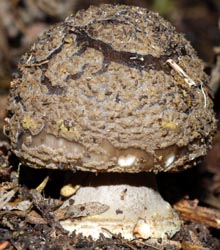
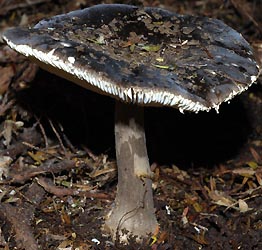
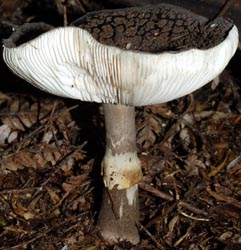
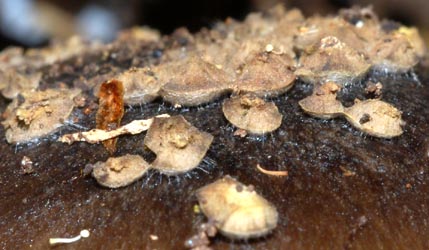
30 - 130 mm, convex to plano-convex, then plano-depressed, with color variable, buff to pale buff, dark mouse-gray to grayish sepia, hazel or cinnamon to buff, dark grayish sepia radially streaked with fuscous, or fuscous black streaked with grayish sepia, viscid when young or wet, drying with age; context predominantly or entirely white, sometimes with mouse-gray region under pileipellis in disc, occasionally with gray line above lamellae; margin striate (0.05 – 0.06 R), entire; universal veil as small to extensive, irregularly shaped, felted patches, dull grayish sepia to sepia, occasionally scab-like, then grayish sepia with pale centers, rarely arranged concentrically. |
| lamellae |
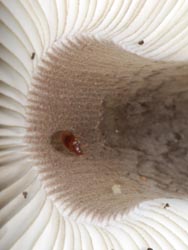
free, crowded, white to cream , with edge entire, 6 – 10 mm broad; lamellulae subtruncate. |
| stipe |
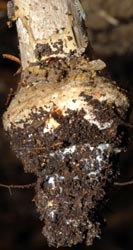
40 – 140 × 5 – 25 mm, white, sordid white, buff or grayish sepia streaked with mouse-gray, occasionally breaking into bands or fibrillose scales, tapering slightly at apex; bulb occasionally abrupt, usually clavate; context white to pale buff, hollow above bulb; partial veil membranous, striate, white to sordid white to buff to grayish sepia or lavender-gray, pendulous then adhering to stipe, often tearing and adhering to pileus margin; universal veil absent or as band or rim of buff to grayish sepia remnants ??on bulb or lower stipe??. |
| pileipellis |
130 – 220 µm thick, with suprapellis strongly gelatinized, with subpellis dense, not gelantinized. |
| basidia |
30 - 57 × (6.5-) 8.0 – 16.0 µm, 4-spored, rarely less; clamps absent. |
| universal veil |
On pileus: hyphae 4 - 9 µm wide, pale umber and either irregularly arranged, or tending to vertical orientation; inflated cells abundant, globose to ellipsoid to clavate, 21 - 119 × 14.5 - 115 µm. On stipe base: not described. |
| lamella edge tissue |
inflated cells 13.0 – 58 × 8.0 – 33 µm, globose or clavate or sphaeropedunculate, hyaline. |
| basidiospores |
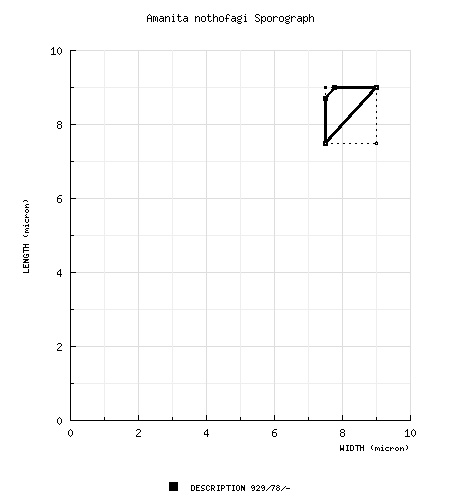
From the revision of (Ridley 1991): [929/78/-] (6.5-) 7.5 – 9.0 (-13.0) × (6.5-) 7.5 – 9.0 (-13.0) µm, (Q = 1.0 – 1.16 (- 1.40); Q' = 1.05), hyaline, thin-walled, amyloid, globose to subglobose to broadly ellipsoid, infrequently ellipsoid; apiculus not described; contents not described; white in deposit. |
| ecology |
From the revision of(Ridley 1991): Solitary to subgregarious. Under Nothofagus fusca, N. menziesii, N. solandri var. solandri, N. truncata, Leptospermum scoparium and Kunzea ericoides. Known from both North and South Islands of New Zealand. |
| material examined |
From the revision of (Ridley 1991): NEW ZEALAND: AUCKLAND—Auckland City, Birkenhead, Kauri Pk., 31.iii.1972 J. M. Dingley s.n. (PDD 29836); Rotorua, Mangorewa Gorge, 25.iv.1967 R. F. R. McNabb s.n. (PDD 25824).
CANTERBURY—Kowai Bush, 5.ii.1969 R. F. R. McNabb s.n. (PDD 31282).
GISBORNE—Urewera Nat. Pk., 14.ii.1982 G. M. Taylor 1169 (??).
NELSON—Cape Farewell, 29.iii.1957 E. B. Kidson s.n. [G. Stevenson ??] (K); Nelson Lakes Nat. Pk., Eve’s Valley, 11.v.1957 G. Stevenson 1221 (K). Nelson Lakes Nat. Pk., Lk. Rotoiti, 18.iv.1954 G. Stevenson 935 (holotype, K); Spooner’s Range, 20.v.1956 G. Stevenson 1092 (K).
OTAGO—Lake Wanaka, Makarora, 11.iv.1968 G. M. Taylor 418 (??).
SOUTHLAND—Fiordland Nat. Pk., Lark Hauroko, 22.ii.1968, G. M. Taylor 395 (??).
WELLINGTON—Orongorongo Track, 1.iv.1987 G. S. Ridley 348 (PDD 56183); Orongorongo Valley, Paua Ridge, 19.iii.1986 G. S. Ridley 15b (PDD 56169), 9.iv.1986 G. S. Ridley 62 (PDD 56174), 11.iii.1987 G. S. Ridley 301 (PDD 56178), 15.iii.1988 G. S. Ridley 592 (PDD 56189); Rimutaka For. Pk., Catchpool Stream, 3.v.1958 G. Stevenson 1297b (K); Wellington city, Otari (Native Plant Mus.), 29.vii.1948 G. Stevenson 399 (K). |
| discussion |
From Ridley (1991), edited by RET: Amanita nothofagi … is the most commonly encountered of the native Amanita species, and is also the most variable in size, stature, coloration and volva configuration.
Stevenson’s original description appears to have been based on a single, dark gray specimen. This has led to a great deal of uncertainty and confusion amongst later collectors when faced with individual basidiomes ranging from buff to fuscous. The paler individuals are reminiscent of A. excelsa and may have contributed to the false belief that this later species occurred in New Zealand.
There would seem to be a strong similarity between A. nothofagi and A. luteofusca Cleland & E. J. Gilbert from Australia. These latter two species both have amyloid, subglobose basidiospores in the 7 – 10 µm range and have basidia of similar size that lack clamp connections. Both species are variable in stature; Reid (1979) noted A. luteofusca could be either ‘gracile’ or ‘relatively stout’. A. luteofusca differs in its coloration of ‘grayish brown’ to ‘yellowish gray brown’ and fading to ‘pinkish buff’ with age. |
| citations |
—R. E. Tulloss |
| editors |
RET |
|




 Spore data sets and their composite