

| name | Amanita excelsa |
| name status | nomen acceptum |
| author | (Fr. : Fr.) Bertillon in Dechambre |
| english name | "European False Blusher" |
| synonyms |
=Amanita ampla Pers. |
| images | |
| intro | The following description is largely based on Bertillon (1866), Breitenbach and Kränzlin (1995), and Neville and Poumarat (2004). |
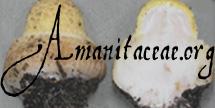
| cap | The cap of A. excelsa is 50 - 120 (-150) mm wide, gray-brown or umber-brown or olive brown, hemispheric when young, convex, then plane, with an incurved and nonstriate margin. The cap is initially covered with a volva, which on expansion of the cap, disrupts into thin, mealy, gray, irregular patches of volval tissue which are easily removable. The cap flesh is white and rather thick above the stem. |
| gills | The gills are crowded, white, adnexed, 4 - 9 mm broad, with an undecorated to finely flocculose edge. Short gills are present in sets of one to three between every pair of full length gills. |
| stem | The stem is 60 - 120 (-150) × 15 - 30 mm, slightly narrowing upward, solid, white to pale gray and striate above the ring. It is covered with inconspicuous, white to pale gray, granular scales below the ring, which form concentric circles towards the base. The base is enlarged to a bulb up to 40 mm wide but can sometimes be barely broader than the stem when the stem is fully expanded. The ring is membranous, skirt-like, with the upper surface striate. The volva is present as 2 - 5 pale ocher brown zones of friable material above the bulb. The flesh is firm. |
| odor/taste | Odor is faintly grass-like according to some European authors. Other European authors say it has a faint odor or taste of radish. |
| spores | The spores measure, according to Neville and Poumarat, (7.0-) 7.5 - 10.0 (-13.5) × (5.0-) 5.5 - 7.0 (-8.0) µm and are broadly ellipsoid to ellipsoid, occasionally elongate and amyloid. Clamps are absent at bases of basidia. |
| discussion |
The species was originally described from Sweden. In Switzerland, Breitenbach and Kränzlin say that, while it occurs at lower altitudes, it is largely montane. Neville and Poumarat list associations with Fir (Abies), Spruce (Picea), Pine (Pinus), Oak (Quercus), and Beech (Fagus). It is said to occur in Morocco with imported Eucalyptus. It is reported to have been imported to South Africa with European trees, but RET could not confirm this from material made available to him. Neville and Poumarat (2004) designated a plate of Krombholz as the neotype of this species. They reprint this image as Plate 82 in the first volume of their Amaniteae. RET has expressed his concern about the value of taking a plate as a neotype (Tulloss, 2005). European authors often comment on the variable nature of this species. Neville and Poumarat accept a number of varieties and forms of the present species. The species name has been extensively misapplied elsewhere in the world. In eastern North America, the name has been applied to A. morrisii Peck and A. submaculata Peck resulting in spread of the false notion in some quarters that A. excelsa has a fruit-like odor. The name has also been applied to one or more undescribed species in the Americas.—R. E. Tulloss and L. Possiel |
| brief editors | RET |
| name | Amanita excelsa | ||||||||||||||||||||
| author | (Fr. : Fr.) Bertillon in DeChambre. 1866. Dict. Encycl. Sci. Med. 1(3): 499. | ||||||||||||||||||||
| name status | nomen acceptum | ||||||||||||||||||||
| english name | "European False Blusher" | ||||||||||||||||||||
| synonyms |
≡Agaricus (Amanita) excelsus Fr. : Fr. 1821. Syst. Mycol. 1: 17. [Explicitly based on Amanita ampla Pers., below.]
≡Amanita excelsa (Fr. : Fr.) P. Kumm. 1871. Führer Pilzk.: 138. [Superfluous combination.]
≡Amanita spissa var. excelsa (Fr. : Fr.) Dörfelt & I. L. Roth. ad int. 1981. Mitt. Florist. Kart. (Halle) 7(1): 29.
≡Amanita spissa var. excelsa (Fr. : Fr.) Dörfelt & I. L. Roth. ex Dörfelt & I. L. Roth. nom. inval. 1982. Pilzfl. Vogtland.: 24. [If the taxa represent a single species, then Amanita excelsa, having priority, must be the name of the species.]
≡Venenarius excelsus (Fr. : Fr.) Murrill. 1948. Lloydia 11: 161.
≡Hypophyllum maculatum Paulet nom. inval. 1808-1835. Iconogr. Champ.: pl. 159. [Devalidated name. The name Amanita Pers. is conserved against Amanita Boehm. of which Hypophylum is an isonym. (Donk. 1962. Beih. Nova Hedwigia 5: 145.)]
≡Fungus viscidus Paulet. 1793. Trait. Champ. 2: 355, index [7].
≡Amanita ampla Pers. 1801. Syn. Meth. Fung. 2: 255.
≡Amplariella ampla (Pers.) E.-J. Gilbert. 1940. Iconogr. Mycol. (Milan) 27, suppl. (1): 78, tab. 39 (figs. 2-6), tab. 40 (figs. 1-6), tab. 41 (fig. 1).
≡Amanita spissa var. ampla (Pers.) Veselý. 1933. Ann. Mycol. 31(4): 268. [If the taxa represent a single species, then Amanita excelsa, having priority, must be the name of the species.]
Extensive additional detail will appear in the Amanita Nomenclator (t.b.d.) The editors of this site owe a great debt to Dr. Cornelis Bas whose famous cigar box files of Amanita nomenclatural information gathered over three or more decades were made available to RET for computerization and make up the lion's share of the nomenclatural information presented on this site. | ||||||||||||||||||||
| MycoBank nos. | 211312 | ||||||||||||||||||||
| GenBank nos. |
Due to delays in data processing at GenBank, some accession numbers may lead to unreleased (pending) pages.
These pages will eventually be made live, so try again later. Search:
Showing 0 to 0 of 0 entries | ||||||||||||||||||||
| neotypes | Krombholz. 1836. Natur. Abbild. Beschreib. essbar. schädl. verdächt. Schwämme Heft 4: taf. 29 (figs. 14-17). | ||||||||||||||||||||
| neotypifications | Neville and Poumarat. 2004. Fungi Europeai 9: 712. [The latter figure number is incorrectly transcribed in the caption of pl. 82 on p. 1018.] | ||||||||||||||||||||
| citations | —R. E. Tulloss | ||||||||||||||||||||
| editors | RET | ||||||||||||||||||||
Information to support the viewer in reading the content of "technical" tabs can be found here.
| name | Amanita excelsa |
| bottom links |
[ Section Validae page. ]
[ Amanita Studies home. ]
[ Keys & Checklists ] |
| name | Amanita excelsa |
| bottom links |
[ Section Validae page. ]
[ Amanita Studies home. ]
[ Keys & Checklists ] |

Text and User-Generated Sporographs are published under the Creative Commons License.

In the case of a taxon page, image credits are on the 'image' tab.