

| name | Amanita miomboensis |
| name status | nomen acceptum |
| author | Pegler & Shah-Sm. |
| english name | "Miombo Lepidella" |
| intro | The following is based on the original description of Pegler & Shah-Smith (1997). |
| cap | The cap of Amanita miomboensis is 70 - 130 mm wide, convex to applanate, dry, appendiculate, with a nonstriate margin. The volval remnants are present as is covered with numerous, small, pyramidal, light pinkish-gray, soft-floccose warts, 1 - 2 mm high, adhering to the cap. The flesh is 15 mm thick over the stem, white, and unchanging. |
| gills | The gills are free, pale yellow, ventricose, up to 12 mm wide, crowded. The short gills are truncate, of two lengths. |
| stem | The stem is 90 - 110 × 10 - 20 mm, cylindrical, solid, white, subviscid, fibrillose scaly with pinkish-gray, indefinite volval remnants covering the top of the bulbous base. The basal bulb is prominent, slightly rooting, up to 40 mm wide. The ring leaves a fibrillose zone near the top of the stem. |
| spores | The spores measure 8.5 - 10 × 5.5 - 6.5 µm and are ellipsoid and amyloid. Clamps are absent at bases of basidia. |
| discussion |
Originally described from Zambia in open grassy forests of the Miombo type. The dominant trees in the Miombo woodlands are from the subfamilies Caesalpinoideae (for example Brachystegia) and Euphorbiaceae (for example Uapaca). Pegler and Shah-Smith suggested this species belongs in subsection Solitariae Bas. No one has proposed a placement in Bas' system at the rank of stirps.—R. E. Tulloss |
| brief editors | RET |
| name | Amanita miomboensis | ||||||||||||||||||||
| author | Pegler & Shah-Sm. 1997. Mycotaxon 61: 409, fig. 5(A-D). | ||||||||||||||||||||
| name status | nomen acceptum | ||||||||||||||||||||
| english name | "Miombo Lepidella" | ||||||||||||||||||||
| MycoBank nos. | 436963 | ||||||||||||||||||||
| GenBank nos. |
Due to delays in data processing at GenBank, some accession numbers may lead to unreleased (pending) pages.
These pages will eventually be made live, so try again later. Search:
Showing 0 to 0 of 0 entries | ||||||||||||||||||||
| holotypes | K | ||||||||||||||||||||
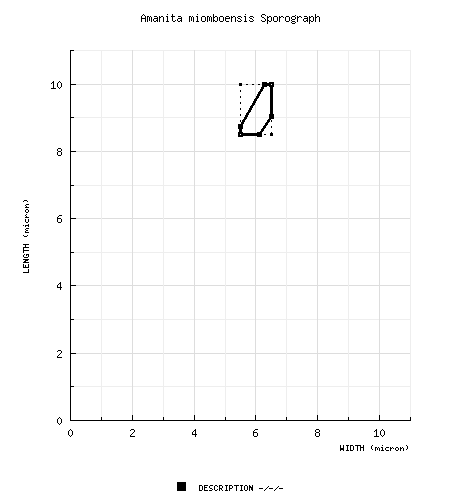
| basidiospores | from protolog: [-/-/-] 8.5 - 10 × 5.5 - 6.5 μm, (L = 9.3 ± 0.5 μm; W = 6.3 ± 0.3 μm; est. Q = 1.39 - 1.59; Q = 1.49), hyaline, thin-walled, amyloid, broadly ellipsoid to ellipsoid, adaxially flattened (per figure); apiculus aublateral (per figure); contents as large refractive guttule; white in deposit. [Note: In order to generate a sporograph, we have estimated values for Q with a conservative range.—ed.] | ||||||||||||||||||||
| ecology | from protolog: In open miombo grassland. | ||||||||||||||||||||
| material examined | from protolog: ZAMBIA: NORTHERN PROV.—Mpika Distr. - North Luangwa Nat. For. Park, s.d. D. Shah-Smith 173 (holotype, K 29971). | ||||||||||||||||||||
| citations | —R. E. Tulloss | ||||||||||||||||||||
| editors | RET | ||||||||||||||||||||
Information to support the viewer in reading the content of "technical" tabs can be found here.
| name | Amanita miomboensis |
| bottom links |
[ Keys & Checklists ] |
| name | Amanita miomboensis |
| bottom links |
[ Keys & Checklists ] |
 Spore data sets and their composite
Each spore data set is intended to comprise a set of measurements from a single specimen made by a single observer; and explanations prepared for this site talk about specimen-observer pairs associated with each data set. Combining more data into a single data set is non-optimal because it obscures observer differences (which may be valuable for instructional purposes, for example) and may obscure instances in which a single collection inadvertently contains a mixture of taxa.

Text and User-Generated Sporographs are published under the Creative Commons License.

In the case of a taxon page, image credits are on the 'image' tab.