

| name | Amanita melleialba |
| name status | nomen acceptum |
| author | Zhu L. Yang, Q. Cai & Yang Y. Cui |
| english name | "Honey on a Biscuit Amanita" |
| images |
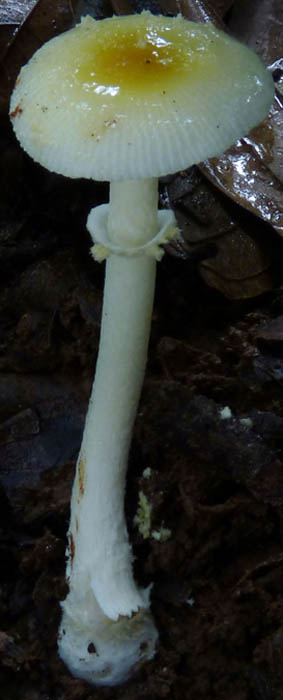 1. Amanita melleialba, Yunnan, China. 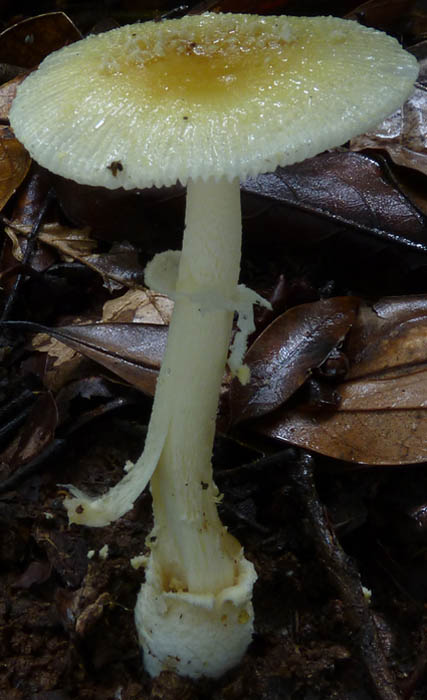 2. Amanita melleialba, Yunnan, China. |
| intro | This text is derived from the original description of Amanita melleialba. |
| cap | The cap of A. melleialba has a central region that is honey-colored or yellowish or yellow with an orange tint; beyound this region, the color fades to yellowish or whitish toward its tuberculate striate margin. The cap is 28 - 50 mm wide. Its center is often slightly depressed. The remains of volva on the cap are small, subconical to granular warts up to 2 mm tall; these are dirty white to cream to yellowish, randomly arrange or densely place in the center. The flesh of the cap is white and unchanging. |
| gills | Gills of the present species are white and crowded. There is a fine powery decoration on their free edges. The short gills are truncate, plentiful and rather evenly distributed. |
| stem | The stem of the present species measures 40 – 80 × 4–8 mm and is subcylindric or slightly tapering upward; it flares slightlu at its apex. The stem is white to cream-colored, covered with white fluffy little scales above and below the ring. The flesh of the stem is white; and the stem is loosely stuffed to hollow; the bulb at the stem's base is subglobose to napiform, 8 – 12 mm wide, and white. Volval remnants are white to cream-colored fluffy little scales or granules or form a short flap at the top of the bulf. The stem's ring hangs from a region 15 – 30 mm below the stem's apex and is white to cream-colored with a yellow fluffy edge. |
| odor/taste | The odor of this species is indistinct. No taste was recorded. |
| spores | The spores of A. melleialba measure 7.5 – 9.5 (–10) × (5.5–) 6 – 7 μm and are inamyloid and ellipsoid (occasionally broadly ellipsoid). Clamps are absent in all tissues. |
| discussion |
Amanita melleialba appears singly or gregarious
in subtropical forests dominated by the Beech-Oak family
(Fagaceae). It is known from southwestern and
central China (Hunan and Yunnan provinces). Amanita melleialba is characterized by its small-sized mushrooms, ellipsoid basidiospores, volval remnants on the cap that are dominated by inflated cells in chains of 2–4, and its occurrence in subtropical forests (see above). Amanita melleialba is very similar to A. parvipantherina Zhu L. Yang et al. However, the latter possesses a brownish pileus with shorter marginal striations, larger spores (8.5–11.5 × 6.5–8.5 μm), and is found in mixed forests with Yunnan Pine (Pinus yunnanensis). Amanita melleialba may be confused with A. elata (Massee) Corner & Bas, a species originally described from Singapore. However, A. elata< has volval remnants on the pileus that are small, scattered, irregularly shaped, fluffy-membranous, flat patches, which are easily washed off by rain, and globose to subglobose spores.—Z.-L. Yang and R. E. Tulloss |
| brief editors | RET |

