| name |
Amanita elata |
| author |
(Massee) Corner & Bas. 1962. Persoonia 2: 286, pl. 9a, figs. 40-44. |
| name status |
nomen acceptum |
| english name |
"False Collybia Amanita" |
| synonyms |
≡ Collybia elata Massee. 1914. Bull. Misc. Inform. Kew [1914]: 73.
non Hypophyllum elatum Paulet nom. inval. 1808-1835. Iconogr. Champ.: pl. 150 (fig. 3). [Devalidated name. The name Amanita Pers. is conserved against Amanita Boehm. of which Hypophylum is an isonym. (Donk. 1962. Beih. Nova Hedwigia 5: 145.)] [Note: Hypophyllum elatum is a synonym of A. arida (Fr.) Bertillon ( 1866), a nomen dubium denoting an undeterminable species of Amanita sect. Vaginatae.]
The editors of this site owe a great debt to Dr. Cornelis Bas
whose famous cigar box files of Amanita nomenclatural information
gathered over three or more decades were made available to RET for computerization
and make up the lion's share of the nomenclatural information presented on this site.
|
| MycoBank nos. |
326093 |
| GenBank nos. |
Due to delays in data processing at GenBank, some accession numbers may lead to unreleased (pending) pages.
These pages will eventually be made live, so try again later.
|
| holotypes |
K |
| intro |
The following text may make multiple use of each data field.
The field may contain magenta text presenting data from a type study
and/or revision of other original material cited in the protolog of the present taxon.
Macroscopic descriptions in magenta are a combination of data from the protolog and
additional observations made on the exiccata during revision of the cited original
material.
The same field may also contain black text, which is data from a revision of the present
taxon (including non-type material and/or material not cited in the protolog).
Paragraphs of black text will be labeled if further subdivision of
this text is appropriate.
Olive text indicates a specimen that has not been
thoroughly examined (for example, for microscopic details) and marks other places in the text
where data is missing or uncertain.
The following material is derived from (Corner & Bas 1962). |
| pileus |
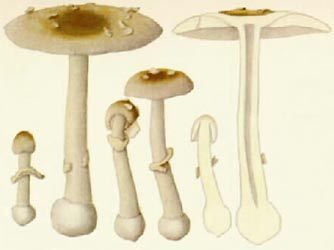
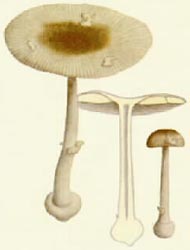
from Corner & Bas (1962): 35 - 90 mm wide, pale dingy ochraceous buff or dingy buff with very faint sulphur-yellow tinge, campanulate to convex when young, becoming plano-convex with depressed disc or concave with flat margin with age, glutinous-viscid, then smeary; context more or less umber or fuliginous in center, pallid whitish toward margin, firm, 2 - 4 mm thick above stipe, thin over limb; margin tuberculate-striate (0.25 -0.35R); universal veil absent or with some small, scattered, irregularly shaped, dingy white, rather thick, floccose-membranous, flat patches, easily washed off by rain. |
| lamellae |
from Corner & Bas (1962): free, crowded, 3 - 6 mm wide, white to cream, slightly transversely veined at base near margin of cap, with 72 - 125 primaries, with edge presumably minutely flocculose; lamellulae truncate, with 0 - 1 (-3) between each pair of otherwise adjacent lamellae. |
| stipe |
from Corner & Bas (1962): 50 - 130 × 4 - 15 mm, white to cream or slightly grayed, cylindric or narrowing upward, somewhat floccose-scabrid below, whitish pruinose above; bulb 8 - 19 wide, globose or subglobose, seldom slightly turbinate, marginate; context solid, becoming hollow, white; exannulate; universal veil as narrow, 2 - 6 mm high rim around top of bulb, often as [additional] spurious ascending ring [of limbus internus material], irregularly shaped, dingy white or pale dingy ochraceous. |
| odor/taste |
from Corner & Bas (1962): Odor unpleasant, as in A. phalloides. Taste not recorded. |
macrochemical
tests |
none recorded. |
| pileipellis |
from Corner & Bas (1962): suprapellis 10 - 40 µm thick and hyaline; subpellis 20 - 40 µm thick, with intracellular pigment; filamentous hyphae 1.5 - 4.5 µm wide, irregularly arranged and distant and apparently slightly embedded, but not dissolved in suprapellis, narrow and more or less radially arranged and very crowded in subpellis. |
| pileus context |
not described. |
| lamella trama |
from Corner & Bas (1962): rather distinctly bilateral; central stratum including elongated inflated cells (e.g., 60 - 200 × 20 - 40 µm) and narrow filamentous hyphae; subhymenial bases comprise diverging hyphae and inflated ellipsoid cells (e.g., 50 - 70 × 25 - 40 µm). |
| subhymenium |
from Corner & Bas (1962): broad, cellular, with inflated cells diminishing in size from 20 (-35) µm wide adjacent to subhymenial base to 5 - 10 µm wide at bases of basidia. |
| basidia |
from Corner & Bas (1962): 38 - 47 × 10 - 12 µm, 4-sterigmate, with sterigmata up to 5 µm long; in collection of 18 March 1931 many with thickened walls, (Corner & Bas (1962): fig. 40) especially near edge of gill; clamps lacking. |
| universal veil |
from Corner & Bas (1962): Universal veil on pileus: not described. Universal veil from basal bulb of stipe: filamentous hyphae 3 - 12 µm wide, numerous, branching, often constricted at septa, occasionally with oily contents; inflated cells up to 60 × 40 µm, mostly about 40 - 50 × 25 - 35 µm, terminal singly or occasionally in short chains. |
| stipe context |
from Corner & Bas (1962): longitudinally acrophysalidic; filamentous hyphae 2- 5 µm wide; acrophysalides up to 220 × 36 µm. In central cylinder softer; filamentous hyphae 4 - 10 µm wide; acrophysalides ellipsoid, constricted, terminal; vascular hyphae common, 6 - 14 µm wide. |
| partial veil |
absent. |
| lamella edge tissue |
from Corner & Bas (1962): broad, sterile; filamentous hyphae 3 µm and more wide, branching; inflated cells cylindric (8 - 12 µm wide, with rounded ends, sometimes forming short chains) and others (up to 25 µm across) often with oily contents. [Note: It is not clear whether all cells have oily contents or only the noncylindric ones do.—ed.] |
| basidiospores |
from Corner & Bas (1962): [-/-/-] 7.0 - 8.5 × (6.0-) 6.8 - 7.7 μm, (Q = 1.0 - 1.10 (-1.20); Q = not provided), hyaline, colorless, smooth, thin-walled, inamyloid, globose to subglobose, seldom broadly ellipsoid; apiculus proportionately rather large; contents with one medium-large gutta or several small ones, sometimes non-guttate; color in deposit not recorded. [Fresh spores reported to measure 7.0 - 9.5 × 6.0 - 8.5 μm.] |
| ecology |
from Corner & Bas (1962): Often very abundant, common every rainy season. Terrestrial in tropical forest remnants. |
| material examined |
from Corner & Bas (1962): SINGAPORE: Botanic Gardens, Gardens' Jungle, 22.ix.1913 E. M. Burkill 150 (holotype, K, with water color drawing); Botanic Gardens viii.1929 E. J. H. Corner s.n. (L), 18.iii.1934 E. J. H. Corner s.n. (L); Reservoir Jungle, 4.xi.1940 E. J. H. Corner s.n. (L, watercolor drawing only), 26.ix.1943 E. J. H. Corner s.n. (L, in liquid, water color drawing). |
| discussion |
from Corner & Bas (1962): "The fresh pileus having been described by the senior author as glutinous-viscid, it is somewhat amazing to find the cuticle of the preserved specimens with only a thin hyaline upper layer with non-dissolving hyphae. However, it may be that the specimens had already lost a more glutinous outer layer. As a matter of fact, all specimens preserved by the senior author had also lost remnants of the volva on pileus.
"Amanita elata greatly resembles A. gemmata... and is undoubtedly closely related to that species. However, A. gemmata differs by (i) a thinner, more paper-like volva, (ii) as a rule larger and more ellipsoid spores [according to 100 measurements of junior author on 10 Dutch collections, 8 - 11 (-12) × (6.0-) 7 - 8.5 µm, average length-breadth ratio per find ranging from 1.1 - 1.4], (iii) a golden yellow to ochraceous yellow pileus, becoming brownish only in center, (iv) absence of a smell, (v) occasional presence of a true ring derived from the partial veil and very rare presence of a spurious ring derived from the volva, only just above bulb, as in A. pantherina....
"It is even more difficult to separate the present species from A. diemii... from Patagonia. However, this species differs from A. elata by (i) a golden yellow to orange ochre yellow pileus turning brown with age from the center toward the margin, (ii) the margin of the cap often set with white denticules of the volva, (iii) the entirely coarsely floccose-granular stipe, (iv) the short ellipsoid, slightly larger spores, (viz., 8.2 - 10 × 7.5 - 9 µm), (v) the absence of a smell, (vi) the presence of clamps in the trama of the gills. Dr. R. Singer, Buenos Aires, who studied color slides of the watercolor drawings and the description of the present species, also looks upon A. elata and A. diemii as different species (in litt.).
"It is somewhat surprising to find this typical species of Amanita described [originally] as a species of Collybia. The type is well preserved, and it is not difficult to recognize in it the species depicted by Corner.
"The pileus of the type (Fig. 42) has a sulcate-striate margin and bears some patches derived from the volva. However, these may easily escape attention, as some pilei are almost completely covered with paper, due to glutinous surface of the fresh pileus. The exannulate stipe has a more or less globose bulbous base on which the margin of volva is easy to distinguish. Spores are non-amyloid and globulose; 6.8 - 8.4 × 6.7 - 7.9 µm and their length-breadth ratio = 1.0 - 1.05. ... " |
| citations |
—R. E. Tulloss |
| editors |
RET |
|




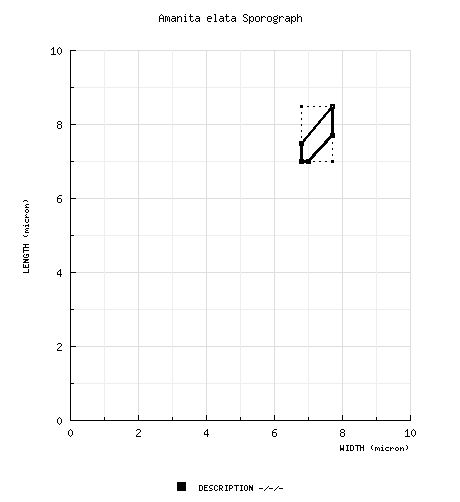
 Spore data sets and their composite