| name |
Amanita macerisolum |
| author |
Tulloss |
| name status |
nomen provisorum |
| english name |
"Poor Soil Lepidella" |
| etymology |
macerus, poor, inferior + solum soil;
because of the
occurrence of this fungus in dry, treeless places
with poor soil. The epithet is a noun in apposition
and retains its gender. |
| GenBank nos. |
Due to delays in data processing at GenBank, some accession numbers may lead to unreleased (pending) pages.
These pages will eventually be made live, so try again later.
|
| intro |
Olive text indicates a specimen that has not been
thoroughly examined (for example, for microscopic details) and marks other places in the text
where data is missing or uncertain.
The following material is based on original research of R. E. Tulloss. |
| pileus |
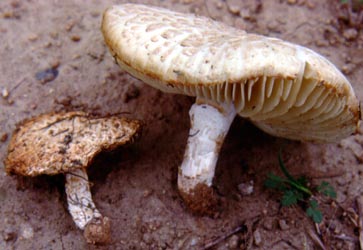
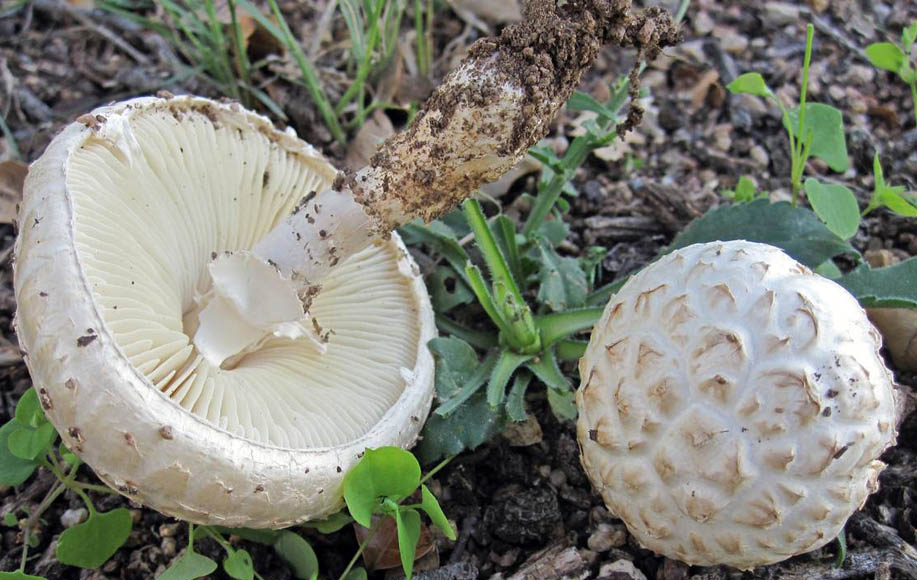
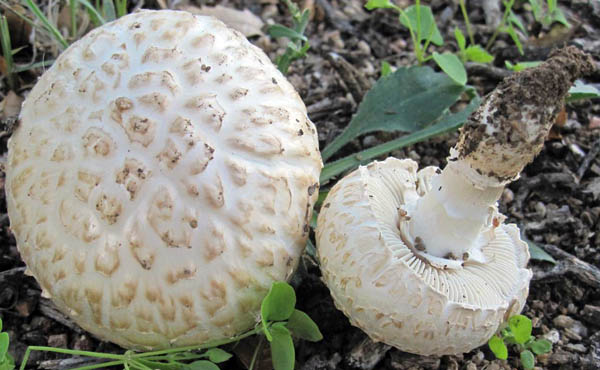
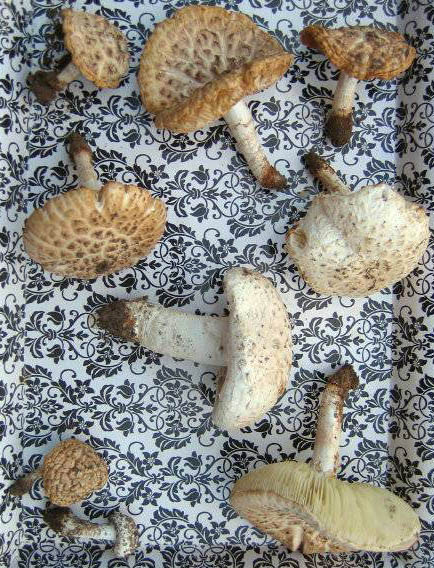
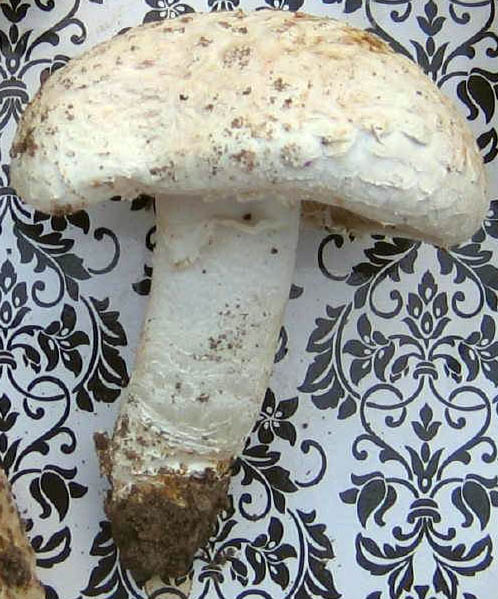
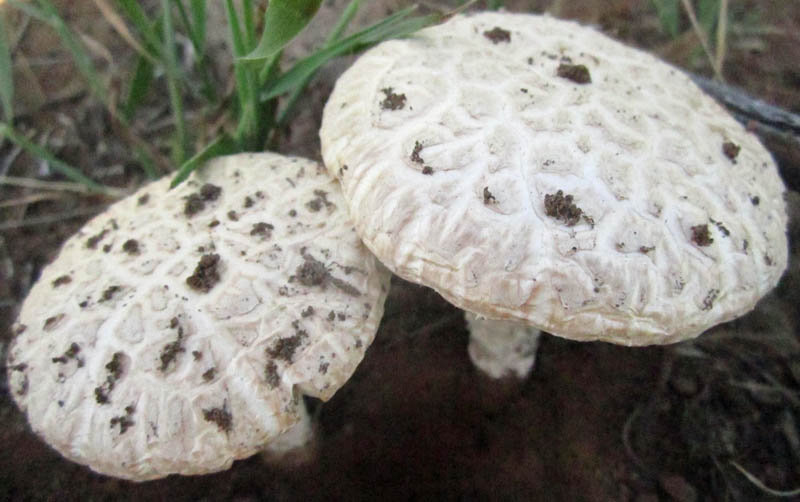
77± mm wide, with whitish surface exposed between warts and scales, areolate when found partially dried in field, plano-convex to convex; context white, up to 13 mm thick at stipe, thinning evenly to margin; margin nonstriate, appendiculate with fine brown pulverulence in narrow band; universal veil in light brown to light gray to pale grayish brown scales or small patches (to 5 mm across), not easily removed, larger scales tending to have raised portion on side nearest the pileus margin with smear of same color extending toward disc. |
| lamellae |
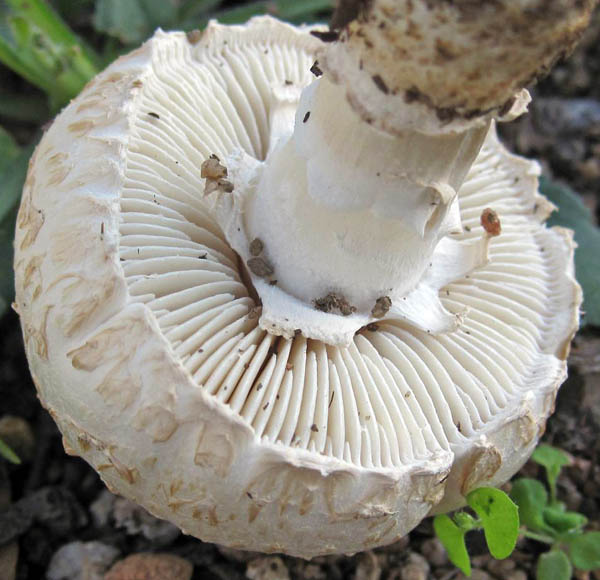
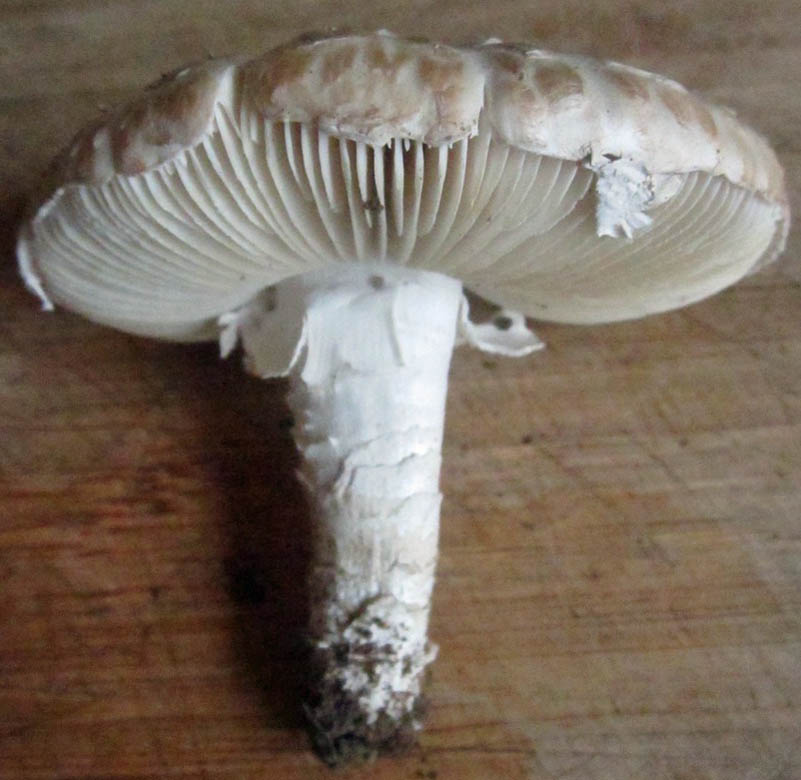
adnexed to adnate, subcrowded, white at first, becoming light dull yellowish to “honey” to “primrose” (Rayner chart), up to 16 mm broad, broadest at midpoint, with edges slight to strongly irregularly fimbriate; lamellulae attenuate, in [at least] one or two ranks. |
| stipe |
40± × 9± mm, white, tapering downward slightly, but not having pointed base, flaring at apex; context white, solid; partial veil as floccose to submembranous ragged ring, superior, tearing, moderately persistent, often eventually evanescent; universal veil as large torn white to brownish scales. |
| odor/taste |
Odor ""aromatic or minty" (Wright) or "mushroomy" (Chapman), strong and unpleasant in exsiccata. Taste “typical of section Lepidella” (Wright) or "very mild" (Chapman). |
macrochemical
tests |
10% KOH - negative on pileus, context of pileus, and lamellae. Meixner test - negative for amatoxins, developing yellow halo around spot tested after several minutes. 2% phenol - negative on stipe context. FeSO4 - negative in pileus and stipe context; positive (gray) on scales on stipe and on universal veil remnants on pileus. Test vouchers: specific vouchers not indicated by collector. |
| pileipellis |
not markedly differentiated from pileus context; filamentous, undifferentiated hyphae ?? µm wide, subradially arranged, gelatinizing slightly and only at pileus surface; ??. |
| pileus context |
with dense region 60± µm thick adjacent to universal veil. |
| lamella trama |
bilateral, narrow, with distinct central stratum comprising filamentous undifferentiated hyphae with intercalary segments inflated up to 17.5 µm wide; elements of subhymenial base diverging at angles under 45°; filamentous, undifferentiated hyphae 2.0 - 8.5 µm wide; possibly terminal inflated cells external in subhymenial base, diverging at shallow angles, in chains, clavate to ovoid to ellipsoid, up to 76 × 28 µm, thin-walled; vascular hyphae ??. |
| subhymenium |
appearing pseudoparenchymatous, with short partially inflated hyphal segments found on close inspection, having obscure branching structure. |
| basidia |
36 - 56 × 10.8 - 17 µm, with rather broad bases, thin-walled, predominantly 4-, but also 1- and 2-sterigmate, of two forms (slenderly clavate and quite broadly clavate), with those of slender type projecting considerably beyond surrounding basidioles; clamps plentiful. |
| universal veil |
On pileus: inflated cells elongate, periclinally arranged, some appearing to arise from hyphae of pileus context, gelatinizing, e.g., clavate to 42± × 15± µm. On stipe: ??. |
| lamella edge tissue |
sterile. |
| basidiospores |
composite of data from all material examined by RET and CRC: [140/7/5] (8.8-) 10.5 - 13.5 (-14.5) × (6.8-) 7.8 - 9.5 (-10.8) µm, (L = 11.5 - 12.7 µm; L’ = 12.0 µm; W = 8.3 - 8.9 µm; W’ = 8.5 µm; Q = (1.22-) 1.27 - 1.54 (-1.76); Q = 1.37 - 1.45; Q’ = 1.41), hyaline, colorless, smooth, thin-walled, amyloid, broadly ellipsoid to ellipsoid to (infrequently) elongate, sometimes somewhat adaxially flattened; contents usually monoguttulate; apiculus sublateral, small, cylindric; color in deposit not recorded. |
| ecology |
Baja California, México: At 610± m elev.
In desert, under mesquite (Prosopsis sp.).
Riverside Co., California, U.S.A.: In semi-arid, Coastal
Sage ecosystem.
San Diego Co., California, U.S.A.: On southwest facing
slope with sparse chapparal vegetation or in lawn distant
from trees or in poor soil distant from trees and
only appearing in wettest years.
Grant Co., New Mexico, U.S.A.: At 1965± m
elev. In sandy-loamy soil of
Quercus-Juniperus woodland, near
Quercus emoryi. |
| material examined |
MÉXICO: BAJA CALIFORNIA—El
Rosario [ca. 610 m], 24.viii.1990 Barry Silver s.n.
(RET 023-3, nrITS seq'd.).
U.S.A.: ARIZONA—Cochise Co. -
S of Apache, St. Hwy. 80, mile 405, 7.ix.1986 David
Goodward s.n. [G. Wright 3685] (RET 023-6, nrITS seq'd.).
CALIFORNIA—Orange Co. - Laguna Beach,
Laguna Coast Wilderness Pk., 16.iii.2014 Kevin Lentz
s.n. [mushroomobserver.org #193940
(RET 686-10, nrITS & nrLSU seq'd.).
Riverside Co. - Hemet, Sabina Dr. [33.6043° N/
116.9196° W, 773 m], 26.v.2015 Diane De Baun
s.n. (RET 689-1, nrLSU seq'd.). loc. unkn.,
7.ix.2013 E. & M. Allen s.n. (RET 567-7,
nrITS seq'd.).
San Diego Co. - San Diego, campus
of Univ. of California at San Diego, 20.x.1987
David Goodward s.n. [G. Wright 3810] (RET 023-4);
San Diego, Encanto [32.714° N/ 117.059° W,
92 m], 5.iv.2011 Bonni Mackintosh s.n.
[mushroomobserver.org
#65225]
(RET 473-9, nrITS & nrLSU seq'd.; RET 613-3), 10.iii.2014 B. MacKintosh s.n.
(RET 609-4, nrLSU seq'd.); Mission Trails Regional Pk.
[32° N/ 117° W, 118 m], 15.iv.2015
Cindy Trubovitz s.n. [mushroomobserver.org
#236924]
(RET 728-4, nrITS &
nrLSU seq'd.); unkn. loc., 18.xii.2018 Bonni Thoreson
s.n. [iNaturalist 19097457]
(RET 860-2, nrITS-LSU seq'd.).
NEW MEXICO— Grant Co. - Gila Nat. For., SW of
Silver City [32.5499° N/ 108.4296° W, 1965 m],
14.ix.2012 Robert M. Chapman 1404
[mushroomobserver.org
#109660]
(in herb. R. M. Chapman; RET 517-1, nrITS seq'd.). |
| discussion |
The above description is incomplete. Fresh
material similar to that described on this page is
sought by RET.
The present species has been reported near
Quercus in one case, but is more often
reported growing without an obvious, nearby
symbiont. It is plausible that A.
macerisolum is not obligately
mycorrhizal.
On morphological grounds, this taxon could be
considered close to, if not identical to,
A prairiicola.
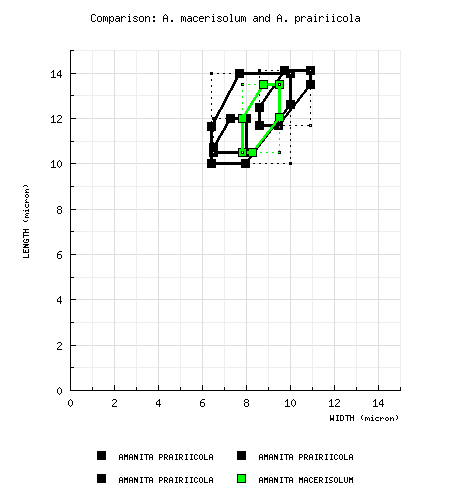
The two species are distinctly separated on genetic
grounds. A sporograph comparison of the
present species with A. prairiicola
follows:
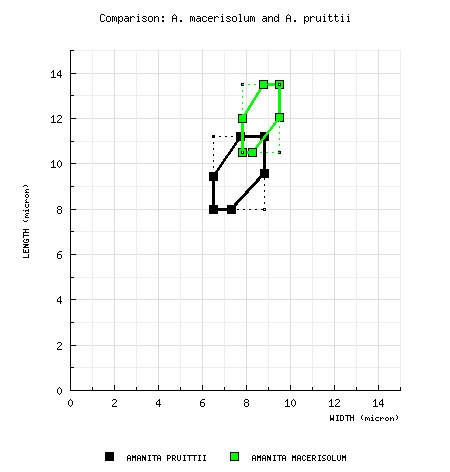
Amanita pruittii may have stature
somewhat similar to that of the present
species. As in the previous case, A.
pruittii is genetically quite distinct from the
present species. A comparative sporograph for
the two species follows:
In correspondence and regional checklists, RET has
referred to this taxon as Amanita
“species C13” and as A. subcaligata sensu
Greg Wright. |
| citations |
—R. E. Tulloss and C. Rodríguez Caycedo |
| editors |
RET |
|



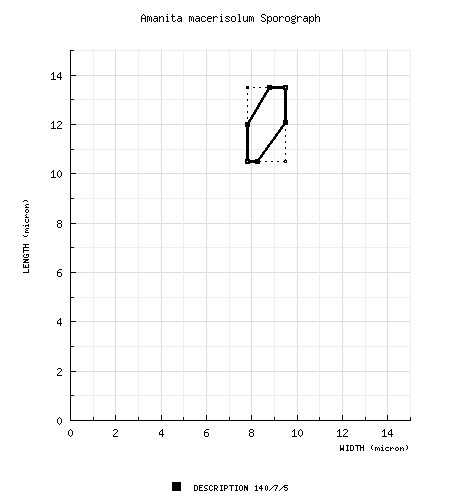
 Spore data sets and their composite