

| name | Amanita lutescens |
| name status | nomen acceptum |
| author | Hongo |
| english name | "Hongo's Gray Yellowing Lepidella" |
| images |
  1. Amanita lutescens |
| intro |
The following is based on the description of Bas (1969). All flesh is white at first and becomes yellow when the fruiting body is cut or broken. |
| cap |
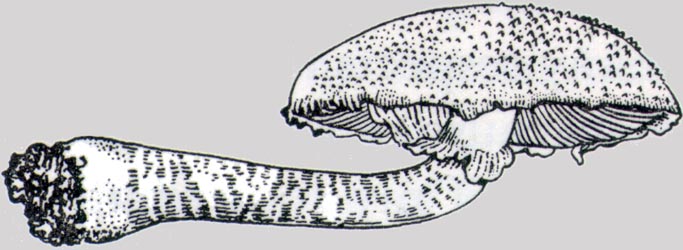
The cap of Amanita lutescens is 35 - 60 mm wide, convex then plano-convex or plane, finally slightly concave, gray, dry, with a nonsulcate, appendiculate margin. The cap is densely covered with very small, darker, brownish gray, pulverulent-subflocculose warts. |
| gills |
The gills are rather distant, narrowly adnate to free, rather broad (5 - 8 mm), and pale cream. The short gills are rounded-attenuate to attenuate. |
| stem |
The stem is 35 - 70 × 4 - 8 mm, subcylindrical, and solid. It is white and striate above the annulus and gray and puverulent-flocculose to pulverulent-squamulose. The annulus is superior and membranous, white and striate on the upper side, and grayish flocculose on the lower side. The stipe bears a small globose bulb. |
| odor/taste |
The fruiting body has a strong odor and a mild taste. |
| spores |
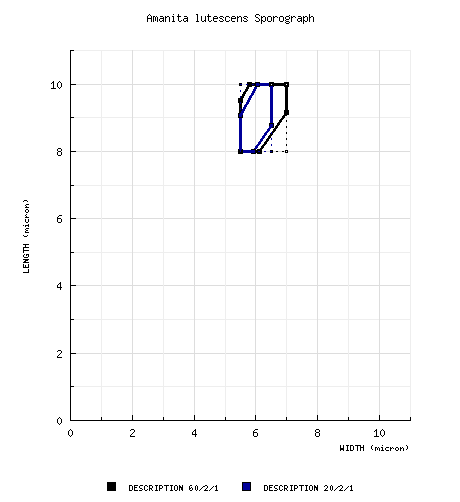
The spores measure (7.5-) 8 - 10 (-10.5) × (5.0-) 5.5 - 7.0 (-7.5) µm and are amyloid and broadly ellipsoid to ellipsoid. Clamps are absent at bases of basidia. |
| discussion |
Amanita lutescens was described from Japan. Bas placed the present species in
his stirps Cinereoconia (see A. cinereoconia G. F. Atk. var. cinereoconia).
Bas felt that the present species was not closely related to A. griseofarinosa Hongo
of the same stirps because of its broader spores, more or less pulverulent layer of volva on the
cap, and a more friable annulus. Because of my experience with yellowing taxa in North America that appear to be
"diseased" specimens of other taxa (see
A. subolitaria (Murrill) Murrill). Note that such specimens often have their
spore shape distorted. I am inclined to be suspicious that A. lutescens may prove to be synonymous
with A. griseofarinosa. After all, A. cinereoconia itself has both pulverulent and warted
volval remnants on the pileus according to environmental circumstances. Moreover, the fact that Bas proposed a
yellowing variety of A. cinereoconia might be taken as suggesting that taxa of stirps Cinereoconia
are liable to the "yellowing syndrome." On the page for A. cinereoconia, I discuss a recent collection
of that species that indeed seemed normal at first, but developed the yellowing syndrome. |
| brief editors | RET |

 Spore data sets and their composite