| name |
Amanita levistriata |
| author |
Dav. T. Jenkins. 1988. Mycotaxon 32: 415, figs. 1-2. |
| name status |
nomen acceptum |
| english name |
"Gulf Coast Lemon Amanita" |
| etymology |
According to the protolog: leviter, "lightly" + striatus, "striated"; hence, "lightly striated," in reference to the pileus margin |
| MycoBank nos. |
133875 |
| GenBank nos. |
Due to delays in data processing at GenBank, some accession numbers may lead to unreleased (pending) pages.
These pages will eventually be made live, so try again later.
|
| holotypes |
in herb. Dr. David T. Jenkins, Univ. of Alabama, Birmingham |
| intro |
The following text may make multiple use of each data field.
The field may contain magenta text presenting data from a type study
and/or revision of other original material cited in the protolog of the present taxon.
Macroscopic descriptions in magenta are a combination of data from the protolog and
additional observations made on the exiccata during revision of the cited original
material.
The same field may also contain black text, which is data from a revision of the present
taxon (including non-type material and/or material not cited in the protolog).
Paragraphs of black text will be labeled if further subdivision of
this text is appropriate.
Olive text indicates a specimen that has not been
thoroughly examined (for example, for microscopic details) and marks other places in the text
where data is missing or uncertain.
The followins is derived from the protolog (as indicated) and, otherwise, is based on original research of R. E. Tulloss. |
| pileus |
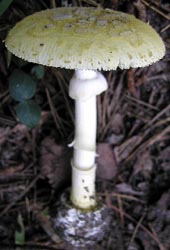
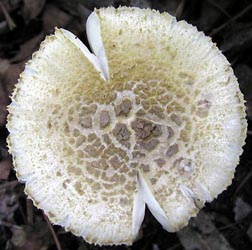
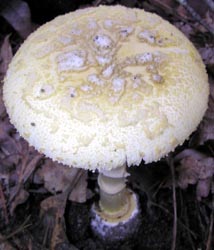
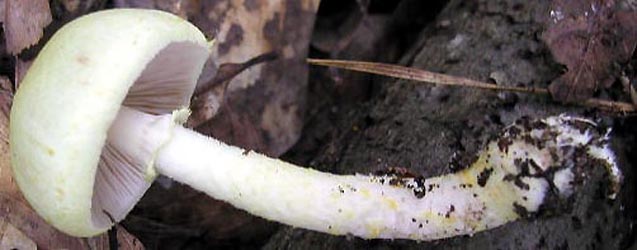
(22-) 31 - 37 mm wide, near yellow ocher [2.5Y 6/8] on disc, paler yellow to colonial buff [5Y 8/6] on margin, shiny, hemispheric then convex or plano-depressed, at maturity having a slightly depressed center; context whitish, yellow under pileipellis; margin faintly striate, sometimes appendiculate with fine yellow bits; universal veil felted patches and warts, largest over disc or fine pulverulent powder, yellowish olive-colored, with olive tint especially noticeable against yellow of pileipellis, darkening with exposure. |
| lamellae |
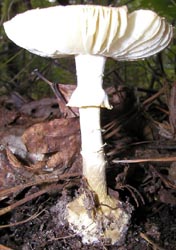
just free with a decurrent line on stipe, close, white to cream, (2-) 3 - 4.5 mm broad; lamellulae truncate, of diverse lengths. |
| stipe |
29 - 65 × (2-) 4 - 5 mm, pale yellow below, whitish or cream above annulus, narrowing upward, barely flaring at apex; bulb 15 - 18 × 11 - 15.5 mm, ovoid to napiform, sometimes subabrupt; context whitish, firmly stuffed to solid; partial veil membranous, skirt-like, superior, white and finely or faintly radially striate above, yellow and smooth below, thick-margined; universal veil as ring of finely fibrillose material (lens) or very fine olive to yellow warts at base of stipe and/or on top surface of bulb. |
| odor/taste |
Odor none. Taste not recorded. |
macrochemical
tests |
1% paracresol (test for tyrosinase) - becoming positive over a period of 8 min. in universal veil remnants, margins of lamellae, and bulb of stipe. 1% syringaldazine (test for laccase) - negative throughout the basidiome. Test voucher: Tulloss 7-17-87-C. |
| basidiospores |
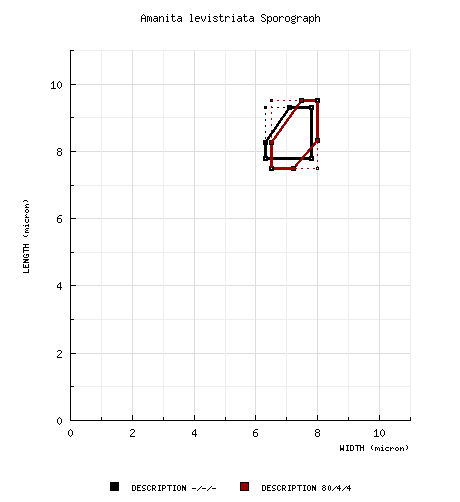
from protolog: (Jenkins, 1988): [-/-/-] (6.7-) 7.8 - 9.3 (-10.0) × (5.5-) 6.3 - 7.8 (-9.5) μm, (Q = 1.0 - 1.31; Q' = 1.11), hyaline, thin-walled, inamyloid, [dominantly—ed.] globose to subglobose [, also broadly ellipsoid and infrequently ellipsoid—ed.], adaxially flattened; apiculus sublateral, truncate; contents guttulate; white in deposit.
RET: [80/4/4] (6.5-) 7.5 - 9.5 (-10.0) × (5.5-) 6.5 - 8.0 (-9.8) µm, (L = 8.3 - 8.7 µm; L’ = 8.5 µm; W = 7.2 - 7.7 µm; W’ = 7.4 µm; Q = (1.0-) 1.04 - 1.27 (-1.31); Q = 1.12 - 1.17; Q’ = 1.15), ??. |
| ecology |
protolog: Mississippi: Solitary. In sandy soil of mixed coniferous-deciduous forest.
Solitary to scattered. Georgia: ??. Mississippi: In sandy soil of mixed deciduous-coniferous forest. Texas: In Quercus alba-dominated forest. |
| material examined |
protolog: U.S.A.: MISSISSIPPI—Harrison Co. - ca. Gulfport, Packard Pond, 15.vii.1987 Dav. T. Jenkins 2822 (paratype, in herb. Dav. T. Jenkins, Univ. Alabama, Birmingham).
Jackson Co. - Pascagoula R. Wildlife Mgmt. Area, Parker's Lk., 17.vii.1987 C. Skeffinton s.n. [Tulloss 7-17-87-H] (paratype, RET 003-8; paratype, in herb. Dav. T. Jenkins, Univ. Alabama, Birmingham), 18.vii.1987 A. G. Parks s.n. [Tulloss 7-18-87-I] (paratype, RET 005-6; paratype, in herb. Dav. T. Jenkins, Univ. Alabama, Birmingham); btwn. Wade and Vancleave, 18.vii.1987 Igor Alexander s.n. [Tulloss 7-18-87-E] (paratype, RET 003-7; paratype, in herb. Dav. T. Jenkins, Univ. Alabama, Birmingham).
Perry Co. - Black Creek Wilderness Area, 16.vii.1987 James Tinius s.n. [Jenkins 2793] (holotype, in herb. Dav. T. Jenkins, Univ. Alabama, Birmingham); Black Creek Wilderness Area, Black Creek Tr., 17.vii.1987 NAMA87 Foray participant s.n. [Tulloss 7-17-87-D] (paratype, RET 005-1; paratype, in herb. Dav. T. Jenkins, Univ. Alabama, Birmingham).
RET: U.S.A.:
GEORGIA—?.
MISSISSIPPI—George
Co. - N of Pascagoula River Wildlife Management
Area, Davis Dead River [30°54.139‘ N/ 88°44.563’ W,
35 m elev.], 9.vii.2012 Jay Justice s.n. (RET
502-4, nrITS seq'd.).
Jackson Co. - Pascagoula R.
Wildlife Mgmt. Area, Parkers Lk., 17.vii.1987 G.
Wright s.n. [Tulloss 7-17-87-C] (paratype,
RET 005-2, nrITS seq'd.), C. Skeffington s.n.
[Tulloss 7-17-87-H] (paratype, RET 003-8, nrITS
seq'd.; paratype, in herb. Dav. T. Jenkins, Univ.
Alabama, Birmingham), 18.vii.1987 A. G. Parks s.n.
[Tulloss 7-18-87-I] (paratype, RET 005-6, nrITS
seq'd.; paratype, in herb. Dav. T. Jenkins, Univ.
Alabama, Birmingham); btwn. Wade and Vancleave,
18.vii.1987 I. Alexander s.n. [Tulloss 8-17-87-E]
(paratype, RET 003-7, nrITS seq'd.; paratype, in
herb. Dav. T. Jenkins, Univ. Alabama,
Birmingham).
Perry Co. - Black Creek Wilderness Area, Black Creek Tr., 17.vii.1987 NAMA87 Foray participant s.n. [Tulloss 7-17-87-D] (paratype, RET 005-1, nrITS seq'd.; paratype, in herb. Dav. T. Jenkins, Univ. Alabama, Birmingham).
TEXAS—Hardin Co. - 6.5 km W of Silsbee,
Roy Larson Sandyland Sanctuary [NAMA2000 Foray 4],
10.vi.2000 E. Schutt
s.n. [Tulloss 6-10-00-C] (RET 313-2, nrITS
seq'd.). Tyler Co. - Forest Lake, 9.vi.1992
D. P. Lewis 4623 (RET 085-7, nrITS seq'd.),
16.vi.1992 D. P. Lewis 4689 (RET 085-8, nrITS
seq'd.), 3.vii.1992 D. P. Lewis
4706 (RET 086-3, nrITS seq'd.), 1.viii.1992
D.P. Lewis 4772 (RET 085-6, nrITS seq'd.). |
| discussion |
This species has been shown to belong in section
Phalloideae. It is apparently also genetically
close to A. sinapicolor
and A.
hormaniorum. |
| citations |
—R. E. Tulloss |
| editors |
RET |
|



 Spore data sets and their composite