| name |
Amanita griseofolia |
| author |
Zhu L. Yang in Agerer, R., M. Pieppenbring and P. Blanz, eds. 2004. Frontiers Basidiomycote Mycol. (IHW Verlag, Eching): 315, figs. 1-7. |
| name status |
nomen acceptum |
| english name |
"Chinese Sister Ringless Amanita" |
| etymology |
griseus, "gray" + folium [folia (plural)], "leaf" or "page"; "referring to the greyish to grey lamellae" [protolog] |
| MycoBank nos. |
529464 |
| GenBank nos. |
Due to delays in data processing at GenBank, some accession numbers may lead to unreleased (pending) pages.
These pages will eventually be made live, so try again later.
|
| holotypes |
HKAS 38159 |
| intro |
The article containing the protolog of this species can be obtained as a PDF (here).
The following text may make multiple use of each data field.
The field may contain magenta text presenting data from a type study
and/or revision of other original material cited in the protolog of the present taxon.
Macroscopic descriptions in magenta are a combination of data from the protolog and
additional observations made on the exiccata during revision of the cited original
material.
The same field may also contain black text, which is data from a revision of the present
taxon (including non-type material and/or material not cited in the protolog).
Paragraphs of black text will be labeled if further subdivision of
this text is appropriate.
Olive text indicates a specimen that has not been
thoroughly examined (for example, for microscopic details) and marks other places in the text
where data is missing or uncertain.
The following material is derived directly from the protolog of the present species.
NOTE: Spore measurements from papers by Z. L. Yang use his "Times New Roman" face for "Q"
and "Q'"—respectively, "Q" and "Q."
from protolog: Basidiomes small to medium-sized, rarely large. Clamps are absent throughout the basidiome. |
| pileus |
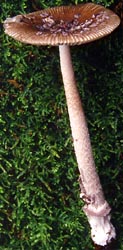
from protolog: 30 - 70 (-105) mm wide, brownish gray to gray-brown (Natal Brown, Buffy Brown, Snuff Brown, Medal Bronze, 4B1-2, 5C2-4, 5D2-4, 5E3-5), darker over disc, becoming somewhat paler towards margin, lacking any yellow or ochreous tint at all stages of development, at first nearly campanulate to hemispherical, then convex to plano-convex, without umbo or slightly umbonate; context white to whitish, unchanging, 2 - 5 mm thick; margin tuberculate-striate (0.2 - 0.45R), non-appendiculate; universal veil gray to dark gray (Iron Gray, somewhat darker than Smoke Gray, 4C1-2, 4D1-2, 4E1-2), verrucose to felty or farinose, sometimes irregularly formed, 0.5 - 1.5 mm thick, easily washed away by rain. |
| lamellae |
from protolog: free, crowded, whitish (Cream Color, 1A1-2), but soon becoming grayish to gray (Pale Smoke Gray to Light Drab, paler than 5D2), often becoming somewhat darker when dried; lamellulae truncate to subtruncate, plentiful, evenly distributed. |
| stipe |
from protolog: (60-) 80 - 170 × 5 - 15 mm, white to dirty white, subcylindric or slightly tapering upward, with apex slightly expanded, with lower half covered with gray to grayish (Pale Smoke Gray, 4D2) fibrillose squamules, upper half densely covered with gray farinose squamules; context white to dirty white, unchanging, fistulose; partial veil lacking; universal veil felty to granular or verrucose, gray to dark gray (Iron Gray, Smoky Gray, Drab, 4E1-2, 5E1-3), arranged irregularly or sometimes in incomplete belts or rings at stipe base. |
| odor/taste |
from protolog: Odor indistinct. Taste not recorded. |
macrochemical
tests |
none recorded. |
| pileipellis |
from protolog: 50 - 100 µm thick; upper layer (20 - 60 µm thick) strongly gelatinized, composed of subradially and moderately compactly arranged, 1 - 4 µm wide, thin-walled, colorless or brownish vacuolar pigmented filamentous hyphae; lower layer (30 - 50 µm thick) composed of radially and compactly arranged, 3 - 8 (15) µm wide filamentous hyphae with brownish yellow, vacuolar pigments; terminal cells present, 5 - 10 µm wide, hardly inflated; vascular hyphae rare. |
| pileus context |
not described in protolog. |
| lamella trama |
from protolog: more or less bilateral. Mediostratum 30 - 40 µm wide, composed of fairly abundant, long ellipsoid to subfusiform inflated cells (70 - 90 × 15 - 20 µm) and abundant interwoven, often anastomosing filamentous hyphae 3 - 7 µm wide, with vascular hyphae rare. Lateral stratum composed of fairly abundant, long ellipsoid to subfusiform inflated cells (40 - 60 × 10 - 15 µm) diverging at angle of ca. 30° to mediostratum; filamentous hyphae fairly abundant to abundant , 3 - 7 µm wide, frequently branching, interwoven, sometimes anastomosing; vascular hyphae rare, 3 - 9 µm wide. |
| subhymenium |
from protolog: 30 - 50 µm thick, with 2 - 3 (4) layers of subglobose or ovoid or shortly ellipsoid cells, 12 - 25 × 10 - 20 µm, occasionally mixed with hardly inflated cells. |
| basidia |
from protolog: 40 - 70 × 15 - 20 µm, clavate, 4-spored, with sterigmata 5 - 7 µm long; clamps absent. |
| universal veil |
from protolog: On pileus: with elements approximately anticlinal (over disc) to periclinal (on other parts of pileus). Inflated cells very abundant to dominant, subglobose, ovoid to shortly ellipsoid (20 - 70 × 15 - 50 µm), sometimes broadly clavate (40 - 60 × 20 - 30 µm) or sphaeropedunculate (50 - 80 × 25 - 45 µm), often in chains of 2-3 and then terminal, thin- to slightly thick-walled (up to 0.5 µm thick), often with brownish-yellow vacuolar pigments; filamentous hyphae scattered to fairly abundant, 2 - 7 µm wide, frequently branching, often anastomosing, thin-walled, colorless and hyaline, sometimes with brownish-yellow vacuolar pigments; vascular hyphae rare, 2 - 8 µm wide. On stipe base: similar to that on pileus, but with inflated cells and filamentous hyphae irregularly arranged. |
| stipe context |
from protolog: acrophysalides dominating, 250 - 350 × 25 - 40 µm; filamentous hyphae 2 - 7 µm wide, scattered (in interior) or abundant (on stipe surface); vascular hyphae rare, 2 - 10 µm wide. |
| lamella edge tissue |
from protolog: sterile; as gelatinized yellow-brown strip up to 250 µm wide in side view, predominantly composed of ovoid to subglobose, sometimes sphaeropedunculate inflated cells (20 - 50 × 15 - 35 µm), terminal singly or in chains of 2 - 3, colorless and hyaline, or with yellowish-brown vacuolar pigments; filamentous hyphae fairly abundant to scattered, 2 - 7 µm wide, colorless and hyaline, sometimes with brownish vacuolar pigments, irregularly arranged or approximately running parallel to lamella edge, with elements embedded in yellow-brown amorphous matrix gradually disappearing in KOH. |
| basidiospores |
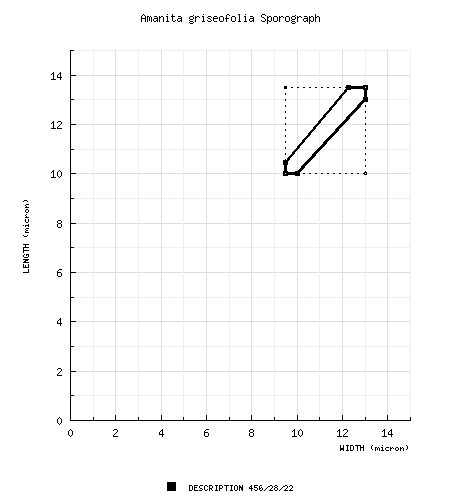
from protolog: [456/28/22] (9.5-) 10.0 - 13.5 (-16.5) × (8.5-) 9.5 - 13.0 (-15.0) μm, (Q = 1.0 - 1.10 (-1.18); Q' = 1.04 ± 0.03), hyaline, colorless, smooth, thin-walled, inamyloid, globose to subglobose, rarely broadly ellipsoid;
apiculus ca. 1 μm long; contents not described; color in deposit not described. |
| ecology |
At 1980 m elev., in forest dominated by Quercus, Pinus armandi, and P. yunnanensis. |
| material examined |
from protolog: CHINA: YUNNAN—Kunming (prefecture level) City - Unkn. Distr., Yu Quan Gong Yuan (Jade Spring Pk.), Heilongtan (Black Dragon Pool) [25°08'40" N/ 102°44'57" E, 2000 m], 27.vi.2001 Z. L. Yang 3081 (holotype, HKAS 38159). |
| discussion |
The following figures compare the sporograph of the present species with those of A. ceciliae and A. sororcula.
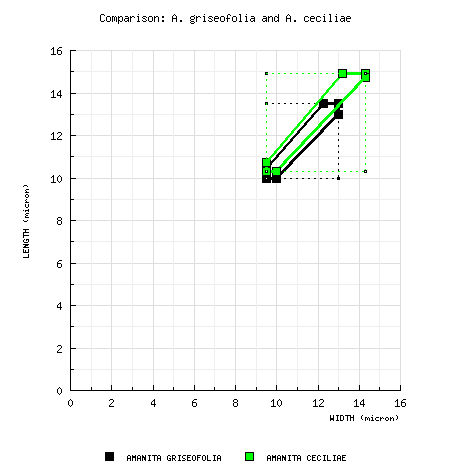
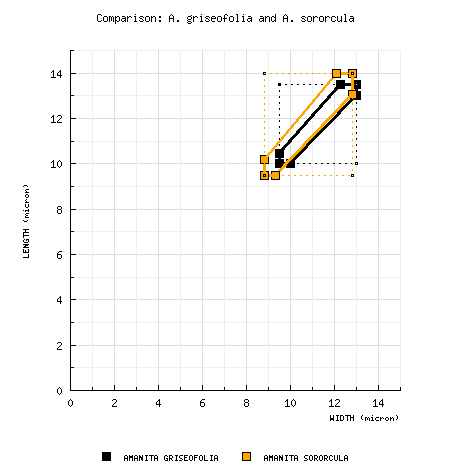
from protolog: "Amanita griseofolia, a member of Amanita [subgenus Amanita] section Vaginatae sensu Yang (1997), is characterized by its small to medium-sized, slender fruitbody with gray to dark gray, felty to verrucose or farinose, easily removed volval remnants on a gray, dark gray to brownish gray pileus, grayish to gray lamellae, a slender grayish stipe, felty to granular or verrucose, gray to dark gray pileus, grayish to gray lamellae, a slender grayish stipe, felty to granular or verrucose, gray to dark gray volval remnants in incomplete belts around the non-bulbous stipe base, and globose to subglobose, inamyloid basidiospores.
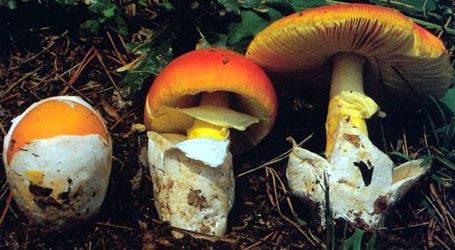
HKAS 4646, 18318, 24219, and 32507, as well as HMAS 4216 and 36284 were regarded as A. ceciliae by Yang (1997). However, A. ceciliae (Berk. et Broome) Bas, originally described from Europe, differs from by its much more robust fruitbody with a yellow-brown, reddish-brown to grey-brown or olive-brown pileus covered with lighter colored (grayish to brownish) volval remnants, white lamellae with white edges, and a relatively thicker stipe. Furthermore, the volval remnants at the base of the stipe of A. ceciliae often form a ring-zone above the strangulate region and a floccose, nearly cupulate structure at the very base of the stipe (Phillips 1990, Breitenbach and Kränzlin 1995), and there are more filamentous hyphae in the volval remnants of European A. ceciliae [France: Jura—ca. Noga, 2.x.1992 C. Bas 9341 (L)] than in A. griseofolia. The basidiospores of A. ceciliae are slightly larger than those of A. griseofolia (Tulloss, Ovrebo & Halling 1992, Breitenbach and Kränzlin 1995).
A. griseofolia is also similar to A. beckeri Huijsman ex Huijsman, A. cinctipes Corner et Bas, A. sororcula Tulloss, Ovrebo et Halling, and A. liquii Zhu L. Yang, M. Weiβ et Oberw. However, Amanita beckeri, originally described from Europe, differs from A. griseofolia by its differently colored pileus, white volval remnants browning in age, but never becoming gray or darker, white to cream lamellae with brownish spots in age, and smaller basidiospores (Huijsman 1962a, 1962b, Tulloss 1994).
Amanita cinctipes, originally described from Singapore, is distinguished from A. griseofolia by its abundant volval remnants on the base of the stipe forming 2 - 4 rings, much thinner pileipellis, smaller basidia, and smaller basidiospores (Corner and Bas 1962).
Amanita sororcula, originally described from Andean Colombia, differs from A. griseofolia by its smaller fruitbody, thinner pileipellis with common vascular hyphae, and somewhat smaller and less perfectly globose basidiospores (Tulloss, Ovrebo, and Halling 1992).
Amanita liquii, originally described from southwestern China, differs from A. griseofolia by its larger, much more robust and fleshier fruitbody with a dark brown to blackish pileus covered with thicker and darker volval remnants, thicker pileipellis, somewhat larger basidia, and larger basidiospores. Furthermore, the pigment in the cells of volval remnants of A. liquii is much darker than the similarly located pigment in A. griseofolia, and the volval remnants at the stipe base of A. liquii are more abundant than those of A. griseofolia (Yang, Weiss, and Oberwinkler 2004). |
| citations |
—Z. L. Yang |
| editors |
RET |
|


 Spore data sets and their composite