

| name | Amanita fuligineoides |
| name status | nomen acceptum |
| author | P. Zhang & Zhu L. Yang |
| english name | "False Brown Death Cap" |
| images |
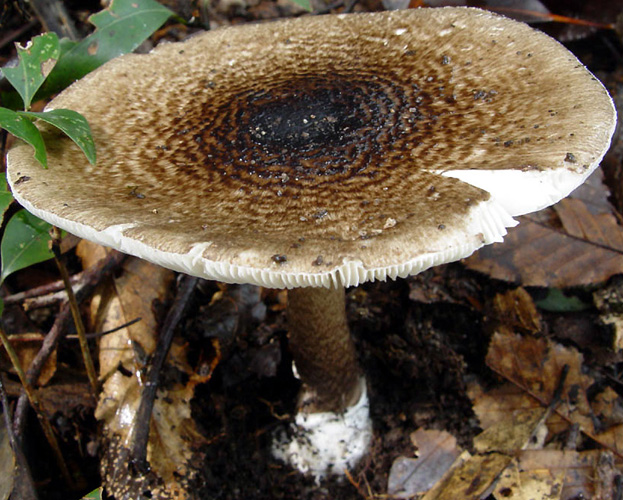  1. Amanita fuligineoides, Hunan Prov., China. 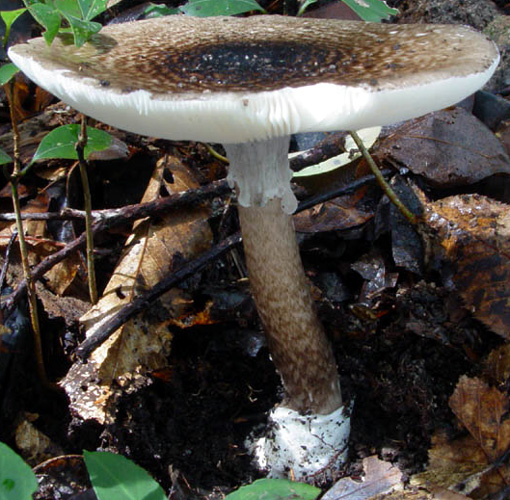 2. Amanita fuligineoides, Hunan Prov., China. |
| intro | The content herein is derived from the original description (Zhang et al., 2010). |
| cap | The fruiting body of Amanita fuligineoides is large (seldom medium-sized). Its cap is 100-120 mm wide, convex to applanate, and glabrous. It is fuliginous umber in the center, paler and becoming grayish brown toward the margin, and with innate dark radiating fibrils. It is subviscid when wet. Its margin is non-striate and non-appendiculate. The cap's flesh is white. |
| gills | The gills of this species are free, white, crowded, and up to 8 mm broad. The short gills are attenuate, plentiful, and in 2-3 ranks. |
| stem | The stem of this species is 100 - 140 × 8 - 15 mm, subcylindric or slightly tapering upward and solid. It is decorated with grayish brown fibrils or squamules. Its flesh is white. The basal bulb is slightly elongated, subclavate to napiform, and 12-25 mm wide. The limbate volva is membranous and firm, with a free limb up to 15 mm high. Both surfaces of the volva are white. The ring is placed near the top of the stem and is skirt-like, thin, membranous, and persistent. The ring's upper surface is whitish and somewhat striate, and its lower surface is whitish, then slightly grayish. |
| odor/taste | The odor of this mushroom is indistinct. This species should be considered deadly POISONOUS. |
| spores | Spores of this species measure (7.0-) 7.5 - 9.0 (-10.0) × (6.5-) 7.0 - 8.5 (-9.0) µm and are globose to subglobose and amyloid. The basidia lack basal clamps. |
| discussion |
Amanita fuligineoides grows in broad-leaved forests dominated by Fagaceae [trees of the Beech-Oak family]. Presently, it is known only from south-central China. This mushroom is similar to Amanita fuliginea, originally described from Japan and widely distributed in China. Amanita fuligineoides differs from A. fuliginea in its significantly larger fruiting body, an umber tinge on the pileus, and an elongated bulb on the stem's base. Basing on the close phylogenetic [DNA] relationship with other lethal Amanita species, the present species must be considered to be deadly POISONOUS. More information and a key to the taxa of sect. Phalloideae in East Asia can be found in Zhang et al. (2010). |
| brief editors | RET |

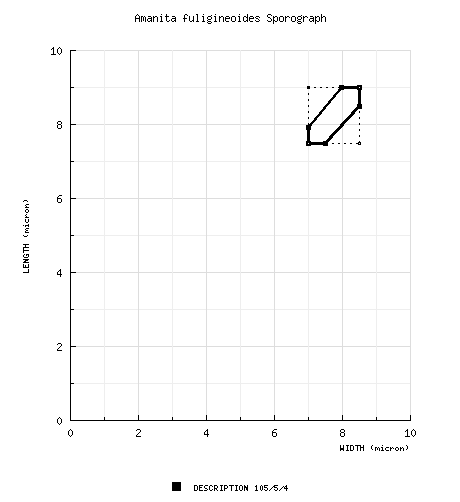
 Spore data sets and their composite