| name |
Amanita augusta |
| author |
Bojantchev & R. M. Davis. 2013. N. Ameri. Fungi 8(5): 1-11, figs. 1-10. |
| name status |
nomen acceptum |
| english name |
"Majestic Amanita" |
| etymology |
augustus - majestic, venerable. |
| MycoBank nos. |
801321 |
| GenBank nos. |
Due to delays in data processing at GenBank, some accession numbers may lead to unreleased (pending) pages.
These pages will eventually be made live, so try again later.
|
| holotypes |
UC 1851352 |
| intro |
The following text may make multiple use of each data field.
The field may contain magenta text presenting data from a type study
and/or revision of other original material cited in the protolog of the present taxon.
Macroscopic descriptions in magenta are a combination of data from the protolog and
additional observations made on the exiccata during revision of the cited original material.
The same field may also contain black text, which is data from a revision of the present taxon (including non-type material and/or material not cited in the protolog). Paragraphs of black text will be labeled if further subdivision of this text is appropriate.
Olive text indicates a specimen that has not been thoroughly examined (for example, for microscopic details) and marks other places in the text where data is missing or uncertain.
The following material is based on the protolog of the present species. |
| pileus |
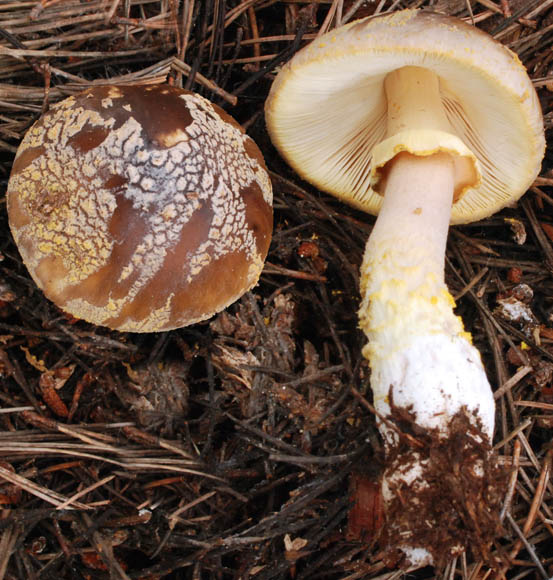
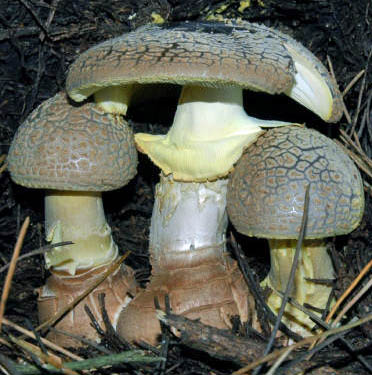
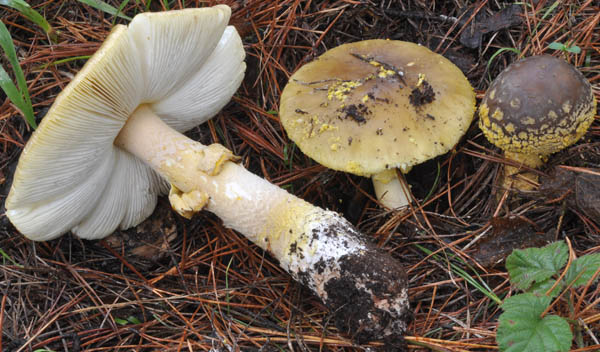
from protolog: 30 - 150 mm wide, dark brown to brown to yellow brown, sometimes yellow to grayish yellow in age, typically paler towards the margin, hemispheric to convex when young, plano-convex to plano-concave with age; context white to pale yellow; margin incurved to straight, occasionally ribbed-striate; universal veil absent or as warts in concentric rings, with warts becoming smaller towards margin, yellow, fading to grayish-white with age, detersile. |
| lamellae |
from protolog: narrowly attached to free, crowded, white, becoming yellowish near pileus margin, even, 9–20 mm broad; lamellulae common. |
| stipe |
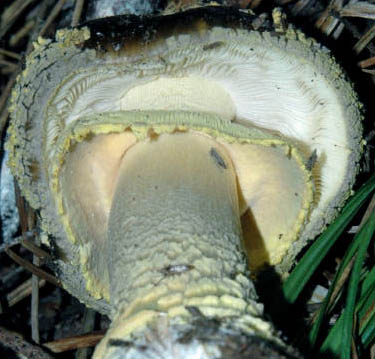
from protolog: 40 - 150 × 10 - 30 mm, yellow when young, often fading to whitish at age, typically yellowish above partial veil, cylindric or narrowing upward, surface above bulb cracking horizontally and forming recurved scales (smaller towards partial veil) with yellow free edges, often becoming glabrous in age, distinctly longitudinally striate above partial veil; bulb often prominent, distinctly rufescent in age; context stuffed, white to pale yellow; partial veil superior, membranous, pendant, pale yellow to yellow above and below, distinctly striate above, below bearing small fragments of universal veil around free edge; universal veil yellow at first [eventually rufescent like bulb surface per photos], girdling bulb and lower stipe. [Note: Apparently the reported stipe length includes the length of the stipe's bulb.—ed.] |
| odor/taste |
from protolog: Odor and taste mild. |
macrochemical
tests |
none recorded. |
| pileipellis |
from protolog: ixocutis, layered, with upper layer slightly gelatinized; filamentous hyphae 2 - 7 μm wide, densely interwoven. |
| pileus context |
not described. |
| lamella trama |
from protolog: divergent; filamentous hyphae and other elements 6 - 22 μm wide; clamps not observed. |
| subhymenium |
from protolog: cellular (pseudoparenchymatous); inflated cells irregular to pyriform, 9 - 31 × 7 - 21 μm, in several layers; clamps not observed |
| basidia |
from protolog: 35 - 62 × 8 = 12 μm, 4-sterigmate;, with sterigmata 4 - 6 μm long; clamps not observed. |
| universal veil |
from protolog: .Location not specified: filamentous hyphae 2 - 8 μm wide, dominating; inflated cells broadly ellipsoid to subglobose, 30 - 80 × 14 - 60 μm; clamps not observed. On partial veil lower surface: filamentous hyphae not described; inflated cells in clusters, subglobose to pyriform, 10 – 30 × 8 – 24 μm. [Note: Other shapes of inflated cells must be present because the lowest dimensions of length and width have a length/width ratio of greater than 2.0. Hence cylindric or narrowly clavate cells must have been present.—ed.] |
| stipe context |
from protolog: acrophysalidic; filamentous hyphae 2 = 6 μm wide; acrophysalides 62 - 176 × 16 - 44 μm; clamps not observed. |
| partial veil |
from protolog: filamentous
hyphae 2 – 6 μm wide, inflated cells not described; clamps not observed.
[Note: Inflated cells are described from the surfaces, not from the interior, of the partial veil. The descriptions of these cells are included in the description of universal veil tissues (for the cells on the lower surface) and in the description of lamella edge tissue (for cells on the upper surface.—ed.) |
| lamella edge tissue |
from protolog: filamentous hyphae not described; inflated cells subglobose to
sphaeropedunculate, 10 – 33 × 7 – 21 μm, some remaining on partial veil upper surface.
RET: sterile. |
| basidiospores |
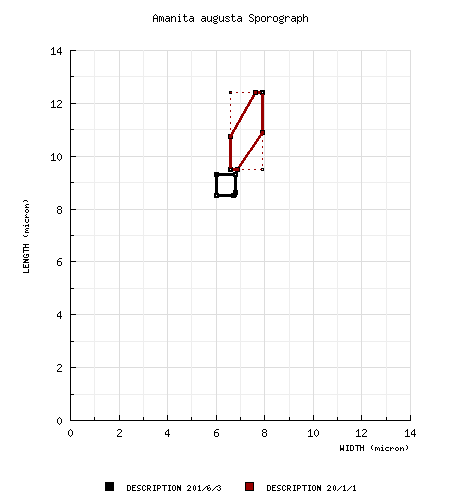
from protolog: [201/6/3] (7.8-) 8.5 - 9.3 (-11.2) × (5.2-) 6.0 - 6.8 (-7.8) μm (L' = 8.9 μm; W' = 6.4 μm; Q = 1.27 - 1.57; Q' = 1.41), hyaline, amyloid, broadly ellipsoid to ellipsoid; apiculus prominent, "lateral" (sic) [cylindric, proportionally large, and sublateral per photograph]; contents not described; white in deposit. [Note: The protolog also contains this phrase applied to the spores of the present taxon: "slightly to distinctly inequilateral in 30-40% of cases." The editor is unsure of the meaning, but perhaps the authors are saying that they viewed 30-40% of the spores in lateral view and noticed the adaxial flattening, which is present in their photographs.—ed.]
RET: [20/1/1] (9.1-) 9.5 - 12.4 (-14.0) × (6.4-) 6.6 - 7.9 (-9.5) μm, (L = 11.0 μm; W = 7.4 μm; Q = (1.36-) 1.38 - 1.63 (-1.75); Q = 1.50), hyaline, colorless, thin-walled, smooth, amyloid, dominantly ellipsoid, occasionally elongate, often adaxially flattened, sometimes expanded more broadly at one end than at the other; apiculus sublateral, cylindric; contents ??; color in deposit not recorded. |
| ecology |
from protolog: .
RET: From ca. sea level to ca. 2550 m (8350 ft.) elev. With Lodgepole Pine (Pinus contorta). |
| material examined |
from protolog: U.S.A.: ALASKA—Kenai Peninsula Co. - off Seward Hwy. [60°19′33″ N/ 149°21′42″ W, 175 m], 22.viii.2007 Dimitar Bojantchev DBB00873 (paratype, in herb. Bojantchev).
CALIFORNIA—Marin Co. - Point Reyes Nat. Seashore, off Mt. Vision Rd. [38°05′03″ N/ 122°52′18″ W, 370 m], 10.xii.2005 D. Bojantchev DBB00014 (paratype, in herb. Bojantchev).
Mendocino Co. - Jackson St. Demonstration For., off Little Lake Rd. [39°18′27″N 123°42′47″W, 200 m], 3.xi.1962 H. D. Thiers 9376 (paratype, SFSU), 19.xii.1967 G. Breckon 297 (paratype, SFSU), 14.xi.2009 D. Bojantchev DBB26180 (paratype, in herb. Bojantchev).
San Mateo Co. - Long Ridge Open Space Preserve, off Skyline Blvd. [37°16′21″ N/ 122°09′13″ W, 770 m], 1.iv.2012 D. Bojantchev DBB50192 (paratype, in herb. Bojantchev); San Francisco Watershed, 6.i.1967 H. D. Thiers s.n. [G. Breckon 673] (paratype, SFSU), 12.i.1967 R. Keller 338 (paratype, SFSU), 16.xii.1969 H. D. Thiers s.n. [R. Keller 604] (paratype, SFSU).
Sonoma Co. - Salt Point St. Pk., 1.2 km N of Hwy. 1 [38°36′25″ N/ 123°21′40″ W, 90 m], 23.xii.2007 D. Bojantchev DBB03543 (paratype, in herb. Bojantchev), DBB03547 (paratype, in herb. Bojantchev); Salt Point St. Pk., 0.8 km S of Hwy. 1 [38°33′40″ N/ 123°18′49″ W, 80 m], 11.xi.2006 D. Bojantchev DBB00982 (paratype, in herb. Bojantchev), 23.xi.2006 D. Bojantchev DBB01312 (paratype, in herb. Bojantchev), 24.xi.2011 D. Bojantchev DBB48532 (paratype, in herb. Bojantchev, nrITS seq'd.).
OREGON—Curry Co. - Samuel Boardman St. Pk. [42°08′52″ N/ 124°21′28″ W, 30 m], 11.xi.2009 D. Bojantchev DBB25368 (paratype, in herb. Bojanthev, nrITS seq'd.).
WASHINGTON—Clallam Co. - Ollympic Peninsula, off Hot Spring Rd. [48°04′29″ N/ 123°57′18″ W, 370 m], 21.x.2009 D. Bojantchev DBB21873 (paratype, in herb. Bojantchev, nrITS seq'd.)
RET: U.S.A.: CALIFORNIA—Alpine Co. - Woods Lk., 29.viii.1999 David Rust s.n. (RET 297-9). Marin Co. - Point Reyes Nat. Seashore, 24.xi.1999 Liz Schmidt s.n. [Tulloss 11-24-99-C] (RET 092-2). Sonoma Co. - Salt Point St. Pk., ca. Fisk Mill Cove parking area, 17.i.2003 Tom Volk & Dan Cederpiltz s.n. [Tulloss 1-17-03-A] (RET 366-4). |
| discussion |
from protolog: .
[Note: In the protolog, the vascular hyphae (reported as "oleiferous hyphae") are not reported on a tissue by tissue basis. The following summary is provided: abundant, 7 - 20 μm wide.—ed.] |
| citations |
—R. E. Tulloss |
| editors |
RET |
|




 Spore data sets and their composite