

| name | Amanita flaccida | ||||||||||||||||||||
| author | (D. A. Reid) Tulloss in Tulloss et al. 2015. Amanitaceae 1(2): 2. | ||||||||||||||||||||
| name status | nomen acceptum | ||||||||||||||||||||
| english name | "Limp Ringless Amanita" | ||||||||||||||||||||
| synonyms |
≡Amanita umbrinolutea var. flaccida D. A. Reid. 1987. Notes Roy. Bot. Gard. Edinburgh 44: 517. The editors of this site owe a great debt to Dr. Cornelis Bas whose famous cigar box files of Amanita nomenclatural information gathered over three or more decades were made available to RET for computerization and make up the lion's share of the nomenclatural information presented on this site. | ||||||||||||||||||||
| MycoBank nos. | 133156, 811625 | ||||||||||||||||||||
| GenBank nos. |
Due to delays in data processing at GenBank, some accession numbers may lead to unreleased (pending) pages.
These pages will eventually be made live, so try again later. Search:
Showing 0 to 0 of 0 entries | ||||||||||||||||||||
| holotypes | K | ||||||||||||||||||||
| type studies | Tulloss, herein. | ||||||||||||||||||||
| intro |
The following text may makes multiple use of each data field. The field may contain magenta text representing a type study by Tulloss. The same field may also contain black text, which will represent a revision of the species by Tulloss. Paragraphs of black text will be labeled if further subdivision of this text is appropriate. Olive text indicates a specimen that has not been thoroughly examined (for example, for microscopic details) and marks other places in the text where data is missing or uncertain. The following is based on the protolog of A. umbrinolutea var. flaccida and original research of R. E. Tulloss. | ||||||||||||||||||||
| pileus | RET type study: 105 mm wide, pale gray-brown, darker over depressed disc, smooth, convex to planar to plano-concave in age, flaccid, fragile; context thin; margin conspicuously sulcate (0.5±R); universal veil absent. | ||||||||||||||||||||
| lamellae | RET type study: nearness to stipe and density not reported, white, with edge minutely punctate with dark brown (most conspicuous toward pileus margin, but scarcely visible to naked eye); lamellulae of diverse lengths, with shortest truncate and longest sub(?)attenuate, unevenly distributed, apparently rather sparse. | ||||||||||||||||||||
| stipe | RET type study: 83 × 7 - 10 mm, pale golden brown, with darker brown fibrils in chevron-like pattern, narrowing upward, gracile, delicate, fragile; context not described; exannulate; universal veil as saccate volva, red-brown on outer surface and gray on inner surface in fresh material, in exsiccatum with pale orangish tan exterior and pallid interior surfaces above base and white with rusty spots and stains near base, broadly spreading, less than 20 mm from base of stipe to highest point on limb. | ||||||||||||||||||||
| odor/taste | not recorded. | ||||||||||||||||||||
| macrochemical tests |
none recorded. | ||||||||||||||||||||
| pileipellis | RET type study: 115 - 135 µm thick, yellow-orange in KOH solution, with surface gelatinized; filamentous, undifferentiated hyphae 1.8 - 7.0 µm wide, densely packed vertically, with subradial arrangement; vascular hyphae 7.0± µm wide, sinuous, infrequent. | ||||||||||||||||||||
| pileus context | RET type study: filamentous, undifferentiated hyphae 2.8 - 12.6 µm wide, branching, plentiful, often in fascicles loosely interwoven around acrophysalides; acrophysalides fusiform to subfusiform to broadly subfusiform to clavate to broadly clavate to broadly subpyriform, up to 87 × 58 µm, thin-walled; vascular hyphae 7.7 - 16.1 µm wide, branching, common, often with encrustations. | ||||||||||||||||||||
| lamella trama | RET type study: bilateral, poorly to very poorly rehydrating, with subhymenial base apparently entirely composed of branching uninflated hyphae; filamentous, undifferentiated hyphae 1.3 - 8.4 µm wide, tangled and interwoven, sometimes with constricted septa, with intercalary chains of fusiform cells (poorly reinflated, up to 68 × 24 µm) probably in central stratum; divergent, terminal, inflated cells not observed; vascular hyphae 2.8 - 10.5 µm wide, branching, scattered. | ||||||||||||||||||||
| subhymenium | RET type study: somewhat poorly to poorly rehydrating, as tangle of plentifully branching hyphae, with basidia arising from end or side of uninflated hyphal segments or from partially inflated hyphal segments. | ||||||||||||||||||||
| basidia | RET type study: (28-) 36 - 48 (-53) × 10.8 - 14.4 µm, 4-sterigmate, some with dextrinoid granular contents; clamps rare or absent (basal septa often hard to see). | ||||||||||||||||||||
| universal veil | RET type study: At stipe base, exterior surface: an open weave of criss-crossing fascicles of hyphae; filamentous, undifferentiated hyphae 1.0 - 10.5 µm wide, branching, dominating, often constricted at septa, sometimes having yellowish subrefractive walls, partially gelatinized at surface; inflated cells scattered, terminal, single, dissociable, partially collapsed, ovoid, up to 33 × 26 µm, thin-walled; vascular hyphae 3.5 - 11.2 µm wide, branching, locally densely tangled, locally plentiful, sinuous, not in fascicles. At stipe base, interior: filamentous, undifferentiated hyphae 2.1 - 14.0 µm wide, dominant, branching, plentiful, thin-walled, often in fascicles; inflated cells scattered to locally clustered, thin-walled, clavate to broadly clavate to narrowly ellipsoid to subglobose, up to 46 × 38 µm; vascular hyphae 2.1 - 8.4 µm wide, branching, common, locally plentiful, sinuous, with walls thin to less than 0.5 µm thick. At stipe base, inner surface: like interior, but with proportionately more filamentous, undifferentiated hyphae, with inflated cells partially gelatinized. | ||||||||||||||||||||
| stipe context | RET type study: longitudinally acrophysalidic; filamentous, undifferentiated hyphae 1.4 - 7.7 µm wide, thin-walled, some with yellow refractive granular deposit on inside of walls; acrophysalides up to 164 × 28 µm, thin-walled, sometimes containing yellowish material (as in hyphae) concentrated near basal septum; vascular hyphae 1.4 - 9.1 µm wide. | ||||||||||||||||||||
| partial veil | absent. | ||||||||||||||||||||
| lamella edge tissue | sterile. | ||||||||||||||||||||
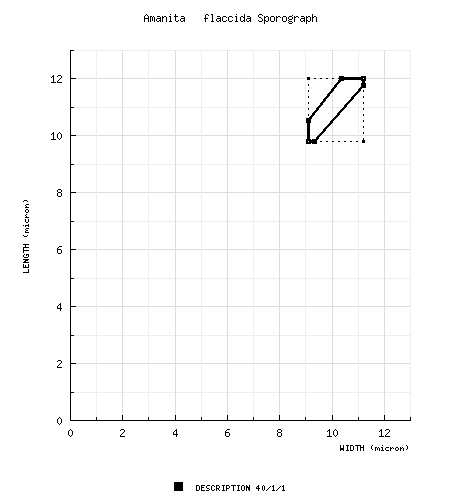
| basidiospores | RET type study: [40/1/1] (9.4-) 9.8 - 12.0 (-13.4) × (8.3-) 9.1 - 11.2 (-12.6) µm, (L = 10.9 µm; W = 9.9 µm; Q = (1.0-) 1.05 - 1.16 (-1.20); Q = 1.10), hyaline, colorless, smooth, thin-walled, inamyloid, subglobose to broadly ellipsoid, occasionally globose, usually adaxially flattened; apiculus sublateral, broad, cylindric to truncate-conic, prominent; contents monoguttulate; color in deposit not recorded. | ||||||||||||||||||||
| ecology | RET type study: In grassy ride through mixed woodland, with nearby trees including Picea, Betula, and Crataegus. | ||||||||||||||||||||
| material examined | RET type study: U.K.: ENGLAND—West Sussex, Madehurst, 11.viii.1982 D. A. Reid & Audrey Thomas s.n. (holotype, K). | ||||||||||||||||||||
| discussion |
The presence of dextrinoid granules in the basidia of a species of Amanita section Vaginatae is very unusual in RET's experience. I believe this type study may be the first report of such an occurrence. In the genus as a whole, the character is known in only three taxa—the other two assignable to Amanita section Lepidella and, hence, distantly related (Bas, 1969; Tulloss and Franco-Molano, 2008): A. mutabilis and A. savannae. A comparison of spore-size and shape in A. umbrinolutea and the present species are presented in the following figure: The spores of the two species are very much the same shape; however, the spores of A. umbrinolutea can be significantly larger than those of the present species. Other striking differences between the present taxon and A. umbrinolutea include the flaccid, non-zonate pileus which lacks a reddish tint and has a diameter greater than the stipe length; and a universal veil with an unusually pigmented ("red-brown") exterior surface. | ||||||||||||||||||||
| citations | —R. E. Tulloss | ||||||||||||||||||||
| editors | RET | ||||||||||||||||||||
Information to support the viewer in reading the content of "technical" tabs can be found here.
| name | Amanita flaccida |
| bottom links | [ Keys & Checklists ] |
| name | Amanita flaccida |
| bottom links | [ Keys & Checklists ] |
 Spore data sets and their composite
Each spore data set is intended to comprise a set of measurements from a single specimen made by a single observer; and explanations prepared for this site talk about specimen-observer pairs associated with each data set. Combining more data into a single data set is non-optimal because it obscures observer differences (which may be valuable for instructional purposes, for example) and may obscure instances in which a single collection inadvertently contains a mixture of taxa.

Text and User-Generated Sporographs are published under the Creative Commons License.

In the case of a taxon page, image credits are on the 'image' tab.