

| name | Amanita eburnea |
| name status | nomen acceptum |
| author | Tulloss |
| english name | "Ivory's Destroying Angel" |
| images |
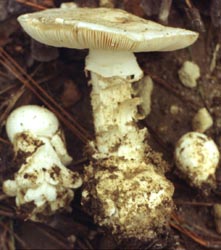 1. Amanita eburnea, Honduras. 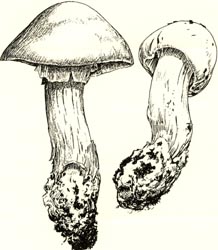 2. Amanita eburnea (holotype), Honduras. 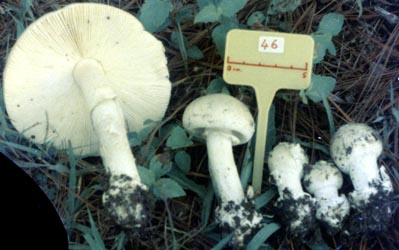  3. Amanita eburnea, Honduras. |
| intro | This description is derived from the original description of A. eburnea (Tulloss 1989a). |
| cap |
The cap of Amanita eburnea is 70 - 90 mm wide, white to smoke-gray, dry, globose at first, then broadly campanulate, then plano-convex to planar. The margin is nonappendiculate and nonstriate. The skin was described as "papery" by the original collector, Dr. Michael Ivory. The flesh is white. |
| gills |
The gills are free, white, up to 6 mm broad. |
| stem |
The stem is 45 - 110 × 10 - 18 mm, white to pale gray, cylindric, decorated with longitudinal striations, stuffed to solid. The flesh is white, firm to spongy. The ring is white to buff, superior to subapical, membranous to submembranous, persistent or left in patches over the gill edges or collapsing and sliding down the stem. The basal bulb slender, rounded or pointed below, approximately 25± mm long. The volva is membranous, white to buff, appressed to the base, limbate, with the top of the longest limb reaching 45± mm from the base of the bulb, with limb free for up to 15± mm. |
| odor/taste | The odor is unpleasant with age. This species should be assumed to be deadly POISONOUS. |
| spores |
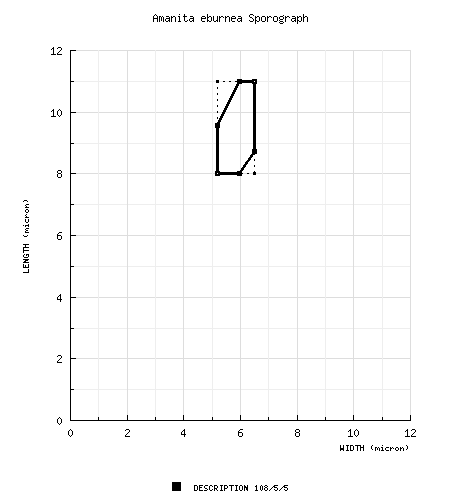
The spores measure (7.0-) 8.0 - 11.0 (-12.0) × (4.8-) 5.2 - 6.5 (-7.5) µm and are ellipsoid to elongate (infrequently broadly ellipsoid, infrequently cylindric) and amyloid. Clamps are absent at bases of basidia. |
| discussion |
The species is originally described based on collections of Dr. M. H. Ivory from Honduras and Belize. It is solitary to gregarious in troops under pine in grass on well-drained, loamy soil or in bushy forests over poorly drained sandy soil. The reader may wish to compare this species to Amanita elliptosperma G.F. Atk. Amanita eburnea is distinct from the A. elliptosperma "group" by the smoke-gray tint of the cap, the spores often dominantly elongate rather than ellipsoid, and having a universal veil which contains many more inflated cells. The ring is also weaker in A. eburnea due to more plentiful inflated cells. The reader may want to examine the recently revised key to the taxa of sect. Phalloideae in North America.—R. E. Tulloss |
| brief editors | RET |

 Spore data sets and their composite