

| name | Amanita dulciarii |
| name status | nomen provisorum |
| author | Tulloss |
| english name | "Confectioner's Ringless Amanita" |
| images |
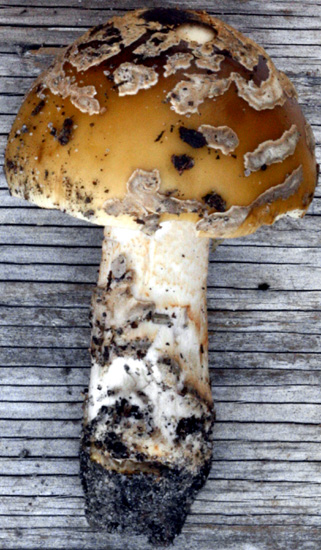 1. Amanita dulciarii, Brendan T. Byrne (=Lebanon) St. For., Burlington Co., New Jersey, U.S.A. (RET 504-2) 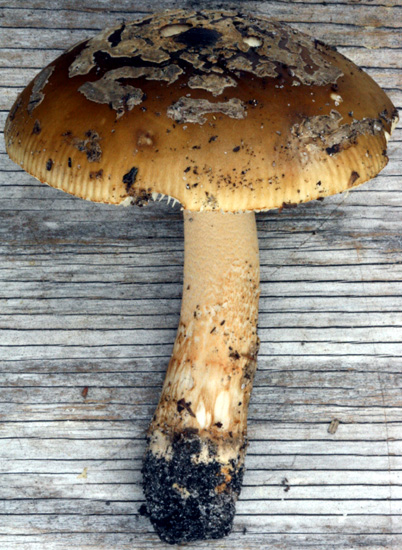 2. Amanita dulciarii, Brendan T. Byrne (=Lebanon) St. For., Burlington Co., New Jersey, U.S.A. (RET 504-2) 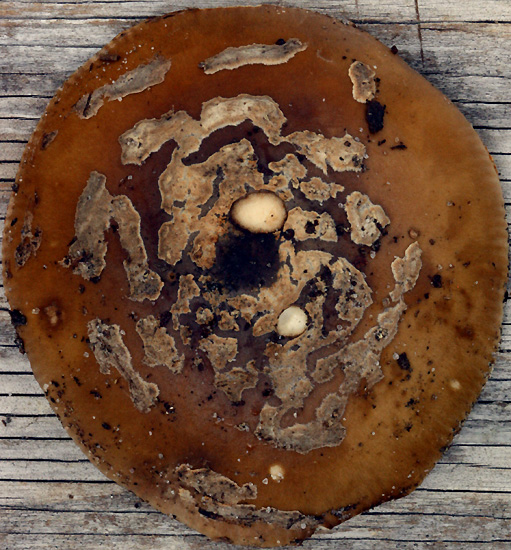 3. Amanita dulciarii, Brendan T. Byrne (=Lebanon) St. For., Burlington Co., New Jersey, U.S.A. (RET 504-2) 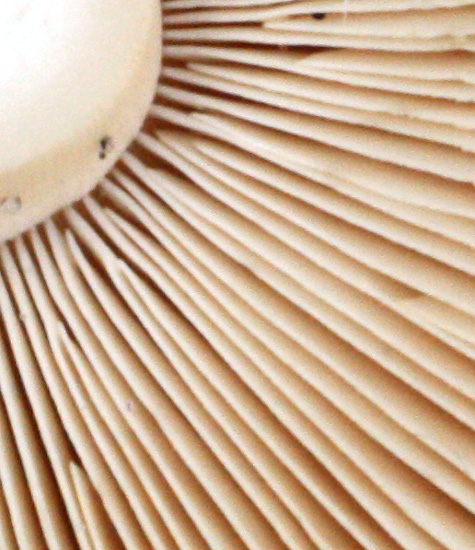 4. Amanita dulciarii, diversity of length among the longer lamellulae, Brendan T. Byrne (=Lebanon) St. For., Burlington Co., New Jersey, U.S.A. (RET 504-2) 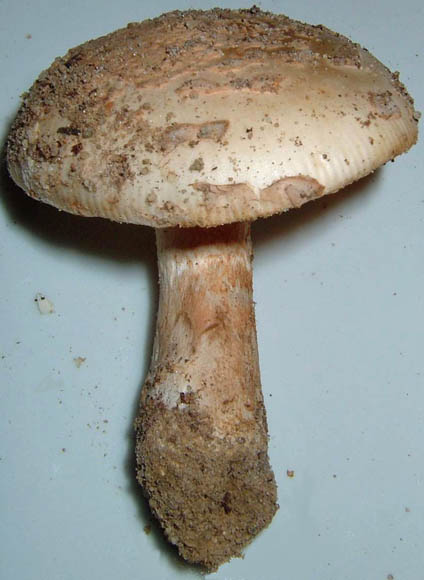 5. Amanita dulciarii, Franklin Parker Preserve, ca. Chatsworth, Burlington Co., New Jersey, U.S.A. 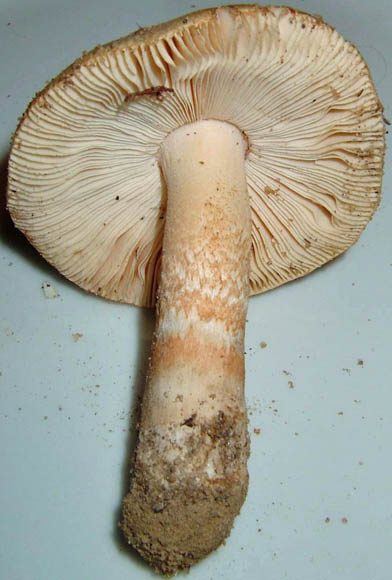 6. Amanita dulciarii, Franklin Parker Preserve, ca. Chatsworth, Burlington Co., New Jersey, U.S.A. (RET 577-8) 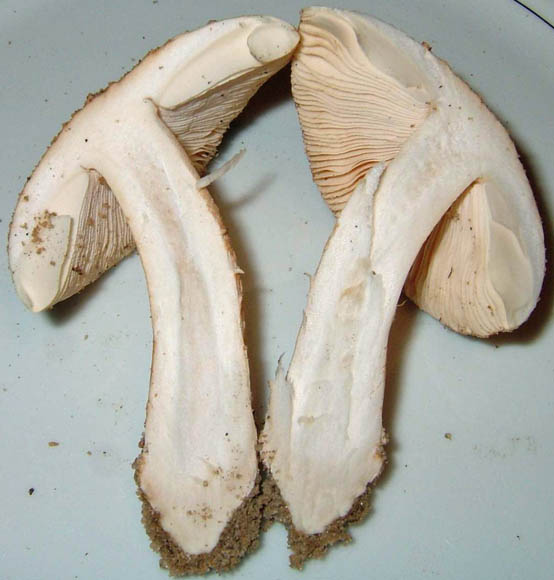 7. Amanita dulciarii, Franklin Parker Preserve, ca. Chatsworth, Burlington Co., New Jersey, U.S.A. (RET 577-8) |
| cap |
The cap of Amanita dulciarii is 34 - 85 mm wide, at first sometimes tannish yellow over the center and yellow with a slight olivaceous tint otherwise except nearly white at the margin, becoming brassy yellowish brown to brown to yellowish brown over the center with an orangish tint near the margin or brown over the center and slightly reddish brown to orangish brown at the margin or dark brown with reddish tint over the center and brown at the margin or fuligineous over the center and Isabella color or a yellower brown at the margin, sometimes not evenly pigmented and then with the palest region yellowish cream, faintly virgate for about half of the radius near the margin or not noticeably virgate, campanulate at first, then broadly campanulate or subhemispheric to convex to planoconvex often with a low and broad umbo, sometimes in a shallow depression, to nearly planar often with umbo, subviscid to tacky to waxy to dry, subshiny, sometimes becoming dull on drying, with a striate margin (10 - 25% (-35%) of the radius), nonappendiculate, incurved at first, then decurved or occasionally slightly incurved. The volva is absent or present in irregular patches or a mixture of low warts and patches of varying size, verruculose to nearly smooth, pale ochraceous becoming pale gray or pale gray with orange tint or pale grayish orange or (infrequently) gray, never very dark gray even in senescence, orangish tint often strongest over the center, weakly submembranous or felted to subpowdery, easily removed. The flesh is white to off-white, concolorous or brown or pale brown or faintly gray under the cap skin, unchanging when cut or bruised, 2 - 8 mm thick above the stem, thinning evenly for about 70% of the radius to the entire radius or rapidly for 50% of the radius then evenly up to 75 - 80% of the radius, then membranous to the margin. |
| gills |
The gills are free to distant or (occasionally) narrowly adnate, subcrowded to crowded, pale orangish white or pale pinkish or pale orangish cream or pale brownish cream or orangish cream in mass, pale cream with faint pink or orange tint or yellowish white or yellowish cream or pale yellow in side view, not changing when cut or bruised, 3 - 9 mm broad, with a short decurrent tooth on the top of the stem, with or without decurrent line on the top of the stem, with a minutely flocculose edge that is pale orangish or paler than face in young specimens, with edge sometimes concolorous (brownish) with the cap surface for a short distance at the cap margin. The short gills are truncate to subtruncate to subattenuate, of diverse lengths, unevenly distributed, and scatttered to common to plentiful. |
| stem |
The stem is 57 - 135 × 6 - 14 mm, with a pallid to pale sordid cream to pale yellowish cream to pale orange-brown ground color, narrowing upward, flaring slightly at the top, with a rather strongly longitudinally striate white strangulate zone extending upward from near the base and sometimes bounded above or below by volval remnants as continuous narrow bands or rings of warts and patches, sometimes with rounded point at base, at first often covered from the top of the stem to the top of the strangulate zone with a fine layer of orange-white powder, later with fibrils and subfelted fibrils in chevron patterns (sometimes densest below mid-point) pale orange or pale orangish cream or pale ochraceous at first and then graying or becoming pale sordid brown or brown (eventually can be quite dark brown) with time or after handling (occasionally browning response to handling noted in ground color), becoming glabrous (at the top) and with the surface below the fibrils longitudinally striatulate. A ring is absent. The volva is present as a short-saccate or cupulate volva; or in rows of warts or patches circling the lower stem; or as a thin continuous ring around the stem and as a shallow and broken cup on the stem base, pale yellowish white when excavated, then orangish white to pale orangish cream to pale orangish gray to pale grayish orange to orange-tan after exposure, friable, uppermost ring or row of warts or patches are up to 61 mm from the stem base; occasionally also as irregular verruculose patches distributed over the strangulate region, often impregnated with sand. The flesh is white to barely off-white to cream to yellowish or tannish white, sometimes with orange tint in lower third, occasionally with brownish streaks, occasionally sordid off-white to pale gray, unchanging when cut or bruised, stuffed or hollow. |
| spores |
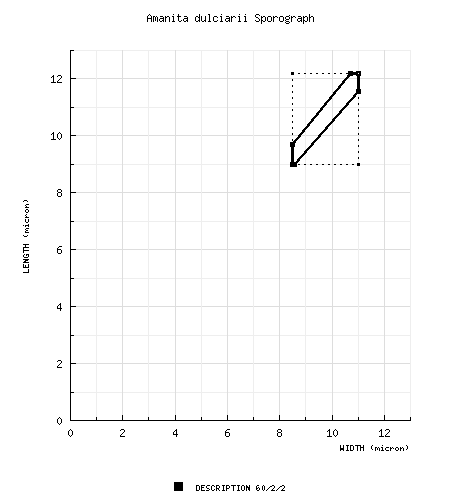
The spores measure (8.5-) 9.0 - 12.2 (-15.5) × (8.0-) 8.5 - 11.0 (-12.5) µm and are subglobose or (occasionally) globose or (infrequently) broadly ellipsoid and inamyloid. There are no clamps at bases of basidia. |
| discussion |
The range of this species extends from St. John Island (Province of Newfoundland and Labrador, Canada) to the Pine Barrens of southern New Jersey, USA. In addition, there is molecular evidence that it is associated with pine plantations in North Carolina—at least in areas with nitrogen poor soils (Edwards et al. 2004). This species was originally referred called "Amanita species 49" in RET's keys and checklists.—R. E. Tulloss and L. Possiel |
| brief editors | RET |

 Spore data sets and their composite