| name |
Amanita aureosolea |
| author |
Tulloss nom. prov. |
| name status |
nomen provisorum |
| english name |
"Golden Shod Ringless Amanita" |
| etymology |
aureus, "golden" + solea, "sole" [of the foot or of a shoe]; so named for the color of the universal veil material found below the base of the stipe; hence, "golden-shod" |
| GenBank nos. |
Due to delays in data processing at GenBank, some accession numbers may lead to unreleased (pending) pages.
These pages will eventually be made live, so try again later.
|
| intro |
Olive text indicates a specimen that has not been
thoroughly examined (for example, for microscopic details) and marks other places in the text
where data is missing or uncertain.
The following is based upon original research of R. E. Tulloss. |
| pileus |
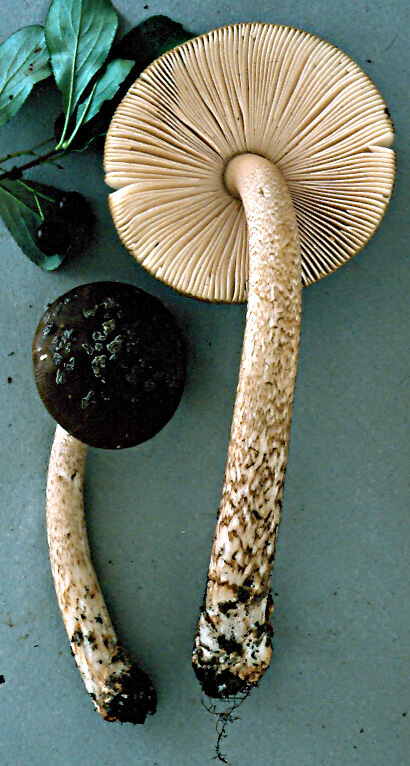
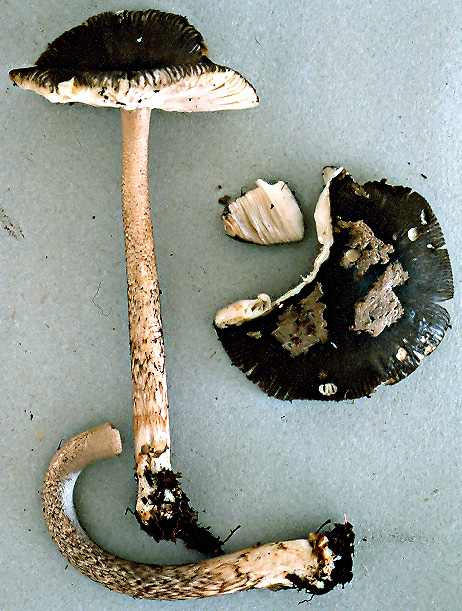
46 - 79 mm wide, chestnut brown at first, becoming sordid brown from the margin inward, unchanging when cut or bruised, planoconvex, umbonate, sometimes with umbo set in broad central depression, viscid becoming tacky, shiny becoming dull; context white or watersoaked or white with brown under pileipellis, unchanging when cut or bruised, 4 - 7.5 mm thick at stipe, thinning evenly for most of radius, then membranous for last few mm (up to 10%) of radius in larger basidiomes, membranous for one quarter of radius in smaller ones; margin striate (0.25R - 0.4R), nonappendiculate; universal veil as small crumb-like warts or slightly larger warts or crust-like patches, smooth to verruculose (10× lens), subfelted, detersile, original color unknown, becoming brown to gray with orange-brown tint or dark brown, then becoming gray brown to brownish gray with pale edges. |
| lamellae |
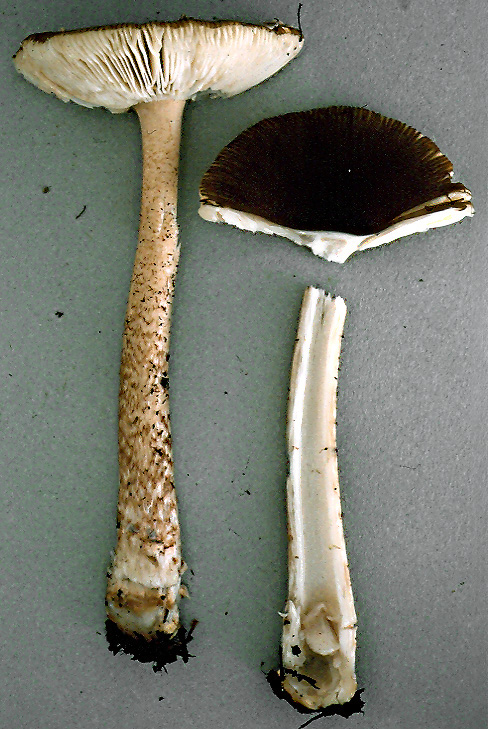
free or receding, with or without decurrent line on stipe apex (10× lens), subcrowded to crowded, orangish cream to pale brownish white to dingy white in mass, cream to dingy cream to dingy white or watersoaked in side view, infrequently forking, 6.5 - 9.5 mm broad; lamellulae truncate, greatly varying in length, plentiful, unevenly distributed |
| stipe |
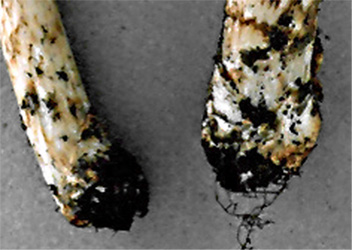
111 - 168 × 7.5 - 13 mm, pale brown to pale orangish-brown to pale orangish cream ground color, unchanging when cut or bruised, decorated with orange-brown to brown fibrils (sometimes with umbrinous tint or becoming very dark brown to black in age) in a chevron-like pattern, minutely punctate near the apex in age, narrowing upward, flaring (sometimes barely) at apex; context white to off-white to pale tan, unchanging when cut or bruised, hollow, with white cottony fibrils in central cylinder of 2 - 6 mm wide; exannulate; universal veil as strangulate volva, ochraceous to bright yellow orange below stipe base and in one or two rings which delimit the strangulate (undecorated) region, with highest such ring 21 - 40 mm from stipe base, these rings may become orange-brown or brownish red with time, occasionally also as gray warts and small patches above the uppermost ring. |
| odor/taste |
Odor indistinct, or (in age) like fried potatos (J. Lennie, Berkeley, California). Taste not recorded. |
macrochemical
tests |
none recorded. |
| partial veil |
absent. |
| basidiospores |
[100/5/4] (8.2-) 9.2 - 12.0 (-13.5) × (7.5-) 8.8 - 11.0 (-12.5) µm, (L = 10.4 - 10.9 µm; L’ = 10.6 µm; W = 9.6 - 9.9 µm; W’ = 9.8 µm; Q = (1.02-) 1.03 - 1.16 (-1.20); Q = 1.06 - 1.11; Q’ = 1.08), thin-walled, smooth, hyaline, inamyloid, globose to subglobose to broadly ellipsoid, somewhat adaxially flattened; apiculus sublateral, cylindrical to truncate conic; contents monoguttulate; white in deposit. |
| ecology |
Solitary to subgregarious. In loam under broad-leaved trees or in mixed broad-leaf/conifer forests or near Betula or under Betula and Populus. |
| material examined |
U.S.A.: MAINE—Hancock Co. - E of Pickerel Pond, 11.viii.1991 Gisela & Andrew Schafer 8-11-91-G [would be good holotype] (RET 029-7); W of Pickerel Pond, 11.viii.1991 NEMF91 foray participant 8-11-91-B (RET 029-4). Penobscot Co. - Orono, Univ. Maine, Hilltop area, White Trail, 11.viii.1991 Alma Homola 8-11-91-A (RET 029-5); NW of Old Town, S of Argyle, in bend of Hwy. 116, 12.viii.1991 John Lennie 8-12-91-F (RET ??). |
| discussion |
The ochraceous remains of the universal veil at the stipe base and the brown color of the universal veil on the pileus in the youngest specimen seen suggest that the universal veil is yellow-orange to ochraceous at first, then becomes brownish red to brown, and eventually gray.
Compare with A. sp-N24 and with A. dulciarii.
The present taxon has been called "Amanita sp. N29" in keys, checklists, and correspondence. |
| citations |
—R. E. Tulloss |
| editors |
RET |
|




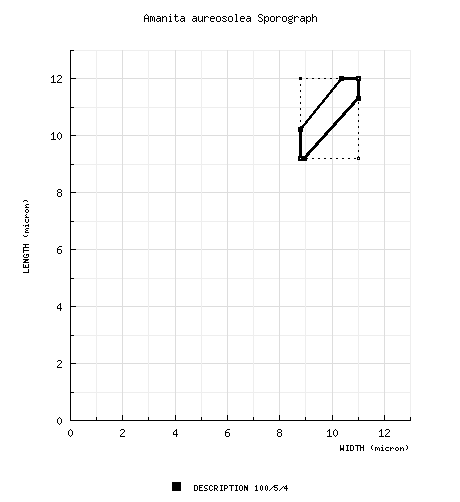
 Spore data sets and their composite