| name |
Amanita dolichopus |
| author |
Tulloss nom. prov. |
| name status |
nomen provisorum |
| synonyms |
≡Amanitopsis volvata var. elongata Peck. 1900 ["1899," "1901"]. Rep. (Annual) Regents Univ. State New York New York State Mus. 53: 856, pl. A (fig. 6-10).
= Amanita peckiana sensu McKnight & McKnight. 1987. Mushr.: 230-231, pl. 25 (fig. 7).
The editors of this site owe a great debt to Dr. Cornelis Bas
whose famous cigar box files of Amanita nomenclatural information
gathered over three or more decades were made available to RET for computerization
and make up the lion's share of the nomenclatural information presented on this site.
|
| etymology |
δολιχοσ (Gr.) "long" + πουσ (Gr.) "foot"
The name is selected in order to preserve in the specific epithet a character of importance in Peck’s protolog. |
| MycoBank nos. |
162240 |
| GenBank nos. |
Due to delays in data processing at GenBank, some accession numbers may lead to unreleased (pending) pages.
These pages will eventually be made live, so try again later.
|
| holotypes |
NYS (implicit) |
| type studies |
Jenkins. 1978. Mycotaxon 7: 43.
Tulloss, here |
| revisions |
Tulloss, here |
| intro |
The following text may make multiple use of each data field.
The field may contain magenta text presenting data from a type study
and/or revision of other original material cited in the protolog of the present taxon.
Macroscopic descriptions in magenta are a combination of data from the protolog and
additional observations made on the exiccata during revision of the cited original
material.
The same field may also contain black text, which is data from a revision of the present
taxon (including non-type material and/or material not cited in the protolog).
Paragraphs of black text will be labeled if further subdivision of
this text is appropriate.
Olive text indicates a specimen that has not been
thoroughly examined (for example, for microscopic details) and marks other places in the text
where data is missing or uncertain.
The following material not directly from the protolog of the present taxon and not cited as the work of another researcher is based on original research by R. E. Tulloss. |
| pileus |
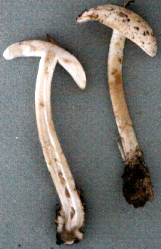
26 - 88 mm wide, subhemispheric to broadly campanulate to plano-convex to plane, subumbonate to subdepressed, white to whitish, becoming pale tan to tannish yellow to pale pinkish buff or pinkish brown or brick with age, darkest over disk, sometimes slightly hygrophanous, often bruising pinkish when scratched, slightly viscid when moist, shiny when dry; context 4 - 7 mm thick at stipe, thinning evenly to margin, whitish, bruising pinkish (approximately 9A3) to pale pinkish beige rapidly in humid weather; margin nonstriate to short striate (0.1R - 0.25R), slightly appendiculate at first with very small, white flocculence which becomes red-brown on exposure (lens); universal veil on pileus absent or occasionally in one large patch which becomes pinkish-brown with age (5B-C4, 6B-C3) or a varying amounts of thin membranous areolate to filamentous patches becoming finer fibrillose scales toward margin (sometimes suggesting cuneiform characters), white at first then avellaneous (pinkish-brownish buff) to red-brown with age. |
| lamellae |
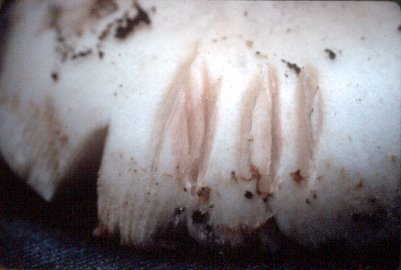
free or occasionally attached by a line or tooth or narrowly adnate, moderately crowded, usually rather narrow, 3.5 - 6 mm broad, white to whitish to cream, pinkish cream in mass, often bruising pinkish, broken places eventually reddish-brown, drying brown (5YR 5/8 to 7.5YR 7/8 or 5C6 to 10YR 7/6), occasionally forking, with edges minutely flocculose; lamellulae truncate to subtruncate to obliquely truncate, in several ranks, occasionally absent for as much as one quarter of the pileus circumference. |
| stipe |
(32-) 50 - 160 × (2-) 5 - 15 mm, white, browning from handling, becoming pinkish brown in age, subcylindric to tapering slightly upward or downward, sometimes sinuate (even strongly so), flaring or unexpanded at apex, floccose-mealy above (this decoration white at first then red-brown), when very fresh with a particularly dense floccose line at about the point at which the pileus margin touched the stipe before expansion, below becoming fibrous/scaly and finely longitudinally striate; context white to pale pinkish beige in age, bruising as in pileus, cottony stuffing or subfelted plugs in thin, central cylinder with diameter about one-third that of stipe or less—1.5 - 5 mm; exannulate; universal veil as a saccate volva, at times subglobose at first, eventually tubular, membranous to leathery, whitish to grayish with brown or red-brown stains or with brown margin, bruising as in pileus, moderately thick (up to about 6 mm below point of attachment to stipe), lobed, attached to stipe only at very base, completely buried in substrate, collapsing on stipe in exsiccata in which the leathery attribute may be totally lost, with small to somewhat thickened limbus internus about at a point about one-quarter to one-half of the distance from the stipe base to the top of the limb, having a separable thin inner layer in some specimens (especially noticeable in exsiccata), having tip of limb (16-) 18 - 81 mm from base of stipe, breadth 10 - 30 mm, about one-third to three-quarters of limb is free. |
| odor/taste |
Odor pleasantly fungoid when fresh or faint to none or faintly soapy at first (Bas) and later unpleasant (Bas). Taste indistinct (Bas). |
macrochemical
tests |
KOH negative on unbruised stipe context, lamellae, pileus, pileus context; yellow on universal veil on pileus, on old bruises in stipe context, in central cylinder of stipe, and (faintly) on outer surface of volval sac. NH4OH similar except stipe context bruises slowly cream and central cylinder bruises intensifying pink tone before becoming yellow. Paracresol spot test for tyrosinase strongly and quickly positive over entire basidiocarp. Syringaldazine spot test for laccase positive along inner surface of central cylinder in less than 9 min. |
| pileipellis |
filamentous, undifferentiated hyphae 2.5 - 3.2 µm wide, densely interwoven, radially oriented, gelatinizing, branching; vascular hyphae 6.5 - 10.5 µm wide, branching, rather common, without particular orientation. |
| pileus context |
filamentous, undifferentiated hyphae 2.0 - 9.0 µm wide, branching; acrophysalides elongate or clavate to 17.5 µm wide and ovoid to subglobose, up to 89 × 55 µm; vascular hyphae ??. |
| lamella trama |
bilateral, divergent, rather narrow—central stratum is relatively broad comprising between one quarter and one third of the distance between bases of basidia on opposing hymenial surfaces; filamentous, undifferentiated hyphae 2.0 - 10.0 µm wide, thin-walled, dominating, moderately branched, without clamps; inflated cells long and narrow to ellipsoid, thin-walled, terminal singly (up to 100* × 34 µm) or in short, terminal chains; occasionally locally plentiful; vascular hyphae, frequently branching, 1.0 - 8.5 µm wide. |
| subhymenium |
with basidia arising from subglobose to pyriform to ovoid cells or barely inflated hyphal segments (to 7 µm wide) which are terminal on branches of filamentous, undifferentiated hyphae or chains of slightly to fully inflated, small cells; these elements at right angles to hymenial surface or only slightly curved and sharply angled (nearly perpendicular) to hyphae and inflated cells of central stratum, occasionally mixed with locally dense, vascular hyphae which occasionally penetrate into the hymenium; no clamps observed. |
| basidia |
31 - 49 × (5.0-) 6.5 - 10.8 (-13.5) µm, dominantly 4-, but occasionally 2- or 1-sterigmate, thin walled; sterigmata up to 8 µm long; clamps not observed. |
| universal veil |
On stipe base, outer surface layer: ca. 5 - 10 hyphal diameters thick; composed of filamentous, undifferentiated hyphae 1.0 - 9.0 µm wide, gelatinizing, sublongitudinally oriented, interwoven, sometimes in fascicles, some terminal cells inflated to 21 µm wide [Bas’ note re Bas 3799: “It is possible that only the most superficial hyphae are strictly interwoven.”]; vascular hyphae 1.4 - 16.8 µm wide. On stipe base, interior layer: filamentous, undifferentiated hyphae 1.8 - 14 µm wide, interlacing in open matrix around inflated cells, at times in fascicles; inflated cells plentiful, up to 128 × 108 µm; vascular hyphae 3.8 - 10.5 µm wide. On stipe base, inner surface layer: filamentous, undifferentiated hyphae 1.8 - 5.2 µm wide, as dense mat, sublongitudinally oriented, gelatinizing; vascular hyphae up to 3.5 µm wide. On pileus, upper layer of a central patch: filamentous, undifferentiated hyphae 1.0 - 9.0 µm wide, gelatinizing, interwoven, branching; inflated cells elongate, up to 115 × 25 µm. On pileus, layer adjacent to pileipellis: sublongitudinally oriented hyphae, difficult to distinguish from pileipellis. |
| stipe context |
longitudinally acrophysalidic; filamentous, undifferentiated hyphae 5.6 - 8.4 (-9.0) µm wide, sparsely branched; acrophysalides up to 309 × 45 µm; vascular hyphae 2.1 - 5.9 µm wide; no clamps observed. |
| basidiospores |
type study (RET): [224/12/1] (7.8-) 9.2 - 12.5 (-14.2) × (4.2-) 4.8 - 6.0 (-6.8) μm, (L = (9.9-) 10.5 - 11.5 μm; L' = 10.9 μm; W = (5.2-) 5.4 - 5.6 μm; W' = 5.5 μm; Q = (1.50-) 1.69 - 2.40 (-2.60); Q = (1.82-) 1.89 - 2.12; Q' = 2.0), hyaline, colorless, smooth, thin-walled, amyloid, ellipsoid to elongate to cylindric; apiculus sublateral, ??; contents ??; color in deposit not recorded.
composite of spore data collected by RET: [978/47/32] (7.0-) 8.8 - 12.5 (-24) × (4.0) 4.9 - 6.2 (-10.0) μm, (L = (8.9-) 9.4 - 11.5 (-13.5) μm; L' = 10.5 μm; W = (4.8-) 5.2 - 5.8 (-5.9) μm; W' = 5.5 μm; Q = (1.36-) 1.59 - 2.30 (-3.33); Q = (1.64-) 1.70 - 2.12 (-2.26); Q' = 1.91), hyaline, colorless, smooth, thin-walled, amyloid, ellipsoid to elongate to cylindric, rarely bacilliform, sometimes inflated at one end, sometimes more or less constricted, rarely subsigmoid; apiculus sublateral, cylindric to (infrequently) truncate-conic, sometimes proiminent; contents granular to guttulate; white in deposit. |
| ecology |
Solitary to subgregarious. Connecticut: In sandy loam of conifer woods or in sand under P. strobus with an understory of Quercus. New Jersey: Under Quercus rubra, Fagus grandifolia, and Carya ovata in moist loam near swampy area containing much Symplocarpus foetidus. New York: “Under or near” Pinus spp. Tennessee: At 780 m elev. In mixed forest. Virginia: In mixed forest of Quercus, Carya, and P. strobus or under P. virginiana and Quercus spp. |
| material examined |
U.S.A.:
CONNECTICUT—New London Co. - Colchester, Day Pond St. Pk. [41°33'25" N/ 72°25'06" W, 134 m], 20.ix.1996 “L. S.” s.n. [Tulloss 9-20-96-A] (RET 250-5); Pachaug St. For., 5.viii.1988 David T. Jenkins s.n. [Tulloss 8-5-88-C] (RET ??), Carlene Skeffington s.n. [Tulloss 8-5-88-B] (RET ??), R. E. Tulloss 8-5-88-F (RET ??), 8-5-88-G (RET ??).
MAINE—Unkn. Co. - unkn. loc., 25.viii.1985 Ted Herman 8-25-85-SSR2 (RET 212-3).
MARYLAND—Baltimore City[?], vii.1880 Mary E. Banning 2 (NYS as “Agaricus volvatus”).
MASSACHUSETTS—Barnstable Co. (Cape Cod) -Orleans, 18.x.1987 BMC member s.n. [Tulloss 10-18-87-SSR1] (RET 124-1). Franklin Co. - Mt. Grace St. For., 18.viii.1989 NEMF foray participant s.n. [Tulloss 8-18-89-D] (RET 245-3); Mt. Toby St. For., 25.viii.1963 C. Bas 3799 (L as “Amanita volvata”). Hampden Co. - Springfield, 30.vii.1986 Ellen Greer 7-30-86-EG1 (RET 466-3). Unkn. Co. - NEMF2001 foray 6, 17.viii.2001 Ralph Cox s.n. [Tulloss 8-17-01-C] (RET 362-2).
NEW HAMPSHIRE—Cheshire Co. - Wantastiquet St. For., 19.viii.1989 Abrahams 8-19-89-D (RET 245-1).
NEW JERSEY—Burlington Co. - Brendan T. Byrne [=Lebanon] St. For., 6.ix.1981 M. A. King & R. E. Tulloss 9-6-81-E (RET 166-4). Hunterdon Co. - Oldwick, behind the old school, 12.vii.1991 Susan Kibby s.n. [Tulloss 7-12-91-SK2] (RET 010-3). Mercer Co. - Hopewell Twp., off Carter Rd., woods behind AT&T/Lucent research labs [40°21’39” N/ 74°43’29” W, 63 m], 2-20.vii.1979 R. E. Tulloss G-B-91 (RET169-4 ), 21.vii.1980 R. E. Tulloss 7-21-80-A (RET 393-2), 28.vii.1980 R. E. Tulloss 7-28-80-A (RET ??), 4.viii.1980 R. E. Tulloss 8-4-80-A (RET ??), 6.vii.1981 R. E. Tulloss 7-6-81-A (RET 169-1), -C (RET 169-2), -D (RET ??), 7.vii.1981 R. E. Tulloss 7-7-81-B (RET 169-3), 21.vii.1981 R. E. Tulloss 7-21-81-B (RET 162-9), 22.vii.1982 R. E. Tulloss 7-22-82-B (RET ??), -G (RET ??), 27.vii.1982 R. E. Tulloss 7-27-82-E (RET 216-9); Hopewell Twp., Mt. Rose [40°22’16” N/ 74°44’14” W], 20.vii.1985 Janice Vansant s.n. [Tulloss 7-20-85-A] (RET 203-9); Washington Crossing St. Pk., arboretum area [40°18’00” N/ 74°52’03” W, 32 m], 5.vii.1992 D. C. & R. E. Tulloss 7-5-92-F (MEXU; RET 061-8), 7.vii.1992 Janice D. Vansant s.n. [Tulloss 7-7-92-JDV1] (RET 062-5). Monmouth Co. - Assunpink Wildlife Mgmt. Area, 14.viii.1980 R. E. Tulloss 8-14-80-A (RET 070-6), -B (RET ??); Shark River Co. Pk. [40°12’18” N/ 74°05’44” W, 16 m], 17.vii.1988 Hanna Tschekunow s.n. {R. E. Tulloss 7-17-88-A] (RET 124-5)
NEW YORK—Albany Co. - Guilderland, Siver Rd. area, autumn.1958 Dr & Mrs. Glasgow 2133 (DAOM 60468 as “A. peckiana”). Dutchess Co. - ca. Pine Plains, Thompson Pond Preserve, Stissing Mtn. [41°57’52” N/ 73°40’57” W, ca. 140-410 m elev.], 30.vii.1988 William Bakaitis 7-30-88-BB (RET ??). Sullivan Co. - Claryville, viii C. H. Peck. s.n. (holotype, NYS).
PENNSYLVANIA—Berks Co. - just W of Eckville, Hawk Mountain Sanctuary, along River of Rocks, 17.vii.1996 J. A. Lankalis s.n. (RET 323-10). Clearfield Co. - ca. Clearfield, Graver Arboretum, 1.viii.1997 A. P. Hilter s.n. [Tulloss 8-1-97-A] (RET 263-3). Border of Franklin & Adams Cos. - Michaux St. For., District Rd., 12.viii.2005 Rhoda Roper s.n. [Tulloss 8-12-05-E] (RET 387-2).
RHODE ISLAND—Washington Co. - Arcadia Mgmt. Area, 4.viii.1988 NEMF88 participant s.n. [Tulloss 8-4-88-B] (RET 119-10), Anna Zelechivsky s.n. [Tulloss 8-4-88-D] (RET ??); Carolina Mgmt. Area, 5.viii.1988 S. Stachula s.n. [Tulloss 8-5-88-E] (RET ??), 5.viii.1988 E. Yetter s.n. [Tulloss 8-5-88-D] (RET ??).
TENNESSEE—Sevier
Co. - GSMNP, ca. Gatlinsburg, Cherokee Orchard
[35.6811° N/ 83.4625° W, 945 m],
12.vii.2004 R. E. Tulloss 7-12-04-C
(RET 376-3).
VIRGINIA—Craig Co. - John’s Crk., 30.viii.1978 P. C. Hammond 36 p.p. (VPI as “A. volvata,” mixed collection). Giles Co. - Jefferson Nat. For., Pandapus Pond Rec. Area, 13.ix.1988 O. K. Miller 23138 (VPI as “A. peckiana”).
WEST VIRGINIA—Preston Co. - Eglon, vii.1902 C. G. Lloyd 02288 (NYS, as “Amanitopsis volvata”). |
|



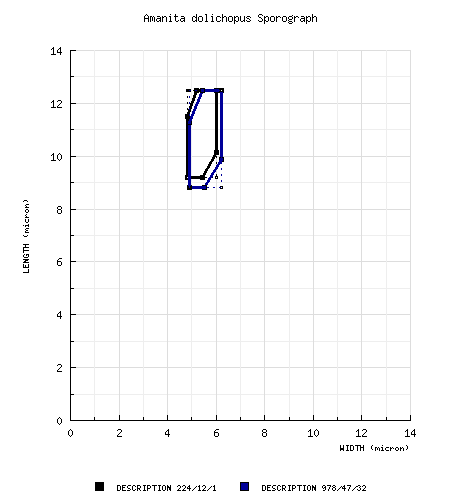
 Spore data sets and their composite