| name |
Amanita
pseudovolvata |
| name status |
nomen provisorum |
| GenBank nos. |
Due to delays in data processing at GenBank, some accession numbers may lead to unreleased (pending) pages.
These pages will eventually be made live, so try again later.
|
| intro |
Olive text indicates a specimen that has not been
thoroughly examined (for example, for microscopic details) and marks other places in the text
where data is missing or uncertain.
The following material is based on original research of R. E. Tulloss. |
| pileus |
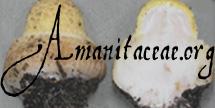
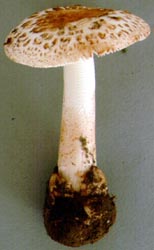
15 - 68 (-99) mm wide, white or whitish, sometimes
cream over disk, sometimes (wet weather) rapidly
bruising faint pink then fading, sometimes with
red-brown or brick stains, red-brown or brick on
edge of old wounds, tacky becoming subshiny to
shiny, subglobose then hemispheric then convex
(often with slight umbo) then planoconvex,
occasionally finally depressed to convex;
context 0.5 - 5 (-7.5) mm thick at stipe,
thinning evenly or rapidly at first then evenly to
margin, sometimes only a membrane over last few mm at
margin, dirty cream to off-white to white, at times
darkest near stipe, occasionally staining faint
pink or pinkish brown or sordid pink, always
red-brown or brick in old wounds; margin
usually short striate ((0+R-) 0.1R -
0.2R (-0.4R)) depending on conditions of growth and
age of specimens, frequently noticeably striate
just as cap expands from volval sac, appendiculate
with small bits of white fibrillose material
becoming red-brown or brick or clay color;
universal veil in thin broken submembranous
to felted/radially fibrillose layer (inner layer of
universal veil) or merely radially fibrillose
scales becoming smaller towards margin, easily
removed, originally white then quickly red-brown
or brick (5YR 5/4 to 5YR 6/2 to 7.5YR 6/2-4 to a
little browner than 7.5YR 7/4 or 5B3-4 to 6C6 to
7B2 to 7C4-5 to 8A2 to 8C-D5), eventually drying to
a pale pinkish beige, occasionally also a whitish
leathery membranous patch. |
| lamellae |
free to narrowly adnate, sometimes with short to long decurrent line on stipe, close to subcrowded to crowded, whitish to off-white to pale cream to cream in mass, white to off-white in side-view, bruising as in pileus and universal veil on pileus, becoming red-brown or brick in wounds, sometimes light sordid buff in age, drying 3A2 to 2.5YR 4/6 to 5YR 4/6, 2 - 6.5 mm broad; margin decorated with white flocculence becoming red-brown or brick, sometimes extending slightly beyond pileus margin; lamellulae truncate to subtruncate to rounded truncate to subattenuate, occasionally with an attenuate tooth at pileus trama, of varying length, in one to many ranks, numerous—between almost every pair of lamellae. |
| stipe |
22 - 90 (-116) × 2.5 - 8.5 mm, narrowing upward or
cylindric, flaring slightly to broadly at apex, white
becoming red-brown or brick in wounds, decorated
with white pulverulence/flocculence becoming
red-brown to brick; context whitish to faint
cream or sordid pale cream, bruising as in pileus,
red-brown or brick in old wounds, stuffed becoming
hollow in part, stuffing occasionally yellowish and
reminiscent of fine sawdust, central cylinder 1.5 -
3 (-5) mm wide, concolorous to red-brown or brick in
larva tunnels; bulb lacking, stuffing material
from stipe extends into lower portion of universal
veil below point where stipe tissue ends;
exannulate (from bud); universal
veil as subglobose to ovoid sac, sometimes with
extended limb on one side, 1- - 3 mm
thick in
upper portion, thicker (to 5 mm or more) in lower
portion, interior off-white and sometimes with
gelatinous appearance, 13 - 37 × 7 - 22 mm,
whitish, soft, tough, leathery, usually dividing
into two or three lobes, adnate for up to
two-thirds of height, with fine hyphae holding soil
to much of surface, layered with most of inner
layer left on pileus; limbus internus rarely
noticeable and then very small and about
one-quarter to one-third of distance from point of
limb attachment to tip of limb. |
| odor/taste |
Odor lacking or mild or occasionally (wet weather) faintly fungoid or like freshly cleaned laundry. Tasteless. |
macrochemical
tests |
Spot test for laccase (syringaldazine) - positive except in central cylinder and volval sac or limited to one or more of following regions: lamellae, central stipe, pileus context, upper portion of volval limb. Spot test for tyrosinase (??) - strongly positive throughout basidiocarp or occasionally negative in base of stipe or negatuve in universal veil tissue below base of stipe. Test vouchers: ??. |
| pileipellis |
as very thin layer less than or equal to 5 hyphal diameters thick; filamentous, undifferentiated hyphae 2.2 - 4.0 µm wide, partially gelatinizing, branching, some with raised tips, interwoven, subradially arranged; vascular hyphae 1.5 - 4.0 µm wide, branching. |
| pileus context |
filamentous, undifferentiated hyphae 1.0 - 6.0 µm wide, branching; acrophysalides plentiful, elongate to 165 × 20 µm; subglobose to ellipsoid (up to 75 × 50 µm), clavate (up to 65 × 28 µm); vascular hyphae up to 3.5 µm wide. |
| lamella trama |
bilateral, divergent; with elements diverging from central stratum at about 45° angle then making smooth curve until at right angles with central stratum only within two or three short hyphal segments or small inflated cells of bases of basidia; filamentous, undifferentiated hyphae 3.0 - 6.2 µm wide, inflated segments to 17.5 µm wide, branching; inflated cells subglobose (up to 57 × 52 µm), ovoid to narrowly clavate, sometimes in chains, frequently nonterminal (up to 62 × 26 µm); vascular hyphae up to 3.0 µm wide, branching; all elements thin-walled. |
| subhymenium |
subramose to subcellular; consisting of branching, frequently septate, only slightly inflated hyphae, 3± µm wide and small, intercalary pyriform to subglobose cells or slightly inflated segments; basidia more frequently arising from hyphae than from expanded cells. |
| basidia |
35 - 51 × 7.5 - 10.8 µm, clavate, 4-spored, rarely 1-spored, thin-walled, some orange in NH4OH; sterigmata to 10 µm long; no clamps observed. |
| universal veil |
On stipe base, outer surface: gelatinizing; filamentous, undifferentiated hyphae 3.5 - 5.6 µm wide, branching, disordered in outermost layer for up to 5 hyphal diameters thickness, then longitudinally oriented. On stipe base, inner surface: absent or as scattered small gelatinized inflated cells. On stipe base, interior: filamentous, undifferentiated hyphae 2.4 - 8.4 µm wide, longitudinally oriented, branching, at times in fascicles and occasionally with terminal segments inflated up to 25 µm wide; inflated cells locally plentiful, ellipsoid to elongate to cylindric to 130 × 60 µm, entwined by hyphae; vascular hyphae 1.7 - 2.8 µm wide. On pileus, inner surface: filamentous, undifferentiated hyphae 2.8 - 11.9 µm wide, partially gelatinizing, interwoven, disoriented, thickest segments sometimes clustered and short; vascular hyphae 4.5 - 9.8 µm wide. Other layers on pileus as on base of stipe. |
| stipe context |
longitudinally acrophysalidic; filamentous, undifferentiated hyphae 1.5 - 6.2 µm wide, branching; acrophysalides up to 178 × 41 µm; vascular hyphae 1.8 - 3.0 µm wide, branching. |
| partial veil |
absent. |
| basidiospores |
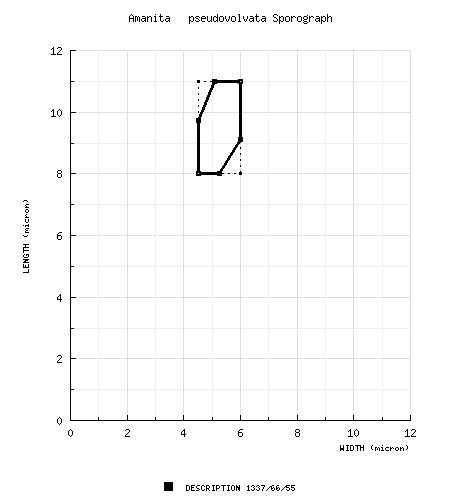
[1337/66/55] (5.0-) 8.0 - 11.0 (-13.5) × (3.8-) 4.5 - 6.0 (-7.8) µm, (L = (7.6-) 8.5 - 10.6 (-11.0) µm; L’ = 9.6 µm; W = (4.5-) 4.8 - 5.9 (-6.5) µm; W’ = 5.2 µm; Q = (1.11-) 1.52 - 2.16 (-2.76); Q = (1.42-) 1.64 - 2.04 (-2.14); Q’ = 1.85), hyaline, colorless, thin-walled, smooth, amyloid, elongate, occasionally ellipsoid, occasionally cylindric; apiculus sublateral, proportionately small, subcylindric; contents guttulate to granular; white in deposit. |
| ecology |
Solitary to subgregarious. Massachusetts: In mixed Pinus-Quercus woods or under Betula. Mississippi and Louisiana: In damp, river bottom land. New Jersey: In mixed deciduous woods including Quercus in sand, sandy loam or sandy clay. Texas: In mixed Pinus and deciduous forest in sandy soils. Virginia: Under Quercus alba and Carya glabra or in mixed forest of Quercus, Carya, and P. strobus. |
| material examined |
CANADA:
ONTARIO—Elgin Co. - SE Southwold, 6.viii.1932 Ferguson s.n. [J. Dearness 8152] (DAOM, as “Amanitopsis volvata”).
QUÉBEC—Région Montérégie - Mont-Saint-Hilaire, 10.ix.1993 Y. Lamoureux 2032 (CMMTL; RET 118-3).
U.S.A.:
ALABAMA—Baldwin Co. - Vaughn, 7.viii.1897 F. S. Earle s.n. (NYS, as “Amanitopsis volvatus” (sic)).
ARKANSAS—Pulaski Co. - Hensley, 13.ix.1991 Edith Nelson s.n. [Tulloss 9-13-91-EN1] (RET 028-5).
CONNECTICUT—New Haven Co. - Cheshire Twp., Sleeping Giant St. Pk. [41°26'02" N/ 72°53'03" W, 179 m], 23.vii.1992 NEMF ‘92 foray participant s.n. [Tulloss 7-23-92-A] (RET 066-4). New London Co. - Colchester, Day Pond St. Pk. [41°33'25" N/ 72°25'06" W, 134 m], 31.viii.1997 Diane Pruden s.n. [Tulloss 8-31-97-Ka] (RET 267-7); Pachaug St. For., Harris Rd., 5.viii.1988 Roy Watling 21178 [Tulloss 8-5-88-J] (E; RET ??). Tolland Co. - Gay City St. Pk. [41°43’23” N/ 72°26’38” W, 209 m], 31.viii.1997 R. E. Tulloss 8-31-97-E (RET 268-1), -F (RET 269-6). Windham Co. - Natchaug St. For., 31.viii.1997 Peter Katsaros s.n. [Tulloss 8-31-97-Kb] (RET 269-4).
DISTRICT OF COLUMBIA—Washington, s.d. F. J. Braendle s.n. (NYS, as “Amanitopsis volvata (Pk.) Sacc.”).
FLORIDA—Alachua Co. - Gainesville, vii.1982 J. W. Kimbrough s.n. (FLAS F53034, as “Amanita volvata”).
ILLINOIS—Jackson Co. - SW of Carbondale, Union Hills subdivision, 4.viii.1979 W. J. Sundberg 4415 (SIU).
LOUISIANA—St. Tammany Parish - Pearl River Wildlife Mgmt. Area, Honey Isl. Nature Tr., 11.viii.1986 S. Harsch 306 (RET 148-3), 18.viii.1986 S. Harsch 301 (RET 112-10), 20.viii.1986 S. Harsch 302 (RET 146-10), 31.viii.1986 S. Harsch 300 (RET 146-8) & 303 (RET 148-1), 14.vii.1987 Col. E. R. Davies & D. C. & R. E. Tulloss 7-14-87-F (RET 179-9), 14.vii.1987 member NAMA Amanita Workshop 7-14-87-I (RET 179-10).
MAINE—Penobscot Co. - Passadumkeag Mtn., 10.viii.1991 Naomi Stern 8-10-91-NS1 (RET 029-6).
MARYLAND—Unkn. Co. - mixed localities in Baltimore & Talbot Cos., vii-viii.1990 P. E. Noell s.n. (RET 147-6).
MASSACHUSETTS—Middlesex Co. - Cambridge, Harvard Univ., 22.vii.1945 R. Singer s.n. (FH, as “A. baccata f. volvata”); Medford, Mystic Lakes, 10.vii.1989 Inge Dewald s.n. [Tulloss 7-10-89-A] (RET 240-1), s.n. [Tulloss 7-10-89-B] (RET 240-2). Worcester Co. - Barre, s.d. Father J. M. Bauchet s.n. (DAOM 114812, as “Amanita agglutinata”).
MISSISSIPPI—Harrison Co. - Desoto Nat. For., Tuxachanie Tr., 19.vii.1987 Dan Guravich et al. s.n. [Tulloss 7-19-87-A] (RET 150-5). Jackson Co. - Pascagoula R. WMA, 17.vii.1987 Dennis Desjardin s.n. [Tulloss 7-17-87-G] (RET 149-10); betwn. Wade & Vancleave, 18.vii.1987 participant NAMA1987 [Tulloss 7-18-87-A] (RET 150-6). Leake Co. - Natchez Trace Pwy., 13.vi.1981 D. Guravich 1221 (MICH, as “A. volvata”). Unkn. Co. - “Southern part of state,” NAMA1987 participant(s) s.n. [Tulloss 7-14-87-L] (RET 179-8), s.n. [Tulloss 7-14-87-M] (RET 179-7).
MISSOURI—St. Louis Co. - St. Louis, 1902 Dr. N. M. Glatfelter s.n. (CUP-A).
NEW HAMPSHIRE—Carroll Co. - Conway, 13.vii.1987 Jean Hurley s.n. [Tulloss 7-13-87-JH1] (RET 179-6).
NEW JERSEY—Hunterdon Co. - Oldwick, behind old school, 12.vii.1991 Susan Kibby s.n. [Tulloss 7-12-91-SK1] (RET 010-1). Mercer Co. - Hopewell Twp., off Carter Rd., woods behind AT&T/Lucent research labs [40°21’39” N/ 74°43’29” W, 63 m], 13.viii.1981 R. E. Tulloss 8-13-81-A (RET 162-8), 28.vii.1984 D. M. Keller, M. A. King & R. E. Tulloss 7-28-84-A (RET 053-3); Hopewell Twp., Aunt Molly Rd., 14.vii.1991 R. Peabody, J. VanSant & B. VanSant s.n. [Tulloss 7-14-91-BV1] (RET 010-2); Washington Crossing St. Pk., ca. Arboretum [40°17’57” N/ 74°52’00” W, 34 m], 5.viii.1996 Britt Carlson & R. E. Tulloss [Tulloss 8-5-96-C] (RET 230-1). Monmouth Co. - Assunpink Wildlife Mgmt. Area, 26.vii.1987 R. E. Tulloss 7-26-87-D (RET 003-6); Roosevelt, just W of Valley Rd. bike path, N of Empty Box Brk. [40°12'53" N/ 74°28'05" W, 41 m], 18.viii.2004 Mary & R. E. Tulloss 8-18-04-A (RET 377-4); Roosevelt, on hill in SE corner of Block 7, Lot 10.01 [40°12’49” N/ 74°28’19” W, 70-105 m], 22.ix.1999 R. E. Tulloss 9-22-99-M (RET 302-7); Shark River Co. Pk. [40°12’18” N/ 74°05’44” W, 16 m], 7.vii.1991 M. A. King & R. E. Tulloss 7-7-91-B (RET 003-3), 28.viii.1996 S. E. K. & R. E. Tulloss 8-28-96-A (RET 248-5), -B (RET 248-6), 13.ix.1998 R. E. Tulloss et al. 9-13-98-A (RET 287-6). Morris Co. - Hackettstown Reservoir, 26.vii.1984 G. G. Kibby, R. Peabody, J. Richards & R. E. Tulloss 7-26-84-Q (RET 053-4), 10.viii.1986 Roger Phillips 3308 (in herb. R. Phillips; RET 089-6); Mendham, Meadowood Twp. Pk. [40°47'31" N/ 74°38'43" W, 214 m], 2.viii.1981 Jim Richards s.n. [Tulloss NJMA-8-2-81-C2] (RET 110-6), 30.vii.1989 Michael Rubin s.n. [Tulloss 7-30-86-G] (RET 241-2). Warren Co. - Jenny Jump St. For., 13.viii.1982 J. Turner & O. K. & H. H. Miller [OKM] 19979 (VPI, as “A. peckiana”).
NEW YORK—Albany Co. - Delmar, “July & August” C. H. Peck s.n. (NYS, in mixed collection as “Amanitopsis volvata (Pk.) Sacc.”). Rockland Co. - Harriman St. Pk., near Ladentown, Lk. Sebago, 23.vii.1963 B. F. Isaacs 2155 (MICH, as “Amanita volvata”). Suffolk Co. (Long Isl.) - Port Jefferson, 7.viii.1902 F. S. Earle s.n. (NYS, as “Amanitopsis volvata (Pk.) Sacc.”); Rocky Pt. Cons. Area, 2.vii.2000 Joel L. Horman s.n. (RET 313-9); Wading R., 26.viii.1905 C. H. Peck s.n. (NYS, as “Amanitopsis volvata” in mixed collection), viii.1906 C. H. Peck s.n. (NYS, as “Amanitopsis volvata”). Tompkins Co. - Danby, Michigan Hollow, 2.x.1996 C. Whittaker s.n. (CUP 63623); Ithaca, Six Mile Crk., 30.vii.1953 R. L. Shaffer 142 (MICH; CU 44382, n.v., as “Amanita agglutinata”). Unkn Co. - Albany Co. & Sussex Co. (Long Isl.), Loudonville/Port Jefferson/Smithtown, mixed localities, 9-30.viii.1909 C. H. Peck s.n. (NYS, as “Amanitopsis volvata” in mixed collection).
NORTH CAROLINA—Henderson Co. - Tuxedo, 14.ix.1974 Ann Schwartz s.n. [O. K. Miller 9743] (VPI, as “A. peckiana”). Macon Co. - Highlands, Highlands Nature Ctr., 22.ix.1980 D. Guravich 1050 (MICH, as “Amanita volvata”), 14.vii.1990 R. E. Tulloss 7-14-90-B (RET 147-3); ca. Otto, Coweeta Hydrological Stn., 10.vii.1990 Richard E. Baird & R. E. Tulloss 7-10-90-A (RET 146-2). Swain Co. - GSMNP, N of Bryson City, Indian Crk., 23.vii.1970 R. L. Shaffer 6283 (MICH, as “A. volvata”).
PENNSYLVANIA—Berks Co. - ca. Eckville, Hawk Mountain Sanctuary [40°38'06" N/ 75°59'16" W, ca. 400 m], 3.ix.1996 J. A. Lankalis s.n. (RET 258-10), 1.viii.1997 Ralph Cox s.n. [Tulloss 8-1-97-B] (RET 263-2). Luzerne Co. - Hunlock Crk., 3.ix.2011 David Wasilewski s.n. (RET 499-5). Pike Co. - Dingman's Ferry, Pocono Environmental Education Ctr. [41°10'17" N/ 74°54'52" W, 235 m], 20.vi.1981 Robert Peabody 6-20-81-L (RET 175-1), 22.vii.1981 R. L. Homola 7590 (MAINE).
RHODE ISLAND—Washington Co. - Arcadia
Mgmt. Area, 4.viii.1988 U. Hoffman 8-4-88-A
(RET 240-8); Carolina Mgmt. Area, 5.viii.1988 S.
Stachula s.n. [Tulloss 8-5-88-I] (RET 119-9).
TENNESSEE—Sevier Co. - ca.
Gatlinburg, GSMNP, Cherokee Orchard [35.6811°
N/ 83.4625° W, 945 m], 12.vii.2004 R. E. Tulloss
7-12-04-I (RET 377-10).
TEXAS—Hardin Co. - Big Thicket Nat.
Preserve, Lance Rosier Unit, 21.ix.1986 D. P.
Lewis 4018 (RET 112-7); Silsbee, 26.vi.1988 D. P.
Lewis 4124 (RET 148-2).
VERMONT—Windham Co. - Townshend St.
For., 7.viii.1961 R. L. Shaffer 3220 (MICH, as
A. volvata).
VIRGINIA—Craig Co. - John’s Crk.,
30.viii.1978 P. C. Hammond 36 p.p. (VPI, as
“A. volvata”). Montgomery Co. -
Mud Pike, 17.vii.1981 Gerald Bills 108
(VPI, as “A. volvata”). |
| discussion |
(t.b.d.)
Note: See also RET 282-10,
RET 363-8, RET 364-3, and RET 452-4. |
| citations |
—R. E. Tulloss and C. Rodríguez Caycedo |
| editors |
RET |
|


 Spore data sets and their composite