
| name | Amanita crebresulcata |
| name status | nomen acceptum |
| author | Bas |
| english name | "Closely Grooved Ringless Amanita" |
| images |
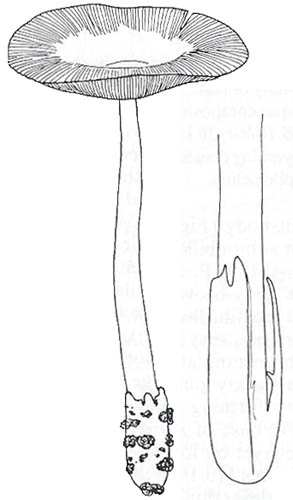 1. Amanita crebresulcata, Manaus, Amazonas, Brazil. |
| intro |
This description is taken from the original description of Bas (1978). |
| cap |
The cap of A. crebresulcata is 50 - 75 mm wide, glabrous, campanulate with a rather acute umbo in young specimens, plano-convex to flat or plano-convace with low obtuse umbo in older specimens, with a broad, densely sulcate-striate margin (45 - 65% of the radius). The cap is dark umber to fuscous-sepia at the umbo and somewhat paler away from the umbo. |
| gills |
The gills are free, crowded, narrow, and white. The short gills are truncate and rather scarce. |
| stem |
The stem is up to 120 × 10 mm, tapering upward, hollow, without a bulb, gray, white at the base, often paler at the apex, glabrous, smooth, and exannulate. The saccate volva is membranous, thin, narrowly sheathing, white to cream, and minutely felted. |
| spores |
The spores from the original material measured (8.0-) 8.5 - 10.5 (-11.0) × (6.5-) 7.0 - 8.5 (-9.0) µm and are subglobose to broadly ellipsoid (rarely ellipsoid) and inamyloid. Clamps are absent at the bases of basidia. |
| discussion |
This species belong to a small group described in the discussion of A. dunicola Guzmán. Amanita crebresulcata was originally described from a collection made in secondary rain forest (Manaus, Amazonas, Brazil) by Dr. Rolf Singer.—R. E. Tulloss & L. Possiel |
| brief editors | RET |

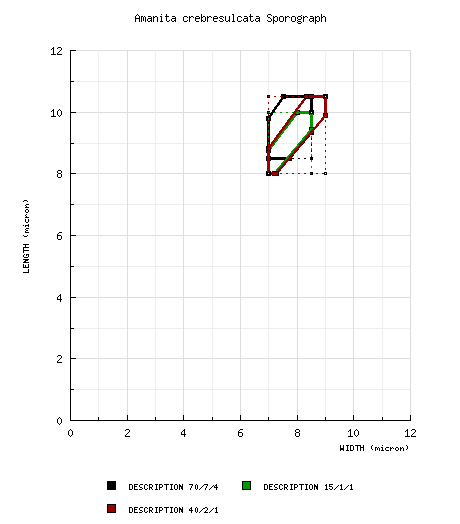
 Spore data sets and their composite