| name |
Amanita costaricensis |
| author |
Tulloss, Halling, G. M. Muell. & Sing. 2011. Mycotaxon 117: 189, figs. 9-11. |
| name status |
nomen acceptum |
| english name |
"Costa Rica Lepidella" |
| etymology |
Costa Rica + -ensis, "occurring in" |
| MycoBank nos. |
518297 |
| GenBank nos. |
Due to delays in data processing at GenBank, some accession numbers may lead to unreleased (pending) pages.
These pages will eventually be made live, so try again later.
|
| intro |
The following is based on original research by R. E. Tulloss, R. E. Halling, and G. M. Mueller. |
| pileus |
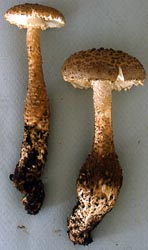
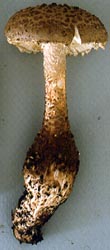
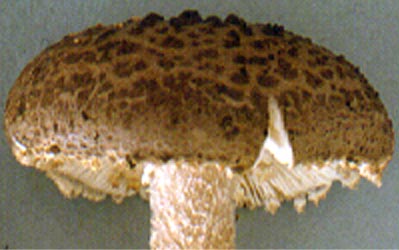
from protolog: (43-) 50 - 120 mm wide [up to 145 mm in Mueller 4368], brown (6C4-5) to light brown (5-6D4-5) to light brown with slight pinkish cast (ca. 7D5) to pale sordid tan to yellowish cream (then with sordid tan disc) to light brownish gray (7.0YR 5.4/1.2) to brownish gray to mouse (or rat) gray, micaceous gray in old material (Gómez & Alfaro 20641) or dull dark brown over disc [Mueller 4368], with pigment at least sometimes washed out by rain, hemispheric to convex at first, becoming applanate around subumbonate disc, tacky when moist, sometimes viscid over disc, dull to satiny to subshiny, shiny in age, sometimes becoming areolate and then with areolae centered on warts; context white, usually with pale brownish gray to gray to brown region under pileipellis, sometimes pale ochraceous when exposed, 3 - 10.5 mm thick over stipe, thinning evenly to margin; margin nonstriate, sometimes short sulcate (0.05 R) in age, incurved at first, then decurved, occasionally uplifted in age, appendiculate with white and or gray floccose-felted shreds of partial veil; universal veil as patches or flakes or warts (some rather broad and irregular, some small and pyramidal), often squamulous near margin, gray to brownish gray to brown or dark grayish brown and darker than pileus (6D-E4-6 to 7E6 to 7F7 to 5.6YR 3.4/0.9), occasionally as flat pinkish brown (7B4) patches, pulverulent, darkening with age, verruculose (10× lens), detersile. |
| lamellae |
from protolog: free to narrowly adnate, close to subcrowded to crowded, lacking decurrent lines on stipe apex, white to pale cream in mass, off-white to slightly sordid white to very pale yellowish white in side view, reddish brown where damaged, relatively thick, 3 - 7.5 mm broad, frequently subventricose, entire, with thin gray edge; lamellulae truncate to rounded truncate to subattenuate to attenuate to attenuate in steps, plentiful, unevenly distributed, of diverse lengths or all very short [only reported for Mueller 4368]. |
| stipe |
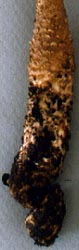
from protolog: 52 - 124 × 9 - 18 (-22) mm [broadest in luxuriant mature specimen of Mueller 4368], ground color white to off-white to pale grayish, pallid to gray matte to whitish-gray and smooth to subglabrous above partial veil, below partial veil (and extending downward to first row of warts of universal veil) decorated with densely pulverulent to floccose or floccose-fibrillose universal veil (q.v.), with such material mouse gray to light gray-brown (ca. 7C3), later decorated with light gray-brown (5B3 to 9.7YR 6.4/2.5) granules and light gray-brown to reddish brown fibrillose upward pointing scales, with such material evenly distributed or in narrow concentric bands, finely striatulate with some raised fibrils in undecorated areas below partial veil, with surface decoration becoming reddish brown from handling, cylindric or narrowing upward or broadest at mid-stipe or narrowest at mid-stipe, flaring at apex or not; bulb (30-) 57 - 112+ × 17 - 40 mm [shortest in mature specimen of Mueller 4368], napiform to narrowly napiform or dauciform, radicating, varying from poorly differentiated from stipe to subabrupt; context white to sordid white [bruising light yellow only in Mueller 4368], solid (under some conditions center of stipe becoming water soaked or gelatinized and pale sordid yellowish tan), sometimes with lacunae in center (especially in large specimens), infrequently becoming hollow [e.g., in Mueller 4368], concolorous to pale pallid brown or pale pinkish brown or ochraceous or pale brick-colored in insect tunnels; partial veil apical to superior, white becoming gray above, occasionally with edge darker gray in age, below bearing gray pulverulence, striate above, skirt-like, submembranous to floccose-felted, tearing, often left as floccose patches over lamellae; universal veil absent or as pyramidal warts or patches placed irregularly or subconcentrically arranged in few to many (up to 10 or more) rows near broadest point of bulb or for as much as upper three-quarters of bulb length, often with underlying context forming white to pale grayish recurved scales with universal veil remnants on tips of such scales, rather dark brownish gray (5.6YR 3.4/0.9), with limbus internus occasionally left as a thick, submembranous ring at base of stipe and then concolorous with stipe. |
| odor/taste |
from protolog: Odor lacking or similar to nutmeg at first; in age, “old ham”-type smell, but more penetrating and unpleasant. [“Musty” in Mueller 4368.] Taste not distinctive. |
macrochemical
tests |
from protolog: Spot test for laccase (syringaldazine) - negative throughout basidiome. except for very few spots on margins of lamellae. Spot test for tyrosinase (paracresol) - negative throughout basidiome. Test voucher: Tulloss 6-20-95-A. |
| pileipellis |
from protolog: 315 - 460 µm thick overall (175 - 235 µm in old specimen); suprapellis 95 - 230 µm thick (40 - 100 µm in old specimen), partially gelatinized, pale yellow to colorless except (occasionally) dark brownish orange at surface; subpellis 160 - 260 µm thick (130 - 135 µm in old specimen), ungelatinized, dark brownish orange; filamentous, undifferentiated hyphae 2.8 - 8.4 µm wide, branching, densely packed, dominantly subradially oriented, but with some criss-crossing; vascular hyphae 7.4 - 21 µm wide, scattered to locally common, sinuous, with those of largest diameter from old (senescent?) specimen (Gómez & Alfaro 20641). |
| pileus context |
from protolog: filamentous, undifferentiated hyphae 2.0 - 20 µm wide (many with width ca. 8.0 µm), branching, dominating, singly and in fascicles interwoven in open lattice, occasionally with yellowish subrefractive walls; inflated cells clavate to narrowly clavate to subfusiform, up to 138 × 34 µm, apparently mostly intercalary, one clavate cell terminal [possibly fitting definition of "acrophysalide" per Bas (1975)] except for hypha branching from one side, with walls thin or slightly thickened; vascular hyphae 8.4 - 31 µm wide, occasionally branching, sinuous, scattered to locally common especially just below pileipellis, locally in loose knots, with those of largest diameter from old (senescent?) specimen (Gómez & Alfaro 20641). |
| lamella trama |
from protolog: bilateral, divergent; wcs = 45 - 60± µm (moderate rehydration); central stratum composed largely of rather broad hyphae, apparently lacking intercalary inflated segments; subhymenial base comprising filamentous, undifferentiated hyphae and narrow intercalary inflated cells (ellipsoid to obclavate to subfusiform to cylindric, up to 90 × 28 µm, singly and in short chains, with width predominantly 17.0 - 28 µm) diverging in smooth curve and achieving marked angle to central stratum; filamentous, undifferentiated hyphae 2.8 - 10.2 µm wide, branching, sometimes constricted at septa; divergent, terminal inflated cells not observed; vascular hyphae not observed. |
| subhymenium |
from protolog: wst-near = 65 - 85 µm (poor to moderate rehydration) or 145 - 150 µm (good rehydration); wst-far = 85 - 110± µm (poor to moderate rehydration) or 170 - 175 µm (good rehydration); appearing pseudoparenchymatous in some regions, comprising inflated cells (often dominating) and irregularly branched partially inflated to inflated elements and partially inflated hyphal segments, with basidia arising from cells of all types. |
| basidia |
from protolog: (21-) 39 - 63 × (6.2-) 8.2 - 14.2 (-15.8) µm, thin-walled, 4-sterigmate, with sterigmata up to 6.0 × 2.8 µm or larger; clamps common. |
| universal veil |
from protolog: On pileus: elements having strong vertical orientation except in base of wart; filamentous, undifferentiated hyphae 1.0 - 13.6 µm wide, branching, common in upper part of wart, dominating in shallow interwoven layer at base of wart and there periclinally oriented and more often in fascicles, sometimes constricted at septa, colorless at first becoming orange-brown like inflated cells; inflated cells pale brown to pale brownish gray to pale gray, becoming brownish orange to orange-brown to brown, 28 - 128 × 11.5 - 50 µm, dominating except in base of wart, terminal in short chains, thin-walled, subglobose to broadly ellipsoid to ellipsoid to broadly clavate (up to 83 × 50 µm) or basidiiform to narrowly clavate to subcylindric to cylindric to subfusiform (up to 128 × 37 µm), all forms occasionally rostrate when in terminal position in chain; vascular hyphae 7.2 - 10.2 µm wide sinuous, infrequent, scattered. On mid-stipe region: almost entirely comprising scattered inflated cells, ungelatinized to partially gelatinized to gelatinized, subglobose (e.g., 32 × 28 µm), ellipsoid (e.g., 38 × 26 µm), narrowly to broadly clavate (e.g., 56 × 33 µm), bacilliform (e.g., 32 × 8.6 µm). On bulb of stipe: comprising disordered elements, with greater proportion of filamentous, undifferentiated hyphae than in universal veil on pileus, otherwise similar to remnants on pileus. |
| stipe context |
from protolog: longitudinally acrophysalidic; filamentous, undifferentiated hyphae 1.9 - 9.9 µm wide, plentiful, occasionally branching; acrophysalides plentiful, up to 406 × 33 µm; vascular hyphae 7.0 - 16.5 µm wide, infrequent, sinuous, yellowish, mostly near exterior surface. |
| partial veil |
from protolog: with hyphae, elongate cells, and rows of cells sometimes subradially oriented; radially streaked on upper surface with partially gelatinized collapsed remains of lamella edge tissue; filamentous, undifferentiated hyphae 1.5 - 7.5 µm wide, moderately common, branching occasionally, often single, sometimes in narrow fascicles, infrequently in fascicles up to 17.5 µm wide; inflated cells arising from nonvascular hyphae (see below for inflated cells arising from vascular hyphae) thin-walled, terminal, singly or in short chains (mostly of two), pyriform or ovoid or elongate or ellipsoid or subfusiform or subcylindric or broadly clavate or clavate or narrowly clavate, up to 113 × 29 µm, occasionally with yellowish walls, dominantly colorless, hyaline; vascular hyphae 2.8 - 5.0 µm wide, very infrequent, infrequently giving rise to yellow-walled terminal cell (elongate to ellipsoid, up to 26 × 22 µm). |
| lamella edge tissue |
not described. |
| basidiospores |
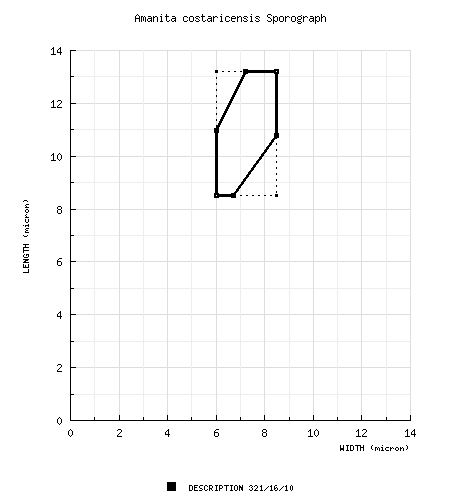
from protolog: [321/16/10] (7.5-) 8.5 - 13.2 (-16.0) × (5.1-) 6.0 - 8.5 (-12.6) µm, (L = (9.1-) 9.4 - 12.3 µm; L’ = 10.8 µm; W = 6.4 - 7.7 (-8.3) µm; W’ = 7.2 µm; Q = (1.10-) 1.27 - 1.83 (-2.15); Q = 1.35 - 1.68 (-1.70); Q’ = 1.51), hyaline, colorless, smooth, thin-walled, amyloid, acyanophilous, dominantly ellipsoid to elongate, infrequently broadly ellipsoid or cylindric, often at least somewhat adaxially flattened, occasionally expanded at one end; apiculus sublateral, small, cylindric; contents mono- to multiguttulate to granular; white in deposit. |
| ecology |
from protolog: Solitary to subgregarious. Costa Rica: At 1715 - 2500 m elev. In Quercus-Magnolia forest or in mixed Quercus forest sometimes with Q. oocarpa dominant. Honduras: At 1900± m elev. In cloud forest with Quercus trichodonta and other hardwoods. |
| material examined |
from protolog: COSTA RICA:
CARTAGO—Ctn. Unkn. - Estrella [9°46’4” N/ 83°57’19” W, 1685-1717 m], 14.vi.1996 R. E. Halling & J. Ammirati [Halling 7684] (NY; USJ); San Cristobal [2000 m], vii.1983 L. D. Gómez & R. Alfaro 21222 (F 1100824).
GUANACASTE—Ctn. Unkn. - Cacao no. 1, Cerro Pedregal, Estación Biología Cacao, Área de Conservación Guanacaste, sendero a derrumbe [10°55’45” N/ 85°28’37” W, 1100 m], 3.vi.1996 C. Cano 197 (INBio; RET 325-4).
SAN JOSÉ—Ctn. Dota - La Chonta, S of Interam.
Hwy. twd. Cerro Chonta [9°41’58” N/ 83°56’31” W, 2400 m elev.], v.1982 L. D. Gómez 18147 (F 1051869); Jaboncillo de Dota, 3.2 km from Interam. Hwy on rd. to San Gerardo de Dota [9°35’21” N/ 83°47’58” W, 2740 m], 20.vi.1995 R. E. Halling & K. Shanks s.n. [Tulloss 6-20-95-A] (RET 330-3; USJ); El Jardín de Dota, 3.5 km W of Interam.
Hwy. at El Empalme, [9°42’52” N/ 83°58’28” W, 2220 m], vii.1983 L. D. Gómez & R. Alfaro 20641 (F 1073283); San Gerardo de Dota no. 1, 5± km SW of Cerro de la Muerte, Albergue de Montaña Savegre, Cabinas Chacón [9°33’2” N/ 83°48’27” W,
2200-2350 m], 26.vii.1992 B. A. Strack, L. D. Gómez, G. Hewson & G. M. Mueller [Mueller 4398] (F 1102451), 21.vi.1995 R. E. Halling s.n. [Tulloss 6-21-95-M] (holotype, USJ; isotype, RET 330-4), 23.vi.1995 Thomas O’Dell s.n. [Tulloss 6-23-95-M] (RET 330-5; USJ); San Gerardo de Dota no. 4, off Interamerican Hwy., 2–3 km N of Cerro de la Muerte, rd. to San Gerardo de Dota, 24.vii.1992 B. A. Strack, J. Polishook, L. D. Gómez, G. Hewson & G. M. Mueller [Mueller 4368] (F 1102421).
HONDURAS: FRANCISCO MORAZAN—Mt. Uyuca [Cerro Oyuca?], Valle Zamorano, 5.vii.1991 G. M. Mueller, B. A. Strack, R. & M. Singer & R. Andino [Mueller 4138] (F 1098682).
OLANCHO—Parq. Nac. La Tigre, ca. Campamento, rd. to Finca Sapote, 9.vii.1991 G. M. Mueller, B. A. Strack, R. & M. Singer & R. Andino [Mueller 4182] (F 1098725). |
| discussion |
from protolog: "The present species was described in the notebooks (F) of the late Dr. Rolf Singer under his herbarium name "costaricensis." Since he originated the name and had a clear concept of its application and since we utilize collections annotated by him, we have included Dr. Singer as an author of the species.
"According to the descriptions and keys of Bas (1969), A. costaricensis fits well within his stirps Microlepis of Amanita [sect. Lepidella] subsect. Solitariae Bas. Within this stirps, the present species is strikingly similar to A. atkinsoniana
Coker (Coker 1917) and A. onusta (Howe) Sacc. (Saccardo 1891a).
"Amanita atkinsoniana is moderately common in a range extending from southern Prov. Québec, Canada (Pomerleau 1980) to Michoacan edo., Mexico. Amanita atkinsoniana can be distinguished from the present species by
-
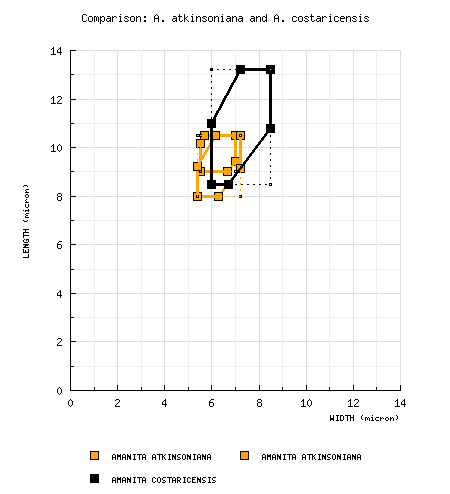
smaller spores—[230/10/10] (6.8–) 8.0–10.5 (–14.3) × (5.0–) 5.4–7.2 (–8.5) μm, (L = (8.2–) 9.0–9.7 μm; L’ = 9.2 μm; W = 5.7–6.6 (–6.9) μm; W’ = 6.2 μm; Q = (1.17–) 1.27–1.71 (–1.95); Q = 1.36–1.57 (–1.67); Q’ = 1.50)
-
basidiome generally white or pallid except for universal veil, with universal veil in fine distinctly separated warts (grayish at first, then reddish brown) on pileus, with basal bulb usually napiform or turbinate, with universal veil brownish gray becoming reddish brown and distributed in rather fine warts in at least six (6) concentric rings around the stipe’s bulb from its top to (often) well below mid-length of the bulb, with fragile apical to subapical partial veil, which (when it persists) may become slimy and yellow while remaining in a superior position on the stipe
-
scattered, minimal, positive spot tests for tyrosinase—with L-tyrosine, slowly positive on surfaces of lower stipe and upper bulb (possibly in association with universal veil material in those areas) and in pileipellis."
[Note: All material examined for the above data is cited on this site on taxon page for A. atkinsoniana (link above). A sporograph comparison diagram for the present species and A. atkinsoniana is provided immediately below.—ed.]
"Amanita onusta is a locally common species of eastern North America with a range extending from Prov. Québec (Pomerleau 1980) and
Prov. Nova Scotia (Stewart & Grund 1974), Canada at least to Illinois and
Mississippi, USA. Amanita onusta can be distinguished
from the present species by
-
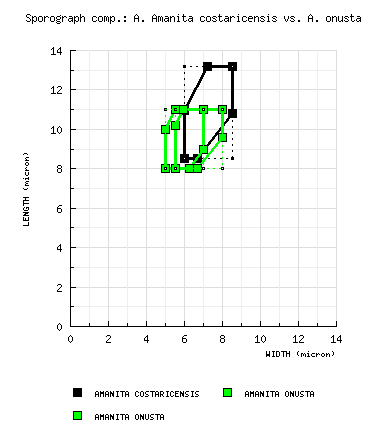
smaller spores—[215/12/12] (7.0–) 8.0–11.0 (–13.0) × (5.0–) 5.5–7.0 (–8.3) μm, (L = 8.3–10.5 (–11.0) μm; L’ = 9.4 μm; W = 5.7–6.5 (–7.1) μm; W = 6.1 μm; Q = (1.14–) 1.28–1.85 (–2.21); Q = 1.35–1.65 (–1.84); Q’ = 1.52)
-
basidiomes paler and with little (if any) brown tint, frequently of smaller size with pileus often less than 40 mm wide [13–76 mm wide in Tulloss’ experience, although Bas (1969) reports at least one instance of a specimen with pileus over 100 mm wide], with lamellae that rather rapidly become yellowish and show signs of decay while the remainder of the basidiome shows none, and often without a persistent partial veil
-
positive spot tests for tyrosinase—with L-tyrosine, positive, throughout the basidiome and, with paracresol, positive in scattered spots in very young material, positive in pileus context and context of stipe above bulb in older material."
[Note: All material examined for the above data is cited on this site on taxon page for A. onusta (link above). A sporograph comparison diagram for the present species and A. onusta is provided immediately below.—ed.]
"In two cases [Halling 7667 (NY; USJ) and Tulloss 6-21-95-E (RET 337-3; USJ)], an amanita assignable to Amanita subgenus Lepidella (sect. Validae or sect. Lepidella) was misdetermined in the field as A. costaricensis. The undetermined species has a gray stipe that is stuffed (becoming hollow), gray underside and margin to the membranous annulus, gray warts on the gray-brown to pale gray pileus, and short basidia [19 - 34 (-44) µm long] apparently lacking clamps. The species is somewhat unusual for sect. Validae because of its unpleasant smell (sometimes like the smell of disinfectant cleaning solution in hospitals). The misdetermined entity should be distinguishable by the lack of a radicating bulb, by the absence of basidial clamps, and by its smaller and more nearly globose spores: [33/2/2] (7.3-) 7.5 - 9.0 (-10.0) × (6.5-) 7.0 - 8.0 (-9.1) µm, (L = 8.2 µm; L’ = 8.2 µm; W = 7.5 µm; W’ = 7.5 µm; Q = (1.04-) 1.05 - 1.14 (-1.23); Q = 1.09 - 1.11; Q’ = 1.09). Especially, considering the apparently parasitized collections of A. costaricensis discussed below, the authors of this species had some hesitation concerning whether or not Halling 7667 and Tulloss 6-21-95-E also comprised parasitized material. However, they were convinced that the two collections represent a distinct species because (1) the spores of these two collections were both shorter (on average) and broader (on average) than those of A. costaricensis [Compare values of L’ and W’. Reduction in spore volume due to stress would more likely reduced both length and width.]; (2) both collections exhibit a membranous annulus; and (3) both apparently lack basidial clamps. Basidia predominantly less than 30 µm long, might support assignment to sect. Validae, but further study is required.
"In one case {Estrella [9°46’4” N/ 83°57’19” W, 1685-1717 m], 14.vi.1996 R. E. Halling & J. Ammirati [Halling 7684] (NY; USJ)}, all the specimens of a rather large collection apparently assignable to A. costaricensis had an odor like pig manure. In addition, some had rather distorted stipes; and the spores of all collections were uniformly smaller than normal ([100/5/1] (7.2-) 7.6 - 9.5 (-11.0) × (5.3-) 5.5 - 7.3 (-8.0) µm, (L = 8.3 - 9.0 µm; L’ = 8.7 µm; W = 6.2 - 6.6 µm; W’ = 6.4 µm; Q = (1.18-) 1.23 - 1.50 (-1.80); Q = 1.30 - 1.45; Q’ = 1.37). Observed at 1250×, many of the spores were surrounded with small, hyaline, colorless, inamyloid spheres (1± - 3± µm diam.) connected to the spore walls by what appeared to be fine tubules—the whole having the appearance of a pincushion. The authors of the protolog hypothesize that the noted alterations in morphology and odor are a result of "parasitization." They explicitly excluded this collection from the set of paratypes of A. costaricensis.
"In another case of apparent parasitization (San Gerardo de Dota no. 4, 24.vii.1992 B. A. Strack, J. Polishook, L. D. Gómez, G. Hewson & G. M. Mueller [Mueller 4368] (F 1102421)), spores, basidia, and lamella trama were quite normal for the species; however, the context of both the pileus and stipe stained yellow when cut. Two other pigment-related characters were unusual for A. costaricensis as we understand it: universal veil remnants on pileus, stipe, and bulb of stipe were paler than usual and remained paler than the pileus disc despite becoming brown with time, even in a mature specimen; and the pileus disc was darker than usual. Further, lamellulae were reported to all be very short; and the basidiomes were said to have had an unusual musty odor. The yellow staining is very similar to that seen in apparently parasitized specimens of A. subsolitaria (Murrill) Murrill from the Atlantic coastal plain of the USA (Tulloss 1998b; 2000a: 57, fig. 5). In the latter case, basidiomes are sometimes found that not only stain bright yellow when cut, but release an orange-amber liquid from wounds. Spores of such specimens are often, but not always, subnormal in size and distorted in shape—the same yellowing phenomenon may be seen in specimens with spores nearly, or quite, normal with regard to size and shape. The provisional name of Bas (1969), A. crassifolia, was put forward for yellowing material that Bas thought might be determinable as A. subsolitaria; RET is now convinced this is the case.
"It should be noted that two North American taxa assignable to sect. Lepidella have been described by Bas (1969) because of their pronounced ability to become bright yellow or yellow-orange when cut (A. cinereoconia var. croceescens Bas and A. rhoadsii var. flavotingens Bas). Tulloss (1998b, 2000a) questioned whether these entities might not be based on parasitized specimens of the respective species. It would be interesting to see what information about Amanita parasites might be determined from study of fresh material of Costa Rican cases of apparent parasitization such as those presented above. If the species with yellowing context reaction in sect. Lepidella may be grouped together and the yellowing attributed to a single cause, or a set of common causes, then A. costaricensis would become the first representative of this group in Bas’ stirps Microlepis. The authors of A. costaricensis included Mueller 4368 as a paratype because microscopic examination produced observations completely consistent with "normal" material of A. costaricensis. In the macroscopic description of this species, the unusual characters from Mueller 4368 collection are so labeled.
"Mueller 4398 consists of a single immature specimen with the partial veil covering the lamellae." |
| citations |
—R. E. Tulloss |
| editors |
RET |
|



 Spore data sets and their composite