| name |
Amanita conara |
| author |
Tulloss, Halling & G. M. Muell. 2011. Mycotaxon 117: 180, figs. 5-8. |
| name status |
nomen acceptum |
| english name |
"Fat Barefoot Lepidella" |
| etymology |
κοναροζ (Grk.) "fat" or "well-fed" |
| MycoBank nos. |
518296 |
| GenBank nos. |
Due to delays in data processing at GenBank, some accession numbers may lead to unreleased (pending) pages.
These pages will eventually be made live, so try again later.
|
| holotypes |
USJ; isotype, NY |
| intro |
The following is based on original research by R. E. Tulloss, R. E. Halling, and G. M. Mueller. |
| pileus |
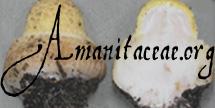
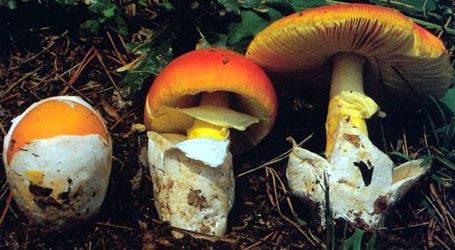
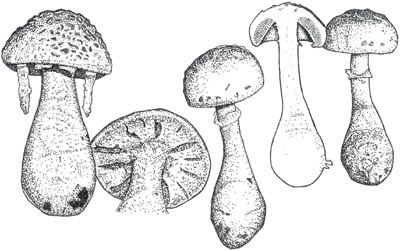
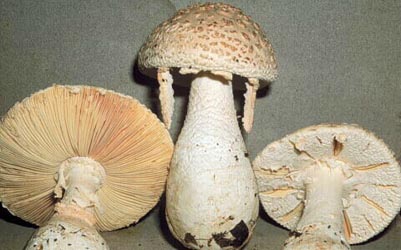
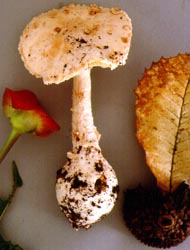
protolog: 60 - 150 mm wide, light ochraceous buff (ca. 5A2) with light orange stains (ca. 6A4) or pale buff to faintly tannish or orangish cream (paler and more tan than 7.5YR 8/4, paler than 10YR 8/4) or grayish orange (6B4), occasionally stained faintly brown here or there, convex at first, planoconvex and somewhat undulate at maturity, not viscid when wet, dull at first, later shiny when dry; context white to cream to slightly brownish cream, context unchanging or slowly staining brown to reddish brown when cut or bruised, 7 - 15 mm thick at stipe, thinning evenly and slowly to margin, rather thick even near margin; margin nonstriate, decurved, appendiculate (at first with appendiculate material floccose and pale pinkish, at maturity only with scattered crumb-like bits); universal veil as crumb-like warts or pyramidal warts over disc, sometimes as eccentric patches, at first pale orangish white to pinkish (5A2, paler toward pileus margin) becoming sordid or brown or taking on brownish tint, smooth surfaced, often easily taking fingerprint, pulverulent to subfelted, detersile, with patches having membranous upper layer. |
| lamellae |
protolog: free, with decurrent lines on stipe apex connecting to striae on upper surface of partial veil, close to subcrowded to crowded, pale cream (immature) to slightly orangish yellowish tan in mass, more vividly colored in side view (light cream in immature material, then more yellow than 2.5Y 7/6 or more brown than 2.5Y 8/6 or more orange than 4B6 or more brown than 4A6 or pale yellow (4A4) or pale orange (5A3)), unchanging when cut or bruised, 6.5 - 12 mm broad, occasionally forked, with edge minutely pulverulent and white to approximately concolorous with partial veil; lamellulae subattenuate to rounded attenuate to truncate, unevenly distributed, of diverse lengths, plentiful. |
| stipe |
protolog: 71 - 115+ × 11 - 30± mm, white, sometimes with ochraceous to light orange stains, sometimes faintly brick colored or pale pink after handling or in wounds, narrowing upward, flaring at apex, pulverulent above partial veil, sometimes satiny below partial veil, longitudinally striatulate, with upward pointing fibrillose scales or squamules (concolorous to light orange (ca. 6A4), with tips sometimes faintly brick colored or concolorous with partial veil and limbus internus of universal veil), with shaggy region beginning below annulus and ending roughly 10 mm above bulb; bulb 42 - 60 × 37 - 60 mm, robustly clavate-subnapiform to robustly napiform, with white mycelial threads prominent at very base; context solid or stuffed? (possibly appearing so due to larva damage), concolorous with pileus context, with bruising/staining reaction as in pileus context, with larva tunnels yellowish in center of stipe and reddish brown elsewhere; partial veil apical, submembranous, shredding, sometimes deciduous at least in part, pale orangish white (5A2), with underside bearing warts and flocculence, with upper side striate, sometimes thickened at edge; universal veil often present as short thin limb on or appressed to upper part of bulb, often with nearly complete limbus internus partially encircling (about half-circumference) base of stipe and in other small fragments on lower stipe above bulb, 1 - 2 mm thick, nearly white to pale orangish white (5A2). |
| odor/taste |
protolog: Odor "earthy" in immature specimen; rich, strong, like "old ham" (but sometimes not unpleasantly) or like "unwashed athletic socks" in a mature specimen. Taste not recorded. |
macrochemical
tests |
protolog: Spot test for laccase (syringaldazine) - negative throughout basidiome. Spot test for tyrosinase (paracresol) - positive in stipe (excluding bulb) and pileipellis and often in large areas of lamellae and pileus context (outside of disc) or strongly positive throughout basidiome except for parts of lamellae. Test vouchers: Halling 7272, Mueller 4643, and Tulloss 6-13-95-C. |
| pileipellis |
protolog: narrow and with pronounced boundaries, bounded above by densely placed anticlinally oriented hyphae binding upper surface to remains of universal veil, bounded below by loosely interwoven and disordered tissue of pileus context, with separation from universal veil at first via mechanical rupture of hyphae; 30 - 55 µm thick at approximately midradius in mature or near mature material, lacking substantial suprapellis, with gelatinization absent even at point of breaking of partial veil and in mature material limited to surface, with elements densely packed vertically, yellow-orange; filamentous, undifferentiated hyphae 2.5 - 7.5 µm wide, branching, disordered and interwoven over disc, dominantly subradially arranged with some criss-crossing hyphae away from disc, often yellow or yellowish, hyphal tips of broader hyphae common; vascular hyphae 3.4 - 11.4 µm wide, sinuous, sometimes in tangles, yellow, scattered. |
| pileus context |
protolog: filamentous, undifferentiated hyphae 2.5 - 8.9 µm wide, occasionally branching, sometimes fasciculate, common in disc, plentiful at mid-radius; acrophysalides broadly ellipsoid to ellipsoid (up to 80 × 60 µm in disc) or clavate (up to 131 × 48 µm), similarly shaped and smaller at mid-radius, commonly with inflated subterminal cell, in disc dominating and disordered, at mid-radius plentiful and with tendency to subradial orientation; vascular hyphae 2.8 - 17.8 µm wide, sinuate to hypersinuate, rarely branching, common in region immediately below pileipellis, rather common elsewhere, scattered in all mounts. |
| lamella trama |
protolog: bilateral, divergent; ws = 50 - 65 µm (good rehydration); central stratum comprising interwoven filamentous undifferentiated hyphae 2.5 - 11.4 µm wide, lacking inflated intercalary segments; subhymenial base dominated by densely packed divergent filamentous undifferentiated hyphae 3.8 - 11.4 µm wide, with angle of divergence shallow; terminal, inflated cells not observed; vascular hyphae not observed. |
| subhymenium |
protolog: wst-near = 70–85 μm (moderate to good rehydration); wst-far = (80-) 90–105
μm (moderate to good rehydration); scant, often with only one (or no) cell(s)
between bases of longest basidia/-oles and subhymenial base, with basidia
arising from elongate cells of subhymenial base and subglobose to branched
to ellipsoid to clavate cells and uninflated hyphal segments, with such elements
arranged approximately perpendicular to central stratum. |
| basidia |
protolog: 30 - 58 × 9.1 - 13 µm, 4-sterigmate, with sterigmata up to 6.0 × 1.5 µm and sometimes subcylindric; clamps and proliferated clamps relatively common. |
| universal veil |
protolog: On pileus, exterior surface: particularly
well-formed and in place on surface of patches, very thin, comprising lattice
of irregularly ordered fascicles of partially gelatinized orange-brown hyphae,
with fascicles up to 18 (or more) hyphal diameters wide; filamentous undifferentiated
hyphae 1.8–3.9 μm wide, branching; with immediately underlying
thin membranous layer, comprising loosely interwoven filamentous undifferentiated
hyphae 2.2–8.9 μm wide, disordered, commonly branching, anastomosing,
plentiful to dominating, sometimes in narrow fascicles, thin-walled,
colorless and hyaline to (infrequently) yellowish and subrefractive; inflated
cells uncommon, terminal, singly or in pairs, broadly clavate to clavate to
cylindric, thin-walled, hyaline, up to 57 × 13.0 μm; vascular hyphae not
observed. On pileus, interior: all elements strongly vertically aligned, orangish brown on wart surface; filamentous undifferentiated hyphae 1.0–12.1 μm
wide, frequently branching, occasionally anastomosing, inside wart colorless
and hyaline or (occasionally) yellowish and with subrefractive walls; inflated
cells in terminal chains of up to at least five, thin-walled, plentiful, colorless
and hyaline inside wart, barrel-shaped to ovoid to broadly clavate to clavate to
narrowly fusiform and up to 48 × 25 μm in lower third of wart above basal
part and subglobose to ellipsoid to clavate (up to at least 78 × 38 μm) to narrowly
clavate or narrowly fusiform (up to 91 × 19.0 μm) to irregularly shaped
and sometimees connected with three or more hyphae via separate septa in
upper third of wart; vascular hyphae not observed except in upper part of wart
and there very infrequent and (e.g.) 2.2–4.9 μm wide. On pileus, basal part: densely packed, anticlinally aligned hyphae connecting intimately with
pileipellis. On underside of partial veil (i.e., limbus internus): filamentous undifferentiated hyphae 2.2–10.8 μm wide, occasionally branching, common;
inflated cells dominating, terminal singly or as concatenated pairs, globose to
subglobose to pyriform to broadly ellipsoid to ellipsoid to elongate to broadly clavate to clavate to narrowly clavate (up to 60 × 33 μm), dominantly thinwalled, occasionally with wall up to 0.8 μm thick; vascular hyphae not observed. On stipe base: with structure very like that of surface layers of universal veil on pileus; filamentous undifferentiated hyphae dominating, thinwalled, slightly gelatinized at surface, hyaline and colorless or (occasionally) with walls yellowish and subrefractive, 2.5–10.0 μm wide, commonly branching, fasciculate, densely packed, with predominantly vertical orientation (i.e.,
not disordered as on pileus); inflated cells rather infrequent, scattered, terminal,
narrowly clavate to clavate (e.g., 30+ × 12.5 μm); vascular hyphae not observed; clamps not observed. |
| stipe context |
protolog: longitudinally acrophysalidic; filamentous, undifferentiated hyphae 3.2 - 17.8 µm wide, branching occasionally, plentiful in interior, dominant near surface, sometimes constricted at septa; acrophysalides up to at least 395 × 32 µm, plentiful in interior, common near surface; vascular hyphae 7.6 - 11.4 µm wide, sinuous, infrequent, occasionally clustered; clamps not observed. |
| partial veil |
protolog: very thin and sparse layer of criss-crossing, hyphae, in mounts dominated by inflated cells of limbus internus attached to underside of hyphal framework; filamentous, undifferentiated hyphae 1.5 - 3.8 µm wide, occasionally branching, in narrow fascicles, rapidly gelatinizing prior to maturity of basidiophore; inflated cells not observed; vascular hyphae not observed. |
| lamella edge tissue |
protolog: sterile. |
| anatomical figures |
|
| basidiospores |
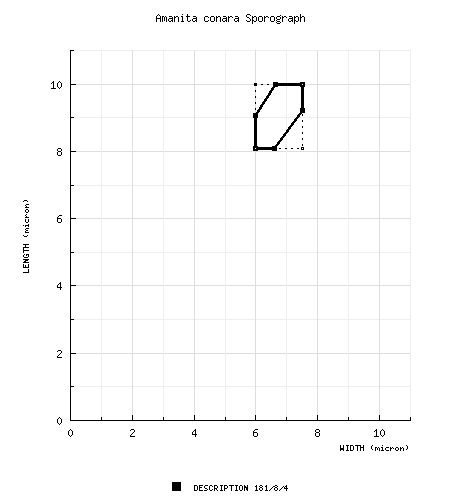
protolog: [181/8/4] (7.8-) 8.1 - 10.0 (-11.5) × (5.3-) 6.0 - 7.5 (-8.7) µm, (L = (8.6-) 8.8 - 9.4 µm; L’ = 9.1 µm; W = 6.5 - 6.8 (-7.0) µm; W’ = 6.6 µm; Q = (1.17-) 1.23 - 1.51 (-1.70); Q = 1.33 - 1.41 (-1.44); Q’ = 1.37), hyaline, colorless, thin-walled, smooth, amyloid, broadly ellipsoid to ellipsoid, sometimes swollen at one end, often at least somewhat adaxially flattened; apiculus sublateral, cylindric; contents guttulate to multi- to monoguttulate; color in deposit unknown. |
| ecology |
protolog: Subgregarious to scattered. At 1600 - 1720 m elev. In thick, dark, wet loam under shallow layer of leaf litter of mixed broadleaf forest including Quercus oocarpa or in such a habitat with that tree and Q. seemannii. |
| material examined |
protolog: COSTA RICA: CARTAGO—Ctn. Unkn. - Estrella, 5 km E of km 31 of Interam. Hwy.,
ca. Estrella [9°46’4” N/ 83°57’19” W, 1685-1717 m], 14.vi.1996 R. E. Halling & J. Ammirati [Halling 7686] (holotype, USJ; isotype, NY); off Interamerican Hwy., 6 km S of Cartago at rd. to Palo Verde, 28.vii.1992 B. A. Strack & G. M. Mueller [Mueller 4434] (paratype, F 1102487); Palo Verde, 4± km E of km 31 of Interam. Hwy., ca. Palo Verde [9°46’34” N/ 83°56’42” W, 1600 m], 31.v.1994 G. M. Mueller 4643 (paratype, F 1112041; paratype, USJ), 11.vi.1994 R. E. Halling & T. J. Baroni [Halling 7272] (paratype, NY; paratype, USJ), 13.vi.1995 R. E. Tulloss 6-13-95-C (paratype, RET 153-4; paratype, USJ). |
| discussion |
protolog: Four taxa have been assigned to Amanita subsect. Gymnopodae world wide, but all can be easily distinguished from the present species. In addition to their general habit, three of these species have in common with A. conara a number of distinctive characters among which are rubescent or darkening context, a distinctive odor, yellow or orange tints on the lamellae, and a submembranous surface layer of the universal veil.
-
Amanita gymnopus Corner & Bas (1962), described from Malaysian "jungle" and reported from Hunan Prov., China (Chen et al. 2001) and Japan (Hongo 1982), has small (5 - 7 × 5 - 6.5 µm per Corner and Bas), globose to subglobose spores; a universal veil that forms submembranous patches and not warts on the pileus; and marked rhizoids attached to the stipe base (Bas 1969: fig. 378). Chen et al. reported spores of 6.0 - 7.5 (-8.0) × (5.0-) 5.5 - 6.5 µm from a single Chinese specimen examined.
-
Amanita ochraceobulbosa A. E. Wood (1997) has subglobose to broadly ellipsoid spores 9.3 - 11.7 × (7.3-) 8.1 - 9.6 (-10.2) µm with est. Q = 1.2, a cap that is cream to cream-buff to yellow-orange-cream with universal veil remains as (often large) pyramidal warts, gills that are white to cream, flesh that apparently is nonstaining when cut or bruised, and pyramidal warts sometimes present on the stipe's basal bulb. Absence of a submembranous outer volval layer, presence of warts on the bulb, and no mention of staining flesh or distinctive odor suggest that this taxon is not appropriately placed in subsect. Gymnopodae.
-
Amanita ochrophylla (Cooke & Massee) Cleland, described from edges of open forest in eastern and southeastern Australia (Bas 1969: 556), has larger, proportionately narrower spores (9 - 11 × 5.5 - 7 µm) with Q = 1.3 - 2.0 and Q = 1.5 - 1.8; a limbus internus that is apparently more coherent than that of A. conara and is frequently left as a "second annulus" on the stipe just below the partial veil (Bas 1969: fig. 374); flesh that becomes pink on exposure; etc. Wood (1997: 803) gives spore measurements as follows: 9.3 - 10.8 (-12.6) × 5.4 - 7.4 (-8.4) µm, with Q = 1.43 - 1.72 (-1.88). We estimate Q’ for Wood’s material as 1.55 - 1.60.
-
Amanita ochrophylloides D. A. Reid (1978, 1980), described from "under Eucalyptus sp. (of peppermint group)" in the state of Victoria, Australia, has predominantly subglobose to broadly ellipsoid to ellipsoid spores (7.0 - 10.0 × 5.0 - 8.0 µm, with est. Q = 1.3); a pale brown pileus with dark, "strobiliform" warts; a tendency to darken from handling; pale golden yellow lamellae; a slight volval limb on the stipe’s basal bulb; an odor that is faint and mealy; abundant, highly refractive hyphae in the universal veil on the pileus; etc.
Guzmán (1975) reported A. ochrophylla from Quercus forest in Guerrero, Mexico. His macroscopic description fits A. conara rather well; and his measurements for spores are 9 - 11 × (5.5-) 6.0 - 7.5 µm. This is a relatively good match for our spore data from A. conara. A Q’ of approximately 1.5 was estimated for spores of Guzmán’s material. The material Guzmán cited has not yet been reviewed, but it appears that A. conara may occur in Mexico.
Mueller 4643 consists of a single, rather large, immature specimen of A. conara. It comes from the same habit as the other material cited and is easily recognizable because of excellent photographs and notes on fresh material that accompany the exsiccatum; moreover, the thin membranous outer layer of the universal veil can be seen on scalp sections of the universal veil remnants on the pileus.
We have three collections of what appears to be a similar, but possibly distinguishable, taxon from Ctn. Coto Brus, Prov. Puntarenas (La Amistad sites nos. 1 and 2) in association with Q. corrugata, Q. seemannii, and other oaks and belonging in subsection Gymnopodae (see Amanita sp-CR18). These collections differ from A. conara in colors of the basidiome (not all collections are annotated) and consistently have smaller subglobose to broadly ellipsoid spores: [160/8/3] (6.1-) 7.0 - 9.5 (-11.6) × (5.1-) 5.9 - 7.9 (-9.5) µm, (L = 7.6 - 8.2 (-8.3) µm; L’ = 7.9 µm; W = (6.3-) 6.7 - 7.0 µm; W’ = 6.7 µm; Q = (1.04-) 1.08 - 1.29 (-1.41); Q = (1.11-) 1.15 - 1.23; Q’ = 1.17). All three collections are deposited in NY (Halling 7803, 8148. 8360).
The present species was called "sp. CR10" in drafts and keys circulated by RET. |
| citations |
—R. E. Tulloss |
| editors |
RET |
|



 Spore data sets and their composite