

| name | Amanita ochraceobulbosa |
| name status | nomen acceptum |
| author | A. E. Wood |
| english name | "Shoes Left Home Lepidella" |
| intro | The following is largely based on the original description (Wood 1997). |
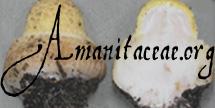
| cap | The cap of Amanita ochraceobulbosa is up to 100 mm wide, convex then flattened-convex, smooth, dry, dull cream to cream-buff or yellowish-orange cream, with a nonstriate and appendiculate margin. Volval remains are abundant on the cap as pyramidal warts, often large, concolorous with the cap or more deeply tinted or deep buff, soft, sometimes flatter towards the cap margin. |
| gills |
The gills are free, thin, crowded, white to cream, with a concolorous margin. The short gills are present in at least two series. |
| stem |
The stem is up to 110 × 15 mm, cream, with white granular covering overall. The ring is usually quick to disappear, but at first is present and fragile, white to cream, striate on the upper surface; it is rarely membranous or persistent. The bulb is markedly differentiated from the stem and subglobose to top-shaped, off-white, sometimes having scattered conical warts on the upper part and sometimes with a "rim" on the upper part. [Note: Wood's illustration of this species shows an entirely undecorated bulb.] |
| spores |
The spores measure 9.3 - 11.7 × (7.3-) 8.1 - 9.6 (-10.2) µm and are subglobose to broadly ellipsoid, (occasionally ellipsoid) and amyloid. Clamps are distinct but often scattered at bases of basidia. |
| discussion |
Wood describes the mushroom as occurring in sclerophyll forests, "tall open forests," and Angophora forests from the state of New South Wales, Australia. A sclerophyll forest in the Australian bush is a forest of hard-leaved plants including Eucalyptus in the overstory (wikipedia). Wood's placement of the current species in subsection Gymnopodae Bas seems inappropriate for a number of reasons: Absence of a submembranous outer volval layer, presence of warts on the bulb, pallid gill coloring, and no mention of staining flesh or distinctive odor.—R. E. Tulloss and L. Possiel |
| brief editors | RET |
| name | Amanita ochraceobulbosa | ||||||||||||||||||||
| author | A. E. Wood. 1997. Austral. Syst. Bot. 10: 805, fig. 43(a-e). | ||||||||||||||||||||
| name status | nomen acceptum | ||||||||||||||||||||
| english name | "Shoes Left Home Lepidella" | ||||||||||||||||||||
| MycoBank nos. | 443200 | ||||||||||||||||||||
| GenBank nos. |
Due to delays in data processing at GenBank, some accession numbers may lead to unreleased (pending) pages.
These pages will eventually be made live, so try again later. Search:
Showing 0 to 0 of 0 entries | ||||||||||||||||||||
| holotypes | UNSW | ||||||||||||||||||||
| intro |
The following text may make multiple use of each data field. The field may contain magenta text presenting data from a type study and/or revision of other original material cited in the protolog of the present taxon. Macroscopic descriptions in magenta are a combination of data from the protolog and additional observations made on the exiccata during revision of the cited original material. The same field may also contain black text, which is data from a revision of the present taxon (including non-type material and/or material not cited in the protolog). Paragraphs of black text will be labeled if further subdivision of this text is appropriate. Olive text indicates a specimen that has not been thoroughly examined (for example, for microscopic details) and marks other places in the text where data is missing or uncertain. The following material is based entirely on the protolog of this species, which does not meet contemporary standards for Amanita taxonomy. | ||||||||||||||||||||
| basidiospores | from the protolog: [-/-/-] 9.3 - 11.7 × (7.3-) 8.1 - 9.6 (-10.2) μm, (Q = 1.09 - 1.30), amyloid, subglobose to broadly ellipsoid. [Note: Data provided is not sufficient to permit generation of a sporograph.—ed.] | ||||||||||||||||||||
| ecology | In sclerophyll forest. | ||||||||||||||||||||
| material examined | from the protolog: AUSTRALIA: NEW SOUTH WALES—Wiseman's Ferry, Dharug Nat. Pk., 28.iii.1992 A. E. Wood et al. s.n. (holotype, UNSW 92/34). | ||||||||||||||||||||
| citations | —R. E. Tulloss | ||||||||||||||||||||
| editors | RET | ||||||||||||||||||||
Information to support the viewer in reading the content of "technical" tabs can be found here.
 Spore data sets and their composite
Each spore data set is intended to comprise a set of measurements from a single specimen made by a single observer; and explanations prepared for this site talk about specimen-observer pairs associated with each data set. Combining more data into a single data set is non-optimal because it obscures observer differences (which may be valuable for instructional purposes, for example) and may obscure instances in which a single collection inadvertently contains a mixture of taxa.

Text and User-Generated Sporographs are published under the Creative Commons License.

In the case of a taxon page, image credits are on the 'image' tab.