
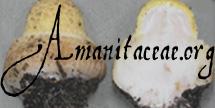

| name | Amanita chrysoleuca |
| name status | nomen acceptum |
| author | Pegler |
| english name | "Pirate Gold Amanita" |
| intro |
The description is based on the original description (1983). |
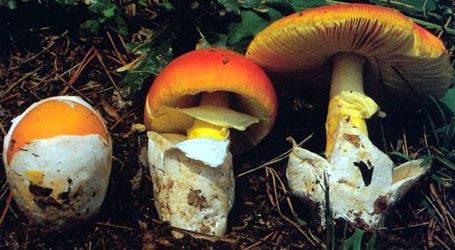
| cap | The cap of Amanita chrysoleuca is apricot yellow at the center, and lemon chrome outside the center. The color continues to fade toward the margin. The cap is also convex to almost planar, slightly depressed in the center, and dry. It has a deeply sulcate-striate margin. The cap is covered with yellowish-ochraceous, powdery volval remnants. The cap's flesh is white and unchanging. |
| gills | The gills are free to adnate, white to cream, thin, narrow, up to 2 mm wide, moderately crowded. The short gills are of at least two lengths. |
| stem | The stem is 35 - 50 × 4 - 5 mm, cylindric with a bulbous base, white, finely pruinose, exannulate. The stem is stuffed. The stem's flesh is white and unchanging. The volva is made up of loose, yellow, floccose squamules deposited in a rim at the upper edge of the bulb. |
| spores | The spores measure 7 - 9.5 × 4.5 - 6 µm and are ellipsoid and are inamyloid. Clamps are absent at bases of basidia. |
| discussion |
This species was described originally from from the island of Martinique where it was found in semi-deciduous forests at 2000 m elev. and in "transitional xero-mesophytic forest" at 200 m elev. Material somewhat similar to the present species has been collected in Florida (USA) and Panama (Dr. Clark L. Ovrebo) and reported from St. John, U.S. Virgin Islands by Miller, Lodge, and Baroni (2000). The bright colors and narrow spores excepted, this species is similar to those small taxa in section Amanita in which the powdery volva is slow to separate from the skin of the cap. For discussion of this group, see Amanita farinosa Schwein.—R. E. Tulloss and L. Possiel |
| brief editors | RET |
| name | Amanita chrysoleuca | ||||||||||||||||||||
| author | Pegler. 1983. Kew Bull., Addit. Ser. 9: 285, fig. 51(A-D), pl. 7 (figs. E-F). | ||||||||||||||||||||
| name status | nomen acceptum | ||||||||||||||||||||
| english name | "Pirate Gold Amanita" | ||||||||||||||||||||
| MycoBank nos. | 108666 | ||||||||||||||||||||
| GenBank nos. |
Due to delays in data processing at GenBank, some accession numbers may lead to unreleased (pending) pages.
These pages will eventually be made live, so try again later. Search:
Showing 0 to 0 of 0 entries | ||||||||||||||||||||
| holotypes | K | ||||||||||||||||||||
| intro |
The following text may make multiple use of each data field. The field may contain magenta text presenting data from a type study and/or revision of other original material cited in the protolog of the present taxon. Macroscopic descriptions in magenta are a combination of data from the protolog and additional observations made on the exiccata during revision of the cited original material. The same field may also contain black text, which is data from a revision of the present taxon (including non-type material and/or material not cited in the protolog). Paragraphs of black text will be labeled if further subdivision of this text is appropriate. Olive text indicates a specimen that has not been thoroughly examined (for example, for microscopic details) and marks other places in the text where data is missing or uncertain. The following material is based on the protolog of the present species. | ||||||||||||||||||||
| basidiospores | from protolog: [-/-/-] 7.0 - 9.5 × 4.5 - 6.0 μm, (L' = 8.0 ± 0.5 μm; W' = 5.0 ± 0.4μm; est. Q = 1.41 - 1.71; Q' = 1.56), hyaline, inamyloid, ellipsoid; apiculus not described; contents guttulate; color in deposit not recorded. [Note: The range of spore shape that can be extracted from the data is unrealistically narrow. with Q' = 1.56, as reported, elongate spores should have been encountered commonly. A type study will be useful.] | ||||||||||||||||||||
| ecology | Solitary. Martinique: At 200 - 2000 m elev. In semi-deciduous forest or in transitional xero-mesophytic forest. | ||||||||||||||||||||
| material examined | from protolog: MARTINIQUE: Morne Préfontaine [2000 m], 14.x.1975 J. P. Fiard 620A (??), xii.1975 J. P. Fiard 620B (??); N of Mont Pelée [200 m], 30.viii.1977 J. P. Fiard 912 (K, holotype). | ||||||||||||||||||||
| citations | —R. E. Tulloss | ||||||||||||||||||||
| editors | RET | ||||||||||||||||||||
Information to support the viewer in reading the content of "technical" tabs can be found here.
| name | Amanita chrysoleuca |
| bottom links |
[ Section Amanita page. ] [ Amanita Studies home. ] [ Keys & Checklists ] |
| name | Amanita chrysoleuca |
| bottom links |
[ Section Amanita page. ] [ Amanita Studies home. ] [ Keys & Checklists ] |
 Spore data sets and their composite
Each spore data set is intended to comprise a set of measurements from a single specimen made by a single observer; and explanations prepared for this site talk about specimen-observer pairs associated with each data set. Combining more data into a single data set is non-optimal because it obscures observer differences (which may be valuable for instructional purposes, for example) and may obscure instances in which a single collection inadvertently contains a mixture of taxa.
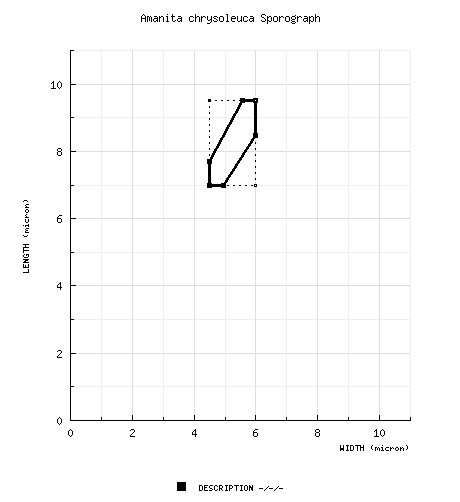

Text and User-Generated Sporographs are published under the Creative Commons License.

In the case of a taxon page, image credits are on the 'image' tab.