| name |
Amanita chlorinosma |
| author |
(Peck in Austin) Lloyd. 1898. Mycol. Writings 1: 7, 15. |
| name status |
nomen acceptum |
| english name |
"Chlorine Lepidella" |
| synonyms |
≡ Agaricus chlorinosmus Peck in Austin. 1878. Bull. Torrey Bot. Club 7: 278.
≡ Lepidella chlorinosma (Peck in Austin) E.-J. Gilbert & Kühner. 1928. Bull. Trimestriel Soc. Mycol. France 44: 151.
≡ Aspidella chlorinosma (Peck in Austin) E.-J. Gilbert. 1940. Iconogr. Mycol. (Milan) 27, suppl. (1): 72. [Gilbert's concept of Amanita chlorinosma includes many other taxa recognized today. Hence, his illustrations of spores (none from the type) cannot be reliably attributed to the present species.]
The editors of this site owe a great debt to Dr. Cornelis Bas
whose famous cigar box files of Amanita nomenclatural information
gathered over three or more decades were made available to RET for computerization
and make up the lion's share of the nomenclatural information presented on this site.
|
| MycoBank nos. |
356668 |
| GenBank nos. |
Due to delays in data processing at GenBank, some accession numbers may lead to unreleased (pending) pages.
These pages will eventually be made live, so try again later.
|
| holotypes |
NYS (implicit) |
| type studies |
Jenkins. 1978a. Mycologia 7: 27. |
| revisions |
Bas. 1969. Persoonia 5: 450, figs. 189-191. |
| intro |
The following text may make multiple use of each data field.
The field may contain magenta text presenting data from a type study
and/or revision of other original material cited in the protolog of the present taxon.
Macroscopic descriptions in magenta are a combination of data from the protolog and
additional observations made on the exiccata during revision of the cited original
material.
The same field may also contain black text, which is data from a revision of the present
taxon (including non-type material and/or material not cited in the protolog).
Paragraphs of black text will be labeled if further subdivision of
this text is appropriate.
Olive text indicates a specimen that has not been
thoroughly examined (for example, for microscopic details) and marks other places in the text
where data is missing or uncertain.
The following material not directly from the protolog of the present taxon and not cited as the work
of Dr. Bas or another researcher is based on original research of R. E. Tulloss. |
| pileus |
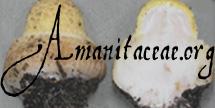
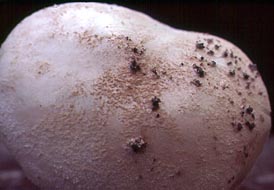
70 - 102 mm wide, white to off-white, sometimes with very pale gray tint here and there, convex to broadly convex, then subplanar, shiny when dry; context white, unchanging when cut or bruised, soft, 5 - 9 mm thick over stipe, thinning evenly to margin; margin nonstriate, appendiculate with white flocculose to submembranous material, slightly incurved at first, then decurved; universal veil as crusty patches, granular patches, or flocculose to pulverulent warts (small or granular to subpyramidal, latter especially over disc), often as flocculence or fine scales near margin, white, sometimes becoming gray or brownish with age and exposure, detersile. |
| lamellae |
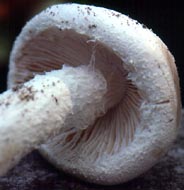
nearly free to adnexed to subadnate, sometimes leaving impression in flocculence of upper stipe, close, pale cream in mass, white to whitish in side view, unchanging when cut or bruised, but sometimes faintly sordid on old drying wounds, 5 - 9.5 mm broad, occasionally forking near margin, with edges white and minutely flocculose and darkening on drying; lamellulae rounded truncate to subattenuate to attenuate, of diverse lengths, plentiful, often several between pair of otherwise adjacent lamellae. |
| stipe |
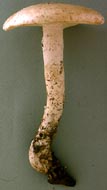
115 - ?? × 12 - 15 mm, white, unchanging even where handled, equal in upper two-thirds, narrowing upward in bottom third, densely cottony flocculose to floccose-scaly (especially in upper several cm) or as irregular felted patches amid dense flocculence, with flocculent material easily coming off when handled; bulb not pronounced to clavate, 30± - ?? × 25 - 30 mm, sometimes twisted, sometimes slightly flattened, often below level of substrate, sometimes radicating; context solid, but easily breaking, white, unchanging when cut or bruised; partial veil subapical?, white, weakly submembranous-fibrillose, often falling away completely or leaving narrow subapical? annular zone; universal veil occasionally present as flat warts at base of stipe and above or on upper part of bulb. |
| odor/taste |
Odor faintly to moderately of chlorine or of “old ham,” meaty-nauseous when drying. Taste not recorded. |
macrochemical
tests |
Spot test for laccase (syringaldazine) - very slowly positive in scattered spots on gills and in stipe context near apex. Spot test for tyrosinase (paracresol) - very slowly positive in scattered spots in lower stipe and bulb. Test voucher: Tulloss 10-20-89-A. |
| pileipellis |
1969): rather thin, gelatinized just at surface where exposed, barely yellowish in alkaline solution; filamentous hyphae 3 - 6 μm wide, interwoven. |
| pileus context |
Bas (1969): not described. |
| lamella trama |
Bas (1969): bilateral. |
| subhymenium |
Bas (1969): subcellular to cellular. |
| basidia |
Bas (1969): 40 - 55 × 8 - 10 μm, 4-sterigmate; clamps present. |
| universal veil |
Bas (1969): On pileus: with elements more or less erect, parallel, colorless in alkaline solution; filamentous hyphae 3 - 5 μm, scattered; inflated cells, 15 - 45 × 10 - 40 μm, mostly globose to ellipsoid to clavate, also occasionally irregular or elongate, in irregular branching chains; vascular hyphae absent or very scarce. |
| stipe context |
Bas (1969): longitudinally acrophysalidic; filamentous hyphae present, sometimes with intercalarly elongate cells; acrophysalides scattered, large, clavate. |
| partial veil |
Bas (1969): not described. |
| lamella edge tissue |
Bas (1969): filamentous hyphae not described; inflated cells in rather broad strip, globose to broadly clavate, up to 20 μm wide. |
| basidiospores |
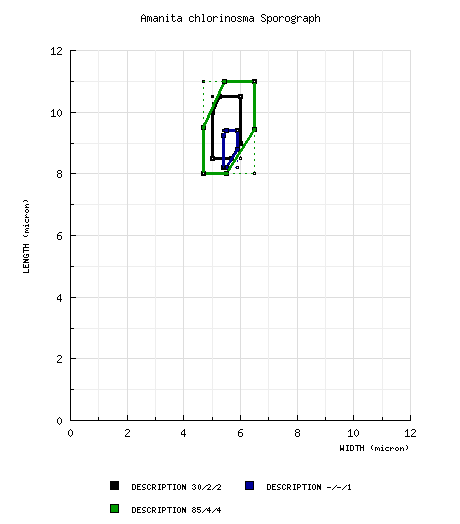
Bas (1969): [30/2/2] (8.0-) 8.5 - 10.5 (-11.0) × 5.0 - 6.0 μm, (Q = 1.50 - 2.0; Q = 1.70-1.80), colorless, hyaline, thin-walled, amyloid, ellipsoid to elongate, sometimes subreniform; apiculus not described; contents subgranular to guttulate; color in deposit not recorded.
from type study of Jenkins (1978a): [-/-/1] 8.2 - 9.4 × 5.4 - 5.9 μm, (Q = 1.49 - 1.71; Q' = 1.61), hyaline, thin-walled amyloid, ellipsoid to elongate, often adaxially flattened; apiculus sublateral, cylindric; contents guttulate; color in deposit not recorded.
[85/4/4] (7.5-) 8.0 - 11.0 (-12.2) × (4.5-) 4.7 - 6.5 (-7.5) µm, (L = 8.5 - 10.2 µm; L’ = 9.2 µm; W = 5.1 - 6.1 µm; W’ = 5.5 µm; Q = (1.37-) 1.45 - 2.02 (-2.35); Q = 1.52 - 1.81; Q’ = 1.69), hyaline, colorless, smooth, thin-walled, amyloid, ellipsoid to elongate, occasionally cylindric, sometimes expanded at one end, often adaxially flattened, rarely with scattered amyloid warts; apiculus sublateral, small, cylindric; contents ??; white in deposit |
| ecology |
Often solitary, sometimes subgregarious to scattered. Florida: Under Pinus sp. Illinois: In sandy soil of deciduous lowland forest dominated by Quercus after two days of rain and snow. Massachusetts: In landscaped area over glacial till between imported shrubs and native scrub Quercus with imported Betula and Pinus at a distance. New York: In sandy soil of forest dominated by Pinus and Quercus with some Populus tremuloides present. North Carolina: Under ancient Q. virginiana in lawn of public garden. |
| material examined |
Bas (1969): U.S.A.: NEW JERSEY—Bergen Co. - Closter, viii.1877 C. F. Austin s.n. (holotype, NYS).
TENNESSEE—Knox Co. - Knoxville, 11.vii.1934 J. K. Underwood s.n. [Hesler 4074 p.p.] (TENN (coll. mixed with A. rhopalopus; L).
from type study of Jenkins (1978a): U.S.A.: NEW JERSEY—Bergen Co. - Closter, viii.1877 C. F. Austin s.n. (holotype, NYS).
U.S.A.:
FLORIDA—Sarasota Co. - Oscar Scherer St. Pk., 3.ii.1991 Rosemary Williams s.n. [Rbt. S. Williams 402] (RET 032-6).
ILLINOIS—Jackson Co. - Lk. Murphysboro
St. Pk., 20.x.1989 David Abel & Bruce Horn
s.n. [R. E. Tulloss 10-20-89-A] (RET
070-1).
MASSACHUSETTS—Barnstable Co. (Cape
Cod) -Hyannis, prop. Software 2000, 22.ix.1995
Peter C. Stevens s.n. (RET 158-5).
NEW YORK—Suffolk Co. (Long Isl.) -
Oak Brush Plains Preserve, 26.x.2002 S.
Viazmensky & G. E. Davis s.n.
(RET 328-6).
NORTH CAROLINA—Dare Co. - Roanoke Island, Fort Raleigh Nat. Hist. Site, Elizabethan Gardens, 18.vii.1980 M. A. King, M. H., D. C. & R. E. Tulloss 7-18-80-A (RET 070-2).
OHIO—Pike Co. - Pike Lake St. Pk., 2.viii.1969 W. B. Cooke 41212 (MU). |
| citations |
—R. E. Tulloss |
| editors |
RET |
|



 Spore data sets and their composite