| name |
Amanita cheelii |
| author |
P. M. Kirk. 2013. Index fungorum (online) 2013 (24): 1. |
| name status |
nomen acceptum |
| english name |
"Spotted Stem Ringless Amanita" |
| synonyms |
≡ Amanitopsis punctata Cleland & Cheel. 1919. Trans. & Proc. Roy. Soc. South Australia 43: 265-6, pl. 28.
≡ Amanitopsis vaginata var. punctata (Cleland & Cheel) E.-J. Gilbert. 1940. Iconogr. Mycol. (Milan) 27, suppl. (1): 75.
≡ Amanita vaginata var. punctata (Cleland & Cheel) E.-J. Gilbert. 1941. Iconogr. Mycol. (Milan) 27, suppl. (2): 208.
≡ Amanita punctata (Cleland & Cheel) D. A. Reid. nom. illeg. 1980. Austral. J. Bot. Suppl. Ser. 8: 50, figs. 34 (a-c), 35, 101-102.
≡ Amanitopsis vaginata var. punctata (Cleland & Cheel) Wasser. 1988. Ukrayin'sk. Bot. Zhurn. 45(6): 77. [Superfluous combination]
non Amanita punctata Lam. 1783. Encycl. Méth. Bot.1(1): 105.
non Amanita punctata sensu auct. Japan
non Amanita punctata sensu Wood. 1997. Austral. Syst. Bot. 10: 742, fig. 9(a-e).
The editors of this site owe a great debt to Dr. Cornelis Bas
whose famous cigar box files of Amanita nomenclatural information
gathered over three or more decades were made available to RET for computerization
and make up the lion's share of the nomenclatural information presented on this site.
|
| etymology |
in honor of the co-author of Amanitopsis punctata. |
| MycoBank nos. |
118374, 275705, 345957, 135306, 550169 |
| GenBank nos. |
Due to delays in data processing at GenBank, some accession numbers may lead to unreleased (pending) pages.
These pages will eventually be made live, so try again later.
|
| lectotypes |
AD [Note: Other original material is in BPI.] |
| lectotypifications |
Reid. 1980. Austral. J. Bot. Suppl. Ser. 8: 50. |
| type studies |
Tulloss, here. |
| intro |
The following text may make multiple use of each data field.
The field may contain magenta text representing a type study
by Tulloss.
The same field may also contain black text, which will represent a revision of the
species by Tulloss. Paragraphs of black text will be labeled if further subdivision of
this text is appropriate.
Olive text indicates a specimen that has not been
thoroughly examined (for example, for microscopic details) and marks other places in the text
where data is missing or uncertain.
The poor to very poor condition of the material examined probably means that the cited upper limit of the size range of some elements (particularly acrophysalides) may be too low. The best preserved syntype found is Cleland 174 (BPI). The macroscopic description of the protolog is expanded by inclusion of information from Cleland’s notes deposited with his collections.
The following is based upon original research by R. E. Tulloss. |
| pileus |
type study of RET: up to 87 mm wide, very dark gray to grayish brown (or smoky brown) to smoke gray (pl 363, Ton 3 or 4) or lead colored, darkest over disc, at first globose, then convex, sometimes gibbous, then planar to slightly depressed, smooth, slightly sticky when moist; context not recorded; margin markedly striate to sulcate and rather short (0.2R - 0.3R in exsiccata), nonappendiculate; universal veil as occasional patches (especially in young material), most often near margin. |
| lamellae |
type study of RET: just free with rather long decurrent lines on stipe apex (observable in exsiccatum), close, grayish white to very pale smoke gray, with edge darker (observable without magnification in exsiccatum of Cleland 174) and finely serrate; lamellulae apparently absent (Cleland 174). |
| stipe |
type study of RET: 100 - 130 × 13± mm, ground color mentioned in protolog (gray per note with Cleland 9259), slightly narrowing upward, finely striate, finely spotted with grayish [smoke gray (pl. 363, Ton 4)] fibrous squamules, becoming longitudinally oriented below ("striae" per protolog) or with fine dark cobweb-like fibrils; context hollow, with some "pith" (latter not evident in cross section of pileus and stipe apex on pl. 28 in protolog); exannulate; universal veil as saccate volva, sheathing, ample, grayish lead color (pl. 363, Ton 1). |
| odor/taste |
not recorded. |
macrochemical
tests |
none recorded. |
| pileipellis |
type study of RET: gelatinized just at surface or with shallow suprapellis 10 - 25 µm thick of largely gelatinized colorless hyphae, with ungelatinized region (i.e., subpellis when suprapellis developed) 55 - 70 µm thick of ungelatinized hyphae, yellow-brown to orange-brown; filamentous, undifferentiated hyphae 1.5 - 9.5 µm wide, branching, in fascicles or singly, in somewhat open criss-cross weave; vascular hyphae 4.0 - 19.0 µm wide, branching, rather common, sinuous, with lumpy outline. |
| pileus context |
type study of RET: filamentous, undifferentiated hyphae 2.0 - 10.5 µm wide, branching, plentiful, singly and in fascicles in open lattice structure; acrophysalides plentiful, thin-walled, clavate to narrowly clavate, up to 156 × 53 µm; vascular hyphae 3.8 - 15.0 µm wide, branching, scattered. |
| lamella trama |
type study of RET: bilateral, almost entirely collapsed with central stratum not clearly distinguishable (Cleland 174); subhymenial base not distinguishable; filamentous, undifferentiated hyphae 3.0 - 8.8 µm wide, branching; terminal, inflated cells not observed (but tissues in bad condition); vascular hyphae not observed. |
| subhymenium |
type study of RET: nearly completely destroyed by mold but possibly with basidia arising from uninflated hyphal segments in some regions in Cleland 174. |
| basidia |
type study of RET: (41?-) 51 - 75 × 12.0 - 16.5 µm, dominantly 4-sterigmate, also occasionally 2- or 1-sterigmate, with sterigmata up to 9.0 × 2.8 µm; clamps unobservable due to state of tissue. |
| universal veil |
type study of RET: On pileus: absent on material examined. On stipe base, exterior surface: thin layer of filamentous, undifferentiated hyphae 1.2 - 4.0 µm wide, collapsed and partially gelatinized, branching, in fascicles, colorless near very base of stipe, orangish brown (and more gelatinized) higher on limb; vascular hyphae not observed. On stipe base, interior: filamentous, undifferentiated hyphae 2.0 - 5.8 µm wide, branching, in fascicles or singly, plentiful, forming very open lattice around inflated cells; inflated cells plentiful to dominant, colorless very near stipe base, pale gray to pale brownish gray higher in limb, terminal, thin-walled, subglobose to pyriform to ellipsoid to clavate, up to 52 × 28 µm; vascular hyphae not observed. On stipe base, inner surface: like interior, but slightly more gelatinized |
| stipe context |
type study of RET: longitudinally acrophysalidic; filamentous, undifferentiated hyphae 3.5 - 15.0 µm wide, branching, plentiful to dominant; acrophysalides plentiful, thin-walled, up to 165 × 38 µm; vascular hyphae not observed. |
| partial veil |
absent. |
| lamella edge tissue |
type study of RET: yellow to yellow-orange, strongly contrasting with face of lamella, all elements partially gelatinized and collapsing; filamentous, undifferentiated hyphae plentiful, with periclinal orientation, intertwined; inflated cells in two to three layers, apparently terminal, up to 29 × 22 µm. |
| basidiospores |
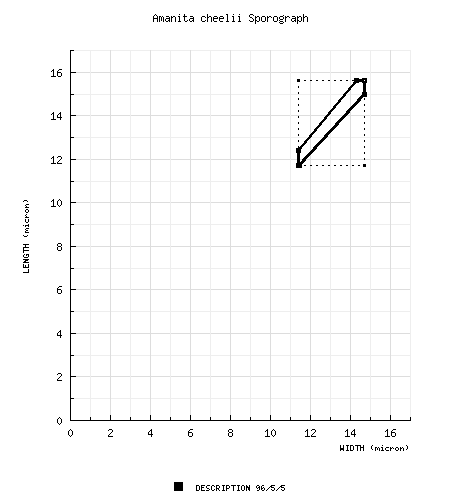
type study of RET: [96/5/5] (10.5-) 11.7 -
15.6 (-21) × (9.9-) 11.4 - 14.7 (-20) μm, (L = 12.8 - 14.2 μm; L’ = 13.5 μm; W = 11.9 - 13.4 μm; W’ = 12.7 μm;
Q = (1.01-) 1.02 - 1.09 (-1.12); Q = 1.04 - 1.07; Q’ = 1.06). |
| ecology |
type study of RET: Usually solitary, occasionally in twos or threes. Type collected after heavy rain. |
| material examined |
type study of RET: AUSTRALIA: NEW SOUTH WALES—Mosman 7.iv.1918 J. B. Cleland s.n. (syntype, ADW 9576 => AD 3283, marked "type" in Cleland’s hand); Sydney, s.d. J. B. Cleland 174 p.p. (syntype, BPI 751249, mixed collection marked "co-type" in Cleland’s hand); Sydney, Bradley Head, 6.v.1917 J. B. Cleland s.n. (lectotype, ADW 9259 => AD, marked "co-type" in Cleland’s hand), 31.iii.1919 J. B. Cleland s.n. (syntype, ADW 9578 => AD 3284, marked "type" in Cleland’s hand), 12.iv.1919 J. B. Cleland s.n. (syntype, ADW 9575 => AD 3280); Sydney, Neutral Bay, Athol Gardens, 7.iii.1916 J. B. Cleland s.n. (syntype, ADW 9577 => AD 3285). |
| discussion |
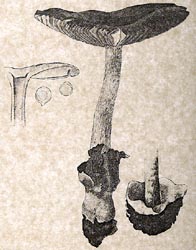
The plate in the protolog shows (on a mature basidiome) a cracking volval limb that is much darker in its upper portion than at the stipe base.
Smaller spored collections assigned to this species by Reid (1980: 51), Young (1986 & 1994), and Wood (1997) may not be contaxic with the New South Wales material collected by Cleland. Fuhrer (1985: 19) depicted a species with a volva that does not appear to be very gray and is constricted below and flaring above in the manner typical of numerous taxa of section Vaginatae [e.g., A. supravolvata Lanne (Tulloss, 1994)]. Ridley (1991) reported that Fuhrer had agreed with him that the depicted fungus was not assignable to A. cheelii. My spore data agree well with the protolog, where it is stated that the spores are "thick-walled, 10.4 to 14 µm, occasionally 17 or 18 µm."
Reid (1980) designated the lectotype without any explanation as to why the particular syntype was chosen. It would have been helpful to do so because a single collection (J. B. Cleland 165 with watercolor by D. I. C[larke?]. numbered 62) apparently preserved in formalin is specifically listed (without qualification as type) in the protolog and must be considered an implicit holotype (ICBN §7.3) if it can be located. This collection and/or the water color are mentioned on slips of paper in Cleland’s hand in the packets of AD 3283 and AD 3285 in context suggesting that Cleland 165 and the watercolor were considered as the foundation of his concept of the present species. Reid does not state whether Cleland 165 still exists. Searches at my request at AD, ADW, K, and PC did not uncover this collection. It may have been lost.
Cleland 174 is a mixed collection. The portion at BPI includes one half of a longitudinally sectioned basidiome of A. cheelii and portions of two very small basidiomes that apparently belong in the Russulaceae.
Cleland and Cheel (1919) designated the color “smoke-grey” to be equivalent to "pl. 313, Ton 4" of Dauthenay (1905). This is a typographical error. That color is a dark ocher labeled "nuance observée sur la Polyporus sulfureus." "Smoke grey" is the name applied to the colors of pl. 363. On slips of paper bearing descriptions of the fresh material of AD 3280 and AD 3283, Cleland records the color as "363-4" and "363 Ton 3 or 4" respectively. The color of pl. 363, Ton 4 is close to 5E3; but the Methuen color chip does not have quite strong enough a red component. 5E4 is more yellow than pl. 363, Ton 4.
The material of AD 3283 is in very bad condition because of the attack of a mold. In the one mount attempted, I could not find sufficient undamaged spores to justify inclusion of their measurements in the data presented above.
The name of the present species is commonly misapplied to one or more species with, among other things, smaller spores. |
| citations |
There appears to be a prior homonym for this name—Amanita puncata Lam. (1783).—R. E. Tulloss |
| editors |
RET |
|


 Spore data sets and their composite