

| name | Amanita caojizongxx |
| name status | nomen acceptum |
| english name | "Chiu's False Death Cap" |
| synonyms |
Amanita manginiana sensu W. F. Chiu |
| intro |
The following description is based on Gilbert (1941). |
| cap |
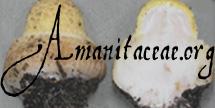
Gilbert (1941): Fruiting bodies of Amanita manginiana sensu W. F. Chiu are medium-sized to large, sometimes very large. The cap is 50 - 150 (-200) mm wide, convex to applanate, grey to dark grey to brownish, darker in the center, innately fibrillose, and usually glabrous, although occasionally covered with a few white, membranous volval remnants. The cap's margin is smooth and non-appendiculate, but often with some pieces of annulus remnants hanging. The cap context is white. [Ed. note: the two images, above show the same mushroom in different lights.] |
| gills |
Gilbert (1941): The gills are free to subfree and white; the short gills are attenuate. |
| stem |
Gilbert (1941): The stem is 80 - 150 × 5 - 30 mm, subcylindric to attenuate upwards, with a surface that is white and covered with white fibrillose to farinose squamules; the stipe's context is white; the stem's basal bulb is 20 - 35 mm wide, ventricose to clavate, or (occasionally) subglobose. At the stipe's base, the volva is limbate, with a free, white to dirty white limb. The annulus is apical to subapical, white, and easily broken during expansion of cap. |
| spores |
Gilbert (1941): The spores measure (5.5-) 6.0 - 8.0 (-9.0) × (4.5-) 5.0 - 7.0 (-7.5) µm and are subglobose to broadly ellipsoid and amyloid. Clamps are not present at the bases of basidia. |
| discussion |
Gilbert (1941): Amanita manginiana was originally described by Hariot & Patouillard from Viet Nam in 1914. The Chinese mushroom is similar to Amanita manginiana, but there are some discrepancies. Chiu first reported the present species from China in 1948. Amanita manginiana sensu W. F. Chiu is a favored edible mushroom in southwestern China and is often sold in the free markets. It has been reported from Japan recently. See also, A. pseudoporphyria Hongo.—Zhu L. Yang |
| brief editors | RET |
| name | Amanita caojizongxx | ||||||||||||||||||||||||
| name status | nomen acceptum | ||||||||||||||||||||||||
| english name | "Chiu's False Death Cap" | ||||||||||||||||||||||||
| GenBank nos. |
Due to delays in data processing at GenBank, some accession numbers may lead to unreleased (pending) pages.
These pages will eventually be made live, so try again later. Search:
Showing 1 to 2 of 2 entries | ||||||||||||||||||||||||
| intro |
Olive text indicates a specimen that has not been
thoroughly examined (for example, for microscopic details) and marks other places in the text
where data is missing or uncertain. NOTE: Spore measurements from papers by Z. L. Yang use his "Times New Roman" face for "Q" and "Q'"—respectively, " | ||||||||||||||||||||||||
| basidiospores |
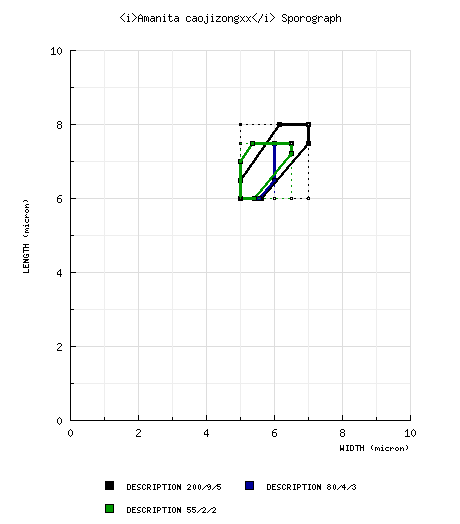
from revision of Yang (1997): [200/9/5] (5.5-) 6.0 - 8.0 (-9.0) × (4.5-) 5.0 - 7.0 (-7.5) μm, ( from revision of Yang and Doi (1999): [80/4/3] (5.5-) 6.0 - 7.5 (-8.0) × (4.5-) 5.0 - 6.0 μm, ( from Yang (2000): [55/2/2] (5.5-) 6.0 - 7.5 (-8.0) × (4.5-) 5.0 - 6.5 μm, ( | ||||||||||||||||||||||||
| ecology | Solitary to gregarious. China: At 2600± m elev. Quite common. In forests. Japan: In forests. | ||||||||||||||||||||||||
| material examined |
Yang (1997): CHINA: YUNNAN—Chuxiong Yi Autonomous Prefecture - Unkn. Co., Zixishan, 2300 m elev., 3.x.1995 Z. L. Yang 1939 (HKAS 29628).
Honghe Hani and Yi Autonomous Prefecture - Pingbian Miao Autonomous Co., in market, 6.vii.1992 Z. L. Yang 1919 (HKAS 26146).
Kunming (prefectural level) City - Unkn. District, in market, 8.ix.1938 F. L. Tai 8191 (HMAS 4191), 24.vii.1993 Z. L. Yang 1931 (HKAS 26150); Unkn. District. unkn. loc., 6.ix.1942 W. F. Chiu 8301 (HMAS 4301). Yang and Doi (1999): JAPAN: HONSHU—Tokyo Metropolis (Pref.) - Oume City, Kurosawa 3-Chôme, left side ridge of Kuosawa-gawa R., 15.vii.1997 Y. Doi & K. Miyazaki s.n. (TNS F-182476), s.n. (TNS F-182482), s.n. (TNS F182492). Yang (2000): CHINA: JIANGSU—Nanjing (sub-provincial) City - former city of Nanjing, unkn. loc., 28.vi.1936 H. N. Shen 303 p.p. [larger basidiome] (formerly "IBN 5485"; BPI 750771, as "A. phalloides"), former city of Nanjing, Linggosi woods, 13.vi.1937 S. C. Teng 2729 (formerly "IBN 7452"; CUP-CH 1156, as "A. phalloides"). Zhang et al. (2004) voucher for sequencing: CHINA:YUNNAN—unkn. loc., s.d. unkn. coll. s.n. (HKAS 38460). | ||||||||||||||||||||||||
| citations | —Z. L. Yang and R. E. Tulloss | ||||||||||||||||||||||||
| editors | RET | ||||||||||||||||||||||||
Information to support the viewer in reading the content of "technical" tabs can be found here.
| name | Amanita caojizongxx |
| bottom links |
[ Section Phalloideae page. ] [ Amanita Studies home. ] [ Keys & Checklists ] [ Section Phalloideae page. ] [ Amanita Studies home. ] [ Keys & Checklists ] |
| name | Amanita caojizongxx |
| bottom links |
[ Section Phalloideae page. ] [ Amanita Studies home. ] [ Keys & Checklists ] [ Section Phalloideae page. ] [ Amanita Studies home. ] [ Keys & Checklists ] |
 Spore data sets and their composite
Each spore data set is intended to comprise a set of measurements from a single specimen made by a single observer; and explanations prepared for this site talk about specimen-observer pairs associated with each data set. Combining more data into a single data set is non-optimal because it obscures observer differences (which may be valuable for instructional purposes, for example) and may obscure instances in which a single collection inadvertently contains a mixture of taxa.

Text and User-Generated Sporographs are published under the Creative Commons License.

In the case of a taxon page, image credits are on the 'image' tab.